A breeze lifting a child’s hair or a puddle shrinking after lunch can spark science, language, math, and joyful conversation. With a simple, child-led routine, you can turn these moments into meaningful learning; the Kids Weather Activities Buy Now $1.49 resource offers practical ideas to help you get started. For a deeper look at planning developmentally appropriate experiences for preschoolers, explore ChildCareEd’s Emergent Learning & Development  Buy Now $24.00 course, which can strengthen your understanding of children’s emerging skills and learning needs.
Weather is already part of children’s daily lives. Providers do not need an elaborate unit or specialized equipment to make it educational. By helping children notice, describe, compare, and represent what they experience, educators can build an ongoing investigation that follows children’s curiosity and fits naturally into classroom routines.
Why does everyday weather make such a meaningful learning opportunity?
Weather is immediate and tangible. Children feel the wind, hear rain against a window, watch clouds change, and notice how the day’s conditions affect what they wear or do outside. These familiar experiences give children an authentic reason to ask questions and share ideas. A child’s “The leaves are dancing” can lead to wondering what else moves in the wind or whether a ribbon will move the same way.
Weather inquiry supports several areas of development at once. Children practice vocabulary as they describe breezy, cloudy, chilly, or sunny conditions. They use early math when they count sunny days or compare puddle sizes. They develop scientific habits by observing evidence, making predictions, and revisiting their ideas. Drawing, movement, conversation, and cooperative chart-making provide additional ways to participate.
Most importantly, a responsive approach tells children their thinking matters. Rather than treating a weather chart as a daily answer-the-teacher task, use it to preserve children’s observations and return to them. The aim is not to teach complex meteorology; it is to nurture curiosity, confidence, and early #inquiry through experiences children can see and feel.
How can you build a simple weather-observation routine?
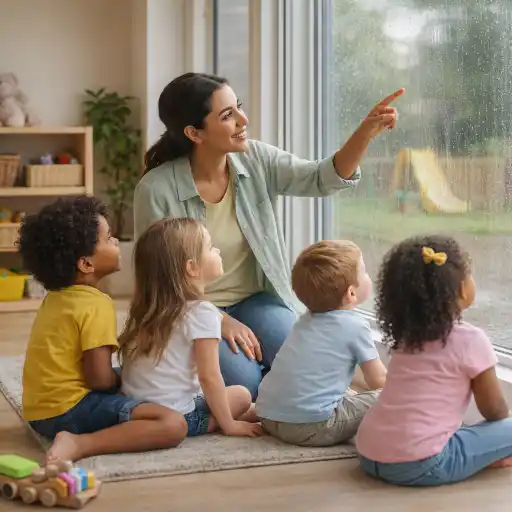
Choose a consistent time, such as morning meeting, and keep the routine brief enough to fit your real schedule. Invite children to look outside from a safe place, or go outdoors when conditions and program procedures allow. Ask open-ended questions: “What do you notice in the sky?” “How does the air feel?” “What sounds can you hear?” Give children time to look carefully before offering vocabulary or ideas.
Use a few accessible weather words—sunny, cloudy, windy, rainy, warm, and cool—and build on children’s own descriptions. A picture chart can support children who are still developing spoken language, learning English, or communicating in other ways. Rotate classroom roles so children can take part as weather reporters, picture-card choosers, or chart helpers.
- Invite children to describe the sky, wind, and air rather than relying only on “What’s the weather?”
- Record ideas with symbols, drawings, gestures, dictated words, or adult writing.
- Return to the observation later if the conditions change.
- Connect the observation to a practical decision, such as choosing suitable clothing or an indoor activity.
Keep the routine playful, not quiz-like. There is no “good” or “bad” weather for learning: sunshine, clouds, rain, and wind each offer different things to notice. A predictable check-in strengthens #observation skills while making space for children’s own interpretations.
How can you help children compare conditions and notice patterns?
Once children have recorded observations, invite them to compare two things they can remember: today and yesterday, morning and afternoon, or a sunny spot and a shaded spot. Ask what stayed the same and what changed. Young children may use qualitative descriptions—“It feels colder,” “The clouds moved,” or “There are more puddles”—and those observations are valuable evidence.
After several days, review the class chart together. Count how many days were sunny or rainy, compare which category has more marks, and notice whether a condition has appeared repeatedly. Keep the focus on what children can see in the record rather than asking them to make abstract explanations. For example, “We marked rain on two days. What do you notice?” can lead to discussion and a new prediction.
Extend the record only while children remain interested. A short weekly chart can be enough; a group that is still curious might continue for several weeks or track observations at different times of day. These experiences lay groundwork for early #STEM reasoning by giving children practice with patterns, comparison, and evidence-based predictions. The purpose is not perfect forecasting but learning to support an idea with what they have noticed.
Which activities make children’s weather thinking visible?
Recording should help children remember and communicate, not become a handwriting assignment. Offer more than one way to document an idea. A child might select a symbol, draw the sky, add a tally with support, point to a picture, or dictate a sentence for an adult to write. A simple journal or shared class chart can reveal how children’s descriptions change over time.
Build from direct observation into playful exploration. If children notice wind, compare how a ribbon, leaf, or pinwheel moves. If they are interested in rain, observe water collected in an adult-prepared, securely placed rain gauge. If they notice sunshine and shade, compare how surfaces feel using safe, simple language such as warmer and cooler. Indoors, children can sort weather symbols, create sky art, move scarves like wind, or use dramatic play to present a forecast.
- 📝 Model a quick drawing and narrate your thinking: “I see gray clouds, so I’m adding gray above our chart.”
- Pair children’s drawings with their exact words when possible.
- Invite them to revisit yesterday’s entry and say whether today looks similar or different.
- Use photos and brief notes to share the learning process with families.
Resources such as ChildCareEd’s Kids Weather Activities Buy Now $1.49 can help you find ideas for weather-themed play. Select activities that extend children’s real observations and preserve room for their own questions and creative responses.
How can you keep weather exploration safe, inclusive, and responsive?
Children’s curiosity can guide planning, but safety and individual needs set the boundaries. Before outdoor time, follow your program’s procedures for weather, air quality, supervision, and play-area checks. Make sure children have suitable clothing and access to shade or water when needed. If outdoor conditions are unsuitable, move the investigation indoors and continue with photos, movement, art, or classroom materials. State requirements vary - check your state licensing agency.
Offer varied ways to participate. A child may prefer to observe from a sheltered spot, communicate by pointing or drawing, use a home language, or explore alongside a trusted adult. Some children may watch before joining; watching is a valid way to engage. Choose materials appropriate for the ages and abilities in your group, supervise experiments, and manage any steps involving potentially hazardous materials yourself.
Common pitfalls are straightforward to avoid:
- Do not turn the chart into a quiz; welcome children’s descriptions and return to evidence together.
- Do not require every child to write; drawing, symbols, gestures, and dictation all count as meaningful recording.
- Do not over-explain; ask a thoughtful question, listen, and allow time to think.
- Do not let a chart or activity replace current safety checks and active supervision.
When adults stay attentive and flexible, children can explore with confidence. A weather routine can also be a starting point for professional reflection: what did children notice, how did they represent it, and what might be a useful next experience? ChildCareEd’s Emergent Learning & Development Buy Now $24.00 course offers additional grounding in developmentally appropriate experiences and the relationship between classroom learning and children’s emerging skills.
How can you turn a daily observation into an ongoing investigation?
Think of a weather routine as a cycle: notice, wonder, explore, document, and revisit. Begin with what children say or do, then choose a small next step that responds to their interest. If a child wonders why a puddle is smaller later in the day, photograph or draw it in the morning and return to the same place after lunch. If children are curious about wind, compare streamers on a breezy and calmer day. One brief investigation may be enough, or the group may want to return to the question over several days.
Keep plans flexible. Children may develop a new question, revise a prediction, or shift their attention. These changes are useful information, not a sign that the plan has failed. Document a few meaningful examples—children’s words, drawings, or photos—and use them to plan what materials or prompts might extend the learning.
Share the process with families through a short note or display. A chart with children’s comments can show that the learning lies not only in naming the weather but also in reasoning, communicating, and revising ideas. The daily weather observation investigation article offers additional ideas for building this kind of consistent classroom inquiry.
Conclusion
How can child care providers turn everyday weather observations into learning opportunities? Help children notice conditions, describe what they see and feel, compare observations, represent their ideas, and return to their questions. Keep the routine short, the materials simple, and participation flexible. Above all, treat children’s comments as meaningful starting points for investigation. A changing sky offers a fresh opportunity each day to build language, early math, scientific thinking, and a sense of belonging in the classroom.
- Moving About the Classroom: Effective Transitions for Everyday
- CDA Subject Area 2
- The ABCs of Behavior: Turning Challenges into Learning Opportunities
- Tracking Progress, Shaping Futures: Observation & Assessment Skills
- CDA Family Child Care Credential with Portfolio Review
- Pediatric RSV First Aid & CPR/AED
- Sensitive Periods in Montessori: Guiding Natural Learning
- Texas Director Credential
- Enhancing STEM Education for Infants and Toddlers
- CDA Certification en Español: Recursos y Consejos para Educadores Bilingües
- 🎈 Better Together: Why Little Friends Make a Big Difference in Early Childhood
- 🎉STEM-sational Fun: How Can You Spark Preschoolers’ Curiosity with Engaging STEM Activities? 🔬🧪🔢
- 🤯 ¿Por qué este niño está teniendo un comportamiento difícil de repente?
- Proporciones de Cuidado Infantil y Tamaños de Grupo por Edad en Maryland (Guía Rápida para Centros y Hogares)
- Proporciones de Cuidado Infantil y Tamaños de Grupo por Edad en Virginia (Guía Rápida para Centros y Hogares)
- Capacitación CDA gratuita en Illinois
- Canciones, juegos y preguntas de círculo para niños
- Cómo Planificar Actividades al Aire Libre Seguras Durante el Calor y la Mala Calidad del Aire
- How Can Child Care Providers Turn Everyday Routines into Learning Opportunities?
- How Can Child Care Programs Make Nature-Based Learning Meaningful, Inclusive, and Safe?
- What Should a 2-Year-Old Be Learning at Daycare?
- How Can Child Care Programs Balance Indoor and Outdoor Learning Across the Week?
- How Can Child Care Providers Help Children Explore Weather Indoors and Outdoors?
- How Can the Walk Between Activities Become a Learning Moment?
- How Can a Familiar Sound Help Infants Anticipate What Comes Next?
- How Can Everyday Fall Routines Support Infant and Toddler Development?
- How Can Responsive Teaching Make Fall Classroom Activities More Effective?
- How Can Child Care Providers Help Families Recognize Their Children’s Developmental Progress in November?
- How Can Child Care Providers Turn Everyday Weather Observations Into Learning Opportunities?
