After a fall rain, a once-neat patch of soil may leave muddy trails, collect in a puddle, or appear somewhere new. A simple model helps children investigate where that soil travels while practicing observation and early scientific reasoning; the Basic Science in Early Childhood Buy Now $25.00 course offers providers a deeper foundation for planning meaningful, inquiry-rich experiences.
Why is erosion a meaningful fall investigation?
Erosion happens when soil or other earth materials move from one place to another, often carried by water, wind, or ice. A rainy fall day makes this process easier to notice: water runs off bare ground, carries loose particles downhill, and may deposit them along a path or at the edge of a puddle. The soil has not vanished; it has been displaced. The U.S. Department of Agriculture’s AgLab describes soil as a life-supporting mixture that stores water, supports plants, and provides habitat, making its movement a useful starting point for discussing how land and living things are connected.
Young children do not need a lecture on watershed science to begin thinking like investigators. They can watch water move, compare surfaces, make predictions, and explain what they notice. In a familiar fall model, children can use damp soil, fallen leaves, small stones, and a gentle “rain” to represent a hillside. The model turns an abstract process into visible, hands-on #science and play.
For providers, this is also a practical way to follow children’s everyday questions. “Where did the dirt go?” can lead to vocabulary, drawing, collaborative problem-solving, and repeated observation. The goal is not to produce a perfect miniature landscape, but to help children connect evidence with an emerging explanation.
- Invite children to share what they have noticed after real rain.
- Emphasize that erosion moves soil; it does not make soil disappear.
- Use children’s ideas as predictions to explore together.
How can you build a simple rain-and-soil model?
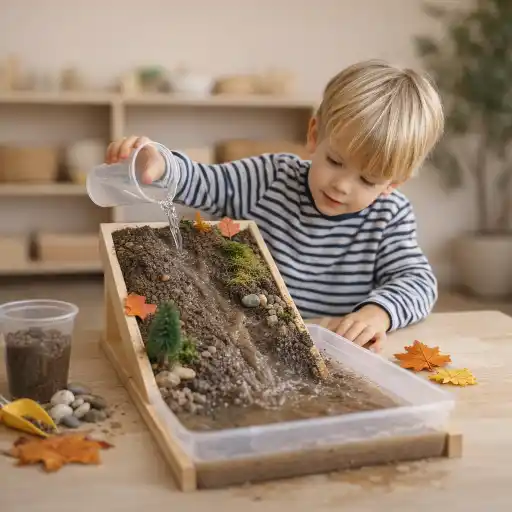
Use a shallow tray or sturdy bin to contain the activity. Add a small mound or sloped section of soil at one end and place a second, lower area where runoff can collect. Gather a spray bottle or small cup, a few leaves, grass clippings, small stones, and a clear collection cup. Keep the model modest: a visible slope and a controlled amount of water are enough to invite observation.
Make two comparable areas if you want children to compare ground cover. Leave one patch bare; cover the other with leaves or grass. Add the same amount of soil to each, and keep the slope and “rain” as similar as possible. The Science Buddies erosion activity likewise highlights comparing bare soil with a planted or root-like surface, while Little Bins for Little Hands describes using ground cover to explore how leaves and grass can protect soil.
Before pouring, ask children what they think will happen. Then use a spray bottle to create a light shower, or pour water slowly from a small cup. Watch where water travels and whether soil particles move into the lower collection area. If conditions allow, repeat with a little more water and compare. This model illustrates a process; it does not reproduce every feature of a real storm or landscape.
- Place the tray on a protected, stable surface and keep water away from walkways.
- Use a small amount of water so the flow is visible and manageable.
- 🌧️ Let children take turns predicting, observing, and describing what changed.
What should children notice as water moves?
Encourage children to attend to both the water and the soil. They may notice droplets making tiny marks, water moving downhill, soil changing color as it gets wet, or muddy water collecting at the bottom. Ask them to compare the bare patch with the covered one: Which surface changed more? Where did the soil collect? Did the water move at the same speed across both areas? Keep questions open-ended so children can point to evidence rather than guess an adult’s expected answer.
Introduce accurate, child-friendly vocabulary in context. Runoff is water that flows across the ground; erosion is the movement of soil or rock; deposition is where moved material settles. Children can represent what they see with drawings, gestures, photos, or a simple before-and-after chart. A science journal does not need conventional writing to document thinking.
Plant cover can change the outcome. Leaves and grass protect the surface from direct raindrop impact, slow moving water, and—in real plants—roots help hold soil together. A model using leaves shows surface cover, but it does not fully represent the living root systems that anchor soil. The Oregon Science Center’s erosion experiment and AgLab’s investigations offer further examples of how different surfaces and soil types can respond differently to rain.
- Compare how muddy the runoff looks and where sediment settles.
- Notice whether the bare or covered patch retains more of its shape.
- Record evidence before deciding what the model suggests.
How can educators extend the inquiry through play?
Follow the children’s observations into a small design challenge: “How could we help keep more soil on this slope?” Offer a few loose materials—leaves, twigs, pebbles, or a small strip of grass—and invite children to build a barrier or add ground cover. Test the design using the same gentle amount of water and compare the result. Encourage children to explain what they changed and what happened, rather than judging a design as simply successful or unsuccessful.
Fall offers natural connections beyond the tray. After a rain, observe where puddles form, where leaves gather, and whether soil has collected near a curb or garden edge. Keep children on safe, permitted paths and observe without disturbing drainage areas. A short nature walk can help them recognize that the model represents a larger process occurring in their community.
Support participation in different ways. Some children may enjoy touching soil; others can use a scoop, watch from a comfortable distance, take photographs, or dictate an observation. Add descriptive words such as damp, gritty, muddy, slope, and settle as they become relevant. The Creating the Natural Outdoor Classroom  Buy Now $16.00 course can help providers think more intentionally about using nature-rich outdoor spaces as places for exploration and discovery.
- Invite children to alter one feature at a time, such as the cover or slope.
- Connect model observations with real-world signs of runoff, without claiming they are identical.
- Value different ways of communicating ideas and participating.
How can you keep the activity safe and avoid common pitfalls?
Prepare the space before inviting children in. Use clean, known materials; avoid soil that may be contaminated, sharp objects, unknown plants, and materials that pose choking risks. Supervise closely, especially when water is present, keep the setup away from walking routes, and follow your program’s handwashing procedures. Check children’s sensory needs and allergies, and offer tools or observation roles as alternatives to direct contact. State requirements vary - check your state licensing agency.
A common pitfall is pouring different amounts of water or using noticeably different slopes and then treating the comparison as conclusive. For a fairer model, keep the setups as similar as practical and change one feature at a time. Another is expecting every trial to show dramatic soil movement. Results depend on soil texture, moisture, slope, and the pace of the water; subtle changes still provide something to notice. Avoid saying that plants “stop” erosion completely. Ground cover can reduce soil movement, but the model is a simplified demonstration.
It is also easy to explain the result too quickly. Pause for children to share their own observations first, then introduce a word such as erosion or runoff. If the outcome differs from their prediction, treat that as useful evidence: “What surprised us? What could we try next?” For staff seeking further learning, Building Early Science Foundations Buy Now $16.00 focuses on supporting young children’s curiosity through developmentally appropriate exploration, while Children at the Wheel: Emergent Curriculum Buy Now $25.00 explores planning from children’s questions and interests.
- Prepare for spills and use a tray or washable outdoor surface.
- Change one variable at a time when comparing results.
- Respect children’s choice to observe without touching.
Conclusion: Where does the soil go when it rains?
When rain moves over exposed ground, it can carry soil downhill and leave it in a lower place, such as a puddle, path edge, or stream. A fall rain-and-soil model makes that movement visible: children can compare bare ground with leaf cover, observe runoff, and use evidence to explain where the soil traveled. Their questions and predictions are the heart of the investigation.
Keep the experience simple, safe, and open-ended. Offer a small slope, a controlled amount of water, and materials children can use to test their ideas. Ask what they notice, document their thinking, and connect the model to careful outdoor observations. For a ready-to-use classroom aid, feature the Rain and Soil Model Investigation Guide alongside children’s drawings and notes. With thoughtful facilitation, a muddy tray can become a memorable introduction to #erosion, environmental care, and inquiry-based #learning.
References
- USDA AgLab: Soil Erosion Experiments
- Science Buddies: Explore Soil Erosion and See What a Plant Can Do
- Oregon Science Center: Soil Science Experiment
- Little Bins for Little Hands: Plant Cover and Soil Erosion Experiment
- U.S. Geological Survey: Lesson Plans and Activities for K–2
- National Park Service: Teaching Resources—Erosion
- 1,2,3, Eyes on Me: Classroom Safety
- CDA Preschool Credential with Portfolio Review
- What Makes Me Special: An Overview of Autism and ADHD
- CDA Bridge Bundle: Preschool
- Pediatric RSV First Aid & CPR/AED
- CDA Bridge Bundle: Family Child Care
- CDA Bridge Bundle: Infant/Toddler
- CDA Infants/Toddlers: Benefits to Observing
- Bienvenido! Welcoming All Families
- CDA Certification en Español: Recursos y Consejos para Educadores Bilingües
- 🪁¿Cómo puede el juego apoyar de manera poderosa a los niños con autismo?🧩
- 🥦✨ ¿Cómo apoyar a los niños selectivos a probar nuevos alimentos sin presión?
- 💛🧩 ¿Cómo puedo hacer que mi enseñanza sea inclusiva para los niños con autismo?
- Cómo Abrir Una Quardería En Casa Sin Dinero?
- Recursos en Español sobre el Sueño Seguro del Bebé
- 10 Ejemplos de Cómo la Cultura Influye en el Desarrollo Infantil
- Proporciones de Cuidado Infantil y Tamaños de Grupo por Edad en Nueva Jersey (Guía Rápida para Centros y Hogares)
- Proporciones de Cuidado Infantil y Tamaños de Grupo por Edad en Virginia (Guía Rápida para Centros y Hogares)
- Actividades de Otoño Fáciles para Preescolares esta Temporada
- Por Qué la Supervisión Activa Es Clave para la Seguridad en el Cuidado Infantil
- Apoyo en Preescolar para Retrasos del Habla: Estrategias Simples que Ayudan
- Consejos de Supervisión Activa para Salones de Preescolar y el Juego al Aire Libre
- Retraso del Habla en la Guardería: Cómo Pueden Ayudar los Proveedores
- Capacitación CDA gratuita en Illinois
- Calabazas, hojas y manzanas: actividades de otoño para preescolares
- Celebrando la amistad en el cuidado infantil durante el Día de los Mejores Amigos
- Canciones, juegos y preguntas de círculo para niños
- How Should You Check a Family Child Care Yard After Heavy Rain or Wind?
- Where Does the Soil Go When It Rains? How Can Fall Model Play Introduce Erosion?
