A puddle after fall rain can become a rich science investigation—one that helps children practice noticing, predicting, and explaining change. Explore a simple, repeatable puddle study, and consider Basic Science in Early Childhood Buy Now $25.00 for practical guidance on planning meaningful science experiences and supporting children’s reasoning. With a few safe materials and a thoughtful question, you can turn an ordinary wet patch into an inquiry children will want to revisit.
Why does following a puddle matter?
A puddle is familiar, temporary, and full of visible change. Returning to the same spot gives children a concrete way to compare what they see now with what they noticed earlier. They practice observation, memory, descriptive language, early measurement, and the habit of asking questions. These are central processes in early science; children do not need a formal lecture or a technical explanation to participate meaningfully.
Following a puddle also makes time and change easier to notice. Children may see the outline shrink, the surface become patchy, or the water disappear between visits. Their ideas—“It went underground,” “The sun drank it,” or “It ran away”—are useful starting points, not answers to grade. Educators can respond with curiosity: “What could we look for to help us figure it out?” This approach supports children in connecting possible explanations to what they actually observe.
For providers, the investigation is a practical way to connect outdoor learning with language, math, drawing, and documentation. As Karen Worth’s discussion of science in early childhood classrooms explains, inquiry can draw on children’s natural curiosity while also strengthening skills such as collaboration, communication, and early mathematical thinking.
- Children can predict what will happen, then compare their prediction with later observations.
- They can describe size, shape, wetness, and changes in nearby conditions.
- Educators can use children’s questions to decide what to explore next.
How can you set up a safe, manageable puddle watch?
Choose a permitted outdoor location that staff and children can revisit safely. Before each visit, check for slippery surfaces, traffic, sharp objects, animal waste, and other hazards. Keep children within active supervision, follow program procedures, and do not allow them to drink or handle potentially contaminated puddle water. If a real puddle is not in a suitable location, recreate the observation with a small amount of water in a shallow tray on a stable surface.
Keep the setup simple and consistent. Invite children to notice the puddle’s outline, approximate size, depth if it can be assessed safely, surrounding surface, and current weather. Mark the outline with chalk only where permitted, or place markers at a safe distance. A photograph or drawing from a similar viewpoint can help children compare observations without relying only on memory.
- Gather a clipboard, paper, crayons, or an approved classroom camera.
- Use a simple chart to record the time and a few weather words or picture symbols.
- Choose a practical return schedule—for example, later in the day and again the next morning.
- 👟 Check footwear, boundaries, and the supervision plan before heading outside.
Offer several ways to participate: children can talk, point, draw, gesture, use a home language, or observe with an adult. For a ready-made classroom aid, the Puddle Watch Prediction and Observation Pages can help staff record predictions and revisit observations. Use the pages as a support for conversation—not as a test or a substitute for educator judgment.
What should children observe and record over time?
Start with one shared question: “What do you think will happen to this puddle?” Record children’s predictions in their own words or through drawings. Avoid labeling predictions as right or wrong. At each return visit, use a few consistent prompts: “What do you notice now?” “Is the outline the same?” “What changed around it?” Repeating the prompts makes comparisons easier and helps children focus on evidence.
A brief record can include the time, a quick sketch or photo, a description, and one child comment. Preschoolers might use words such as bigger, smaller, same, wet, or dry; younger children may show interest through pointing, repeated looks, or gestures. Document what you see and hear rather than assuming what a child understands. The Science in Pre-K guidance on documenting inquiry describes how drawings, charts, photos, and journals can help children revisit discoveries and communicate ideas.
Keep documentation manageable. One image and one meaningful quote at each check-in may be enough. If rain returns, wind moves debris, or someone disturbs the puddle, record that too. These conditions are part of the investigation. A puddle study follows the real world, so the observations may not unfold exactly as planned.
- Use a “first, next, later” visual sequence to support children who benefit from predictable routines.
- Invite children to compare two drawings or photographs side by side.
- Accept speech, movement, pointing, drawing, and supported observation as valid contributions.
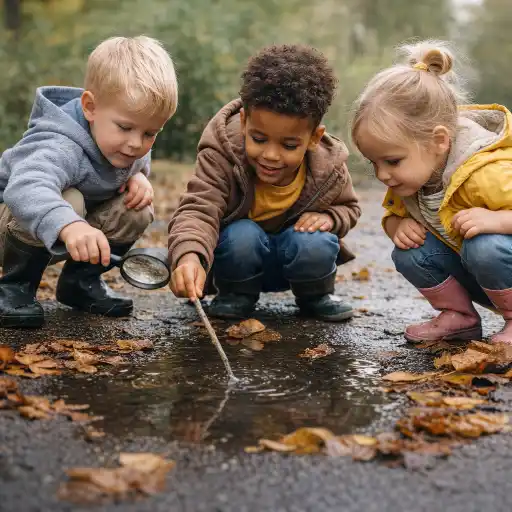
Where does the water go, and how can we explain it?
When a puddle gets smaller, more than one process may be involved. Some water can soak into soil, flow toward a lower area or drain, or be moved by wind, feet, or other activity. Some liquid water changes into water vapor and mixes with the air. This gradual change is called evaporation. It is not usually visible as a stream of vapor rising from a puddle.
Use accurate, accessible language: “The puddle is smaller now. Some water may have soaked into the ground or moved somewhere else. Some may have changed into water vapor in the air. That change is called evaporation.” The American Chemical Society’s puddle lesson explains that warming can help water molecules leave a puddle and enter the air. The USGS water-cycle diagram places evaporation within the larger, continuous movement of water on, above, and within Earth.
Sunlight is not the only factor. Temperature, wind, humidity, puddle depth, and the surface beneath the water can all influence how quickly a puddle changes. A single observation cannot establish which process was responsible. Instead, help children connect possible explanations to evidence: Was it sunny, cloudy, or windy? Was the puddle on pavement or soil? Did one edge change more than another?
How can you extend the investigation without taking over?
The educator’s role is to make children’s thinking visible, not to deliver every answer. Observe first, listen, and then offer a question that builds on what a child noticed: “What makes you think that?” “How could we check?” or “What might we see next time?” Give children time to answer in the way that works for them. An unexpected explanation is an invitation to explore evidence, not a reason to correct the child immediately.
Connect the puddle to other areas of learning while keeping the investigation focused. Children might compare its width using a strip of paper, sort weather picture cards, dictate a story about the puddle’s journey, or make a sequence of drawings. They can act out water warming, rising, and returning as rain, while understanding that one puddle offers only a small view of the broader water cycle. For more professional learning on inquiry and intentional planning, explore Building Early Science Foundations  Buy Now $16.00, which focuses on supporting young children’s curiosity through developmentally appropriate exploration.
For staff teams, agree on a few shared prompts and a consistent way to record observations. This makes it easier for different educators to support the same investigation across the day. A short reflection afterward—what children noticed, which questions engaged them, and what might be useful to revisit—can guide the next experience.
- Use one clear question at a time and allow room for children’s own questions.
- Extend the study with comparison, drawing, storytelling, or early measurement.
- Keep activities flexible when weather or children’s interests change the plan.
What common pitfalls should providers avoid?
One common pitfall is explaining too soon. If adults immediately announce “evaporation,” children may miss the chance to observe, describe, and compare. Start with what children see; introduce the scientific word when it helps name a process they are investigating. Another pitfall is expecting a quick or tidy result. A puddle may change slowly, disappear through several processes, or be altered by new rain or foot traffic. Follow the conditions rather than forcing a conclusion.
Consistency and inclusion matter as well. Changing the observation point each time can make comparisons confusing, while requiring every child to record information in the same way can exclude children with different communication, sensory, or mobility needs. Offer multiple ways to take part and make adaptations without lowering the value of a child’s contribution.
- Use a similar viewpoint and a small set of repeated prompts at each visit.
- Do not assume sunlight alone explains why a puddle became smaller.
- Adapt or relocate the investigation if the site is unsafe; never prioritize the activity over supervision.
- Follow program policies for outdoor conditions and handwashing. State requirements vary - check your state licensing agency.
Most of all, remember that this is an opportunity for inquiry, not a quiz on vocabulary. Children can make meaningful scientific contributions by noticing change, sharing a theory, revising an idea, or simply returning to look again.
Conclusion: How can one puddle become a meaningful science inquiry?
Following a puddle over time gives children a concrete way to practice observation, prediction, comparison, communication, and early reasoning. Choose a safe place, revisit it at practical intervals, record what children actually notice, and use open-ended questions to help them connect evidence with possible explanations. Remember that puddle water may evaporate, soak into the ground, flow elsewhere, or be affected by several processes at once.
Keep the experience flexible and responsive: children can participate through words, drawings, gestures, or attentive looking, and unexpected weather changes can become part of the record. A few thoughtful notes—and a teacher willing to wonder alongside the group—can turn an ordinary post-rain puddle into an investigation that keeps children asking, “Where did the water go?”
For a classroom tool, explore the Puddle Watch Prediction and Observation Pages. To deepen your professional practice, the Basic Science in Early Childhood Buy Now $25.00 course supports providers in planning intentional, meaningful science experiences.
- CDA: Special Needs: Understanding the Whole Child
- Teacher-Child Interactions for Stronger CLASS® Outcomes
- The Science of Growing Up: Typical and Atypical Development
- From Stress to Wellness
- Self-Regulation & Change: Helping Children Cope
- Creating Environments that Nurture Growth and Community
- Texas Director Credential
- Building Early Science Foundations
- Montessori Cultural Activities: Exploring the World Through Play and Learning
- Environments That Inspire Independence and Exploration
- Proporciones de Cuidado Infantil y Tamaños de Grupo por Edad en Nueva Jersey (Guía Rápida para Centros y Hogares)
- Consejos de Supervisión Activa para Salones de Preescolar y el Juego al Aire Libre
- Retraso del Habla en la Guardería: Cómo Pueden Ayudar los Proveedores
- How can we use nature-based learning through Minnesota's outdoor seasons?
- Calabazas, hojas y manzanas: actividades de otoño para preescolares
- Canciones, juegos y preguntas de círculo para niños
- Rainy Fall Day? 12 Indoor Activities Preschoolers Won’t Want to Stop
- What’s Happening Outside? Fall Science Adventures for Preschoolers
- How Can Child Care Providers Teach Children to Choose Clothing for Weather and Activities?
- How Can Child Care Providers Help Children Explore Weather Indoors and Outdoors?
- How Can You Add Rhythm to a Preschool Weather Movement Activity?
- Where Did the Puddle Go? How Can Children Follow One Puddle Over Time?
- What Can Children Investigate in a Garden Bed That Has Not Been Planted?
- When Rain Erases the Chalk, How Can Disappearing Art Become a Science Investigation?
- How Can Teachers Turn Daily Weather Observations into a Preschool Investigation?
- What Fall Health and Safety Tips Should Every Child Care Provider Know?
- How Can Child Care Providers Turn Everyday Weather Observations Into Learning Opportunities?
- Why Can Observing the Same Tree Teach Preschoolers More Than a Nature Walk?
- Where Did the Puddle Go? How Can Children Explore Evaporation After Fall Rain?
- What Should You Record During Child-Led Fall Play?
