When a bridge of sticks collapses or a ball rolls into a puddle, children meet a real challenge—and a chance to think, test, and try again. With thoughtful planning, outdoor play can strengthen children’s reasoning, persistence, and collaboration while fitting naturally into your program day. Explore Creating the Natural Outdoor Classroom  Buy Now $16.00 to build practical knowledge for planning nature-rich experiences that invite curiosity and active learning.
Why is outdoor play a powerful setting for problem-solving?
Problem-solving develops when children notice a challenge, imagine possible responses, test an idea, and adjust based on what happens. Outdoor spaces make this process tangible. A slope changes how a ball rolls; a gust of wind shifts a fort’s fabric; a puddle may block a familiar path. These everyday surprises invite children to observe, predict, make decisions, and learn from results.
Natural settings also offer varied materials and room for movement. Sticks, leaves, sand, water, and stones can be used in many ways, rather than pointing toward one predetermined outcome. A review of loose-parts play literature connects open-ended material exploration with cognitive processes such as reasoning, self-regulation, and problem-solving, while noting that research continues to develop. A systematic review of nature-based play describes how educator support can include both facilitating child-led exploration and joining playful interactions when useful.
For providers, the goal is not to turn every outdoor moment into a formal lesson. It is to recognize that play already contains meaningful thinking. A child’s first attempt may fail; that is information, not a setback to erase. With time, accessible materials, and reassuring adults nearby, children can experience themselves as capable thinkers. This matters because repeated practice helps them approach unfamiliar tasks with greater flexibility and confidence.
Which outdoor experiences invite children to reason and experiment?
Choose activities with a clear invitation and more than one possible solution. Keep the process open: children can decide what to build, which route to try, or how to solve a shared challenge. Ordinary materials are often enough, especially when they can be moved, combined, and repurposed.
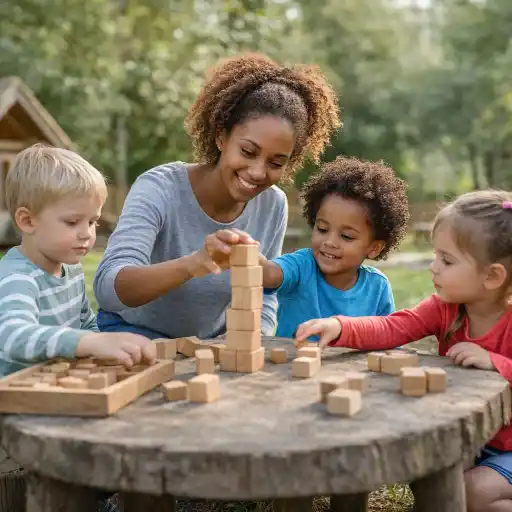
- 🪵 Build and redesign: Offer safe sticks, blocks, fabric, or large cardboard pieces and invite children to make a shelter for a toy animal. If it tips, ask what might help it stand.
- Make a water pathway: With close supervision, provide containers, scoops, and channels. Children can test how to move water from one place to another and notice which arrangements work.
- Plan a route: Invite children to find a way across a marked area using stepping spots, then consider how to adapt it for a toy, a partner, or a different movement.
- Garden together: Children can decide where to plant, how to share watering, and what they observe as plants change over time.
- Invent a group game: Children develop rules, assign roles, and revise the game when new players join.
These invitations provide useful opportunities to use #curiosity, compare possibilities, and explain decisions. Loose parts are especially adaptable: research reviews describe how children can combine them in constructive, pretend, and exploratory play. Choose materials that are developmentally appropriate, clean, non-toxic, and free of choking or sharp-edge hazards. Respect living things; children can observe nature without damaging plants or disturbing animals.
How can adults scaffold thinking without taking over?
Children benefit from attentive adults, but immediate directions can unintentionally replace a child’s thinking. Begin by observing. Notice whether the child is testing an idea, seeking a peer, becoming frustrated, or simply taking time to plan. A brief pause communicates trust and gives the child room to continue.
When support is useful, offer a prompt that keeps the problem in the child’s hands. Open-ended questions encourage children to notice evidence and consider alternatives:
- “What do you notice about the way it moved?”
- “What have you tried so far?”
- “What might happen if we change this part?”
- “Would you like to test another idea or ask a friend for help?”
Use descriptive language instead of evaluating the result: “The base became wider, and now the tower is steadier.” If a child needs more support, offer a small step—point to a relevant tool, present two manageable options, or model one action. Then step back as the child resumes. This responsive approach is often called scaffolding: provide enough help to support progress, but not so much that the adult completes the task.
Outdoor-play research reviews describe a range of educator roles, from enabling independent exploration to participating in guided play. The appropriate level of involvement depends on the child, the situation, and safety needs. A calm acknowledgement—“It is frustrating when the bridge falls”—can support regulation without removing the challenge. Celebrate strategies and persistence, not only a finished structure or a “correct” answer.
How does outdoor problem-solving build collaboration and inclusion?
Many outdoor challenges involve relationships as much as materials. Children may want the same shovel, have competing ideas for a fort, or disagree about the rules of a chasing game. With adult support, these moments can become practice in listening, negotiating, and creating a shared plan. The aim is not to require instant agreement; it is to help children express needs, hear one another, and explore fair possibilities.
Give children accessible language and communication supports. Model phrases such as “Can I use it when you’re done?” or “Let’s find a way to use both ideas.” Some children may communicate through gestures, picture supports, communication devices, home languages, or additional processing time. Make sure outdoor areas and materials are accessible: consider clear routes, stable surfaces, varied ways to participate, and tools that can be adapted to different strengths and abilities.
Shared projects create natural reasons to cooperate. A group might build one long channel, care for a garden, or design a path that accommodates different ways of moving. Invite children to contribute in multiple roles—collecting materials, suggesting a design, testing, observing, or documenting. Avoid assuming that every child will want to climb, speak in a group, or engage in the same way.
- Notice and name collaborative strategies: “You listened to Maya’s idea and tried it together.”
- When conflict rises, ensure safety and help children settle before brainstorming solutions.
- Offer meaningful choices while maintaining clear boundaries around hazards and respectful treatment of people and nature.
When adults make participation flexible and affirm children’s varied approaches, outdoor problem-solving can strengthen belonging as well as reasoning.
How can providers plan safe, consistent opportunities outdoors?
Strong outdoor problem-solving does not depend on a large natural area or expensive equipment. A small yard, courtyard, or approved nearby space can offer useful invitations through containers, water play, planters, chalk, portable loose parts, and nature observation. Arrange materials so children can access them, combine them, and return to an unfinished project. Rotate a few items when interest fades rather than changing everything at once.
Safety is the foundation for meaningful exploration. Conduct a daily scan for hazards, check materials and equipment, and use active supervision—position yourself to see and hear children, move as needed, and anticipate risks. Water play requires close attention. Match challenges to children’s developmental abilities and the setting; encourage manageable challenge without exposing children to preventable danger. State requirements vary - check your state licensing agency for rules on supervision, outdoor spaces, and equipment.
Directors can help make outdoor learning a program routine by protecting time in schedules, ensuring staff coverage, and making clothing and materials easier to prepare. A brief staff reflection can strengthen consistency: What problem did children encounter? What did they try? Did adult support help or take over? What might we add or adapt next time?
Common pitfalls include rushing to fix a child’s difficulty, overloading the space with materials, or treating outdoor time as separate from learning. Instead, offer one purposeful invitation, allow enough uninterrupted time, and document children’s strategies through notes, photographs, or their own explanations. For additional planning ideas, the CDA: Creating the Outdoor Classroom Buy Now $16.00 course focuses on designing and implementing an intentional outdoor learning environment.
How can teams reflect on and extend children’s learning?
Observation helps educators see problem-solving as a process rather than a single successful outcome. During outdoor play, note whether a child identifies a challenge, makes a plan, tests materials, changes strategy, seeks help, or works with peers. A short record can guide the next invitation without interrupting play. For example, if children repeatedly try to carry water in a container that tips, educators might add a wider vessel or invite them to compare options.
Reflection can be conversational and accessible. Ask “What did you try?” or “What changed when you moved that piece?” Children can respond with words, gestures, drawings, demonstrations, or home-language explanations. These conversations reinforce that thinking happens through noticing, trying, and revising—not just reaching a particular endpoint.
For program teams, keep documentation focused and useful. At a weekly huddle, share one observation and decide whether to maintain the challenge, add a resource, adjust the level of support, or make access easier. Invite families to share children’s interests and experiences outdoors, while respecting privacy and program policies. This ongoing cycle supports responsive planning and helps directors connect outdoor play with curriculum goals without making every moment overly structured.
For a broader professional-learning foundation in play, scaffolding, problem-solving, and inclusive curriculum planning, explore From Play to Planning: Building Culturally Competent, Child-Centered Curriculum Buy Now $55.00. The course can help providers translate observations into thoughtful, child-centered experiences.
Conclusion: How can outdoor play strengthen problem-solving?
Providers can strengthen children’s problem-solving through outdoor play by offering open-ended materials, authentic challenges, and enough time for experimentation. Nature, movement, construction, gardening, and invented games give children opportunities to observe, plan, test, revise, communicate, and persist. These everyday experiences become more valuable when adults notice children’s ideas and scaffold with thoughtful questions rather than taking over.
Keep participation inclusive and supervision active. Plan for varied abilities, prepare safe materials, and check relevant local licensing guidance. Start with one outdoor invitation this week, observe the strategies children use, and reflect with your team about what to offer next. The central question is not whether children found the adult’s answer, but how they explored possibilities and grew as capable problem-solvers.
Further relevant ChildCareEd courses
- Creating the Natural Outdoor Classroom Buy Now $16.00 — Plan sensory-rich, nature-based outdoor experiences.
- CDA: Creating the Outdoor Classroom Buy Now $16.00 — Explore intentional outdoor learning environment design and implementation.
- From Play to Planning: Building Culturally Competent, Child-Centered Curriculum Buy Now $55.00 — Connect play, scaffolding, problem-solving, and inclusive curriculum planning.
- The Best Promotion is Play Buy Now $24.00 — Learn about play’s role in development, creativity, problem-solving, and cooperation.
- 1,2,3, Eyes on Me: Classroom Safety Buy Now
$32.00$24.00 — Strengthen outdoor safety and supervision practices.
- Creating the Natural Outdoor Classroom
- CDA Home Visitor Subject Area 3 Part 3 Birth to 5
- CDA Home Visitor Subject Area 2 Part 3 Birth to 5
- Children at the Wheel: Emergent Curriculum
- Pediatric RSV First Aid & CPR/AED
- Mysteries of Challenging Behavior Solved
- Texas Director Credential
- Bridging Cultures: Family Communication & Collaboration
- Family Child Care: Building, Premises, and Outdoor Safety
- Bye Bye Winter: The Role of Outdoor Play in Early Childhood Development
- Actividades de Motricidad Gruesa que Desarrollan el Equilibrio, la Coordinación y la Fuerza
- 10 Ejemplos de Cómo la Cultura Influye en el Desarrollo Infantil
- Proporciones de Cuidado Infantil y Tamaños de Grupo por Edad en Maryland (Guía Rápida para Centros y Hogares)
- Proporciones de Cuidado Infantil y Tamaños de Grupo por Edad en Virginia (Guía Rápida para Centros y Hogares)
- Actividades de Otoño Fáciles para Preescolares esta Temporada
- Team-Building Activities for Daycare: Helping Children Learn Together
- Celebrando la amistad en el cuidado infantil durante el Día de los Mejores Amigos
- Canciones, juegos y preguntas de círculo para niños
- Why Should Early Childhood Programs Prioritize Outdoor Play?
- How can child care programs support cognitive development through problem-solving activities?
- How Does Play Support Children’s Physical, Cognitive, and Social Growth?
- How Can Preschool Teachers Help Children Build Problem-Solving Skills?
- How Can School-Age Programs Teach Conflict Resolution That Actually Works?
- Cómo Planificar Actividades al Aire Libre Seguras Durante el Calor y la Mala Calidad del Aire
- How Can Child Care Programs Build Meaningful School Readiness?
- How Can Child Care Providers Support Preschool Development?
- How Can Child Care Providers Support Healthy Child Growth and Development?
- How Can Child Care Providers Create Effective Learning Centers in Small Spaces?
- How Do Children Learn Through Play?
