Introduction
You see children every day. You notice small things that parents and doctors may not see. That makes you one of the first people to spot a concern. This short guide helps child care providers and directors know when to recommend an evaluation and what to write down. We focus on clear steps, simple tools, and kind ways to talk with families.
Why it matters: early help often makes a big difference. Noticing and recording facts can speed up supports and make life easier for a child and family. Use plain notes, checklists, and trusted screening tools. Also remember: state requirements vary - check your state licensing agency. Your careful #documentation and gentle partnership with #families can lead to timely #evaluation and the supports a child needs to reach important #milestones.
What exactly should I document?
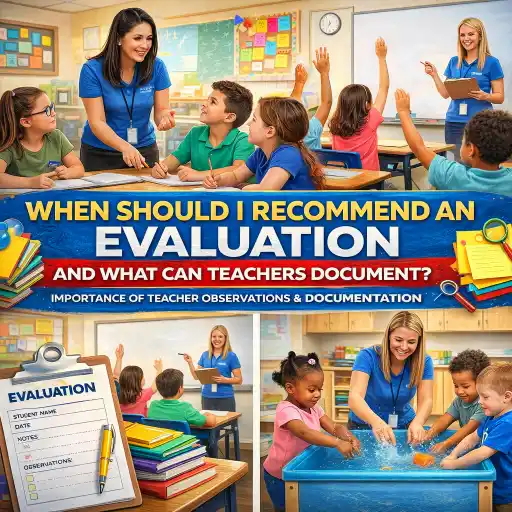
Good documentation is concrete and short. Focus on facts, not labels. Use numbered lists so your notes are easy to read later.
- 🔍 Describe what you saw (objective): say what the child did, not why. Example: "On 4/12 at circle time, did not respond when name called; looked down and played with hands for 2 minutes." See ChildCareEd examples like What Are the Red Flags in Infant Development for behaviors to watch.
- 🕒 Record date, time, and setting: inside/outside, meal time, transition, nap, playground.
- 📈 Note frequency and duration: how often and how long the behavior lasts (e.g., 3 times this week; 5–7 minutes each).
- 📋 Antecedent-Behavior-Consequence (A-B-C): what happened before, what the child did, what happened after. This helps spot patterns (see A-B-C forms and observation tips at sampleforms).
- 📸 Add evidence when allowed: photos, work samples, or short videos (with family consent). ChildCareEd highlights using portfolios and photos in classroom documentation e-clips.
- 🧭 Track across routines and settings: if the same issue appears at meals, circle time, and playground, that matters more than a one-time event.
How should I write and store documentation to be useful?
Make notes neat, dated, and easy for others to read. Use forms or digital tools when possible. The Ages & Stages and ASQ tools are useful for screening and tracking; see ASQ Online and the ASQ publisher info at WPS.
- 📝 Use a simple template:
- Who, When, Where
- What happened (objective)
- How long / how often
- What you tried and the result
- 📁 Save notes in a private child file or secure digital folder. Keep a running log (short entries) rather than one long note.
- 📊 Use checklists for milestones. The CDC’s milestone lists help you compare observed skills to typical ages: CDC Milestones.
- 📎 Use behavior observation forms and ABC charts. Free samples and templates are available (see Behavior Observation Form samples).
- 🔐 Respect privacy and consent. Ask families before taking photos or videos and follow your program’s record rules. Remember: state requirements vary - check your state licensing agency.
When should I suggest an evaluation and how do I talk with families?
Aim for partnership. You are sharing observations, not giving a diagnosis. Consider recommending an evaluation when any of the following occur:
- ❗ Repeating patterns across settings and days (not just once).
- ❗ Concerns in more than one area (for example, language and movement).
- ❗ Loss of skills the child once used (this is urgent).
- ❗ Major differences from peers of the same age on milestone checklists (see Understanding Developmental Milestones and Red Flags by Age).
How to talk with families: use strengths-first language and share facts.
- 🤝 Start with a positive: "I love how curious Maya is. I have some observations I want to share so we can support her together."
- 🗂 Show examples: short notes, dates, and any photos or work samples (with permission). ChildCareEd offers helpful scripts and family tips in their parent strategy pieces: Resources and strategies for parents.
- 📞 Suggest next steps: "It might help to talk with your pediatrician or request a screening like ASQ. I can share what I’ve documented and help with referrals."
How do we avoid common mistakes and what are next steps after a referral?
Common mistakes happen when notes are vague or when staff act without family partnership. Avoid these errors by following simple rules.
- ❌ Mistake: Writing opinions instead of facts. Fix: Use clear, objective language (who, what, where, when).
- ❌ Mistake: Waiting too long to record patterns. Fix: Make brief entries each time you see concerning behavior.
- ❌ Mistake: Acting alone or excluding families. Fix: Always invite family input and share observations kindly.
- ✅ Next steps after referral:
- 1. Provide the family with copies of your notes and samples.
- 2. Help complete screening tools like ASQ or PEDS and document the results (ASQ Online).
- 3. Offer to attend meetings or provide teacher input for IEP/IFSP if invited (see IEP forms and guidance at your state DOE; example: Massachusetts IEP form).
- 4. Keep monitoring and adjusting classroom supports (see behavior support tools from ChildCareEd: Special Needs in Daycare: Behavior Support Buy Now $0.00).
- 🔁 Keep communicating: follow up with families and the evaluation team. Track outcomes so your documentation shows progress or ongoing needs.
Providers who want stronger observation and documentation skills may benefit from Tracking Progress, Shaping Futures: Observation & Assessment Skills  Buy Now $55.00. This training helps child care professionals learn how to observe children carefully, document progress clearly, and use assessment tools to better support development. (childcareed.com Buy Now $55.00)
For those who want guidance on referrals, inclusion, and supporting children with developmental concerns, Special Needs: From Referral to Inclusion Buy Now $24.00 is a strong choice. This training helps providers understand the referral process and build supportive, inclusive care for every child. (childcareed.com Buy Now $24.00)
Conclusion
Teachers and directors play a key role in spotting concerns early. Clear, dated, and objective notes help families and specialists move faster. Use checklists, ABC charts, and screening tools like ASQ as part of your toolkit. For training and printable resources, ChildCareEd has many helpful courses and articles (for example: What should child care providers watch for with sensory needs?, Understanding Developmental Milestones).
Quick checklist to remember: #documentation, #families, #evaluation, #milestones, #referral.
You are not diagnosing — you are helping. Small, kind steps and good notes can change a child's path. If in doubt, suggest screening and support the family to connect with early intervention. state requirements vary - check your state licensing agency.
- Strong Good Hug, And A Kiss to Say Good Bye
- Identifying Developmental Milestones in Children
- CDA Certification en Español: Recursos y Consejos para Educadores Bilingües
- Recursos en Español sobre el Sueño Seguro del Bebé
- Cómo simplificar la capacitación para sus empleados de daycare
- What should providers expect at different ages and when should they recommend further evaluation?
- How Can Child Care Directors Create Fair and Useful Employee Evaluations?
- When Is Repetitive Speech Typical—and When Should Teachers Pay Closer Attention?
- Pediatric First Aid for Teachers: Are Your Skills Still Fresh When an Emergency Happens?
- Pediatric First Aid for Teachers: Blended or In-Person—Which Should You Choose?
- Early Intervention Strategies: What Can Teachers Do While a Child Is Waiting for Services?
- Is This Development Typical? When Child Care Providers Should Watch, Document, or Refer
- How Can Child Care Providers Use Developmental Screening to Support Every Child?
- How Can Child Care Providers Set Age-Appropriate Expectations for Young Children?
- How Can Teachers Recognize Developmental Red Flags Early?
- What Should a Teacher Do If They Suspect Autism?
- How Can Child Care Leaders Set Boundaries Between Mentoring and Evaluating a New Teacher?
- Coaching vs. Mentoring: Which Support Does a Teacher Need?
- Is Your New-Teacher Support Program Working?
