Being a childcare center director means keeping kids safe, leading teachers, and running a strong program families trust. Good #leadership starts with the right #training. It helps you protect children, support #staff, and follow rules for #safety and #compliance. State requirements vary - check your state licensing agency.
Why it matters: Directors shape the daily life of children and teachers. Research shows director training raises classroom quality and builds local support networks for leaders (Doherty et al.). Investing time in training improves safety, staff morale, and family trust.
1) What training should a new director take first?
- 📘 Take a director administration course (example: the 45-Hour Director-Administrator
 Buy Now
 $399.00$275.00 or the 40-Hour Director's Course Buy Now $125.00$100.00 where state-appropriate). These teach licensing basics, record keeping, and leadership. - 🩺 Complete health and safety training such as CPR/First Aid and courses on emergency preparedness and injury prevention. See Injury Prevention Buy Now $24.00 and Emergency and Disaster Preparedness Buy Now $55.00.
- 🎓 Add a credential like a CDA or a state director credential (e.g., Texas Director Credential Buy Now
$256.00$216.00) if your state requires it. - 📁 Build a simple records system as you learn so documentation is ready for visits. ChildCareEd resources on director courses explain what files to keep.
Cite courses that are approved in your state. For example, Maryland lists approved training rules in their training approval regulations.
2) How do I build a training plan for my center?
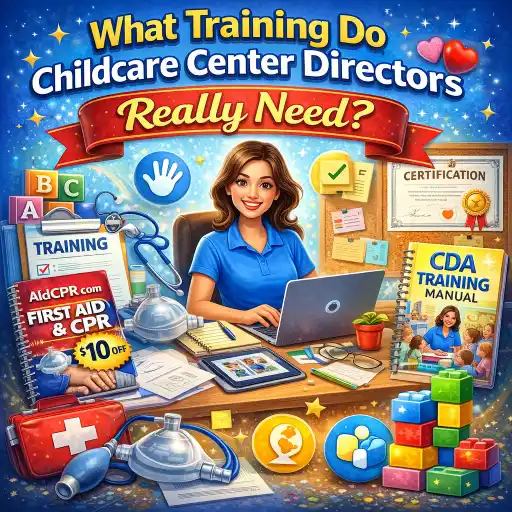
A clear plan keeps staff learning and keeps your program ready for inspections. Use this easy 6-step plan:
- 📋 Assess needs: list required trainings (licensing, CPR, child protection) and classroom gaps.
- 🧭 Prioritize: pick 1–3 trainings this quarter (safety first).
- 💻 Use group tools: buy staff hours or bulk courses through a group admin portal to save money and track progress — see leadership tools in Level Up Your Leadership.
- 👩🏫 Pair trainings with coaching: assign a mentor or do short observation plus a feedback chat after training.
- 📅 Schedule and document: make a simple calendar and keep certificates in one folder (digital or paper).
- 🔁 Review: every 3–6 months update the plan and reassign unused training hours to new hires.
Tools like the Texas training plan template Buy Now $0.00 give a ready format. Keep training tied to your program goals and budgets.
3) What skills and topics must director training include?
- 🛡️ Health & Safety: illness control, medication, safe sleep, CPR, emergency drills. ChildCareEd offers focused courses like Transportation Safety Buy Now $16.00.
- 📑 Administration & Compliance: record keeping, licensing rules, audits, hiring, and staff files. The 45-hour Buy Now
$399.00$275.00 course covers many of these topics. - 🤝 Family & Community: family engagement, communication, referrals, and partnerships.
- 👥 Staff Leadership: coaching, supervision, hiring, and retention strategies. Leadership articles like What Leadership Skills explain practical steps.
- 💼 Business & Budgeting: simple budgeting, scheduling, and basic marketing for enrollment.
- 🌍 Inclusion & Equity: cultural competence and adapting for diverse learners (see OECD findings on inclusion (OECD)).
Mix online courses, short in-person practice, and coaching for best results. Adult learning approaches help staff apply what they learn — use short follow-up activities after training to anchor new skills. State-approved trainer guidance like the Trainer Toolkit is helpful for designing sessions.
4) How do I stay compliant and avoid common mistakes?
Staying compliant is about planning and simple habits. Common mistakes and fixes:
For programs operating in Texas, review Staying Compliant in the Lone Star State: Avoiding Common Licensing Pitfalls for practical, state-specific guidance on preventing common licensing mistakes and maintaining ongoing compliance.
- 🚫 Missing or disorganized records — fix: keep a "Licensing Ready" binder with current certificates and forms.
- 🚫 Waiting until inspection — fix: do quarterly self-checks and track expirations on a calendar.
- 🚫 Not matching training to roles — fix: build role-based paths (lead teacher, aide, director) using resources like Essential Directors Certification.
- 🚫 Skipping staff coaching after training — fix: add one short observation and feedback session within two weeks of training.
FAQ (quick answers):
- Q: Do I need a degree to be a director? A: It depends on your state. Some paths combine experience + coursework. See state-specific guides like California and Texas.
- Q: How often must I train? A: Many states expect ongoing annual hours. Example: Texas requires 30 hours annually (30-hour Texas Annual Buy Now $240.00).
- Q: What if staff turnover is high? A: Use bulk training hours and a group admin portal to reassign hours and onboard quickly (Level Up).
Conclusion
Good director training is practical, ongoing, and tied to your program goals. Follow 1) core courses, 2) a simple training plan, 3) focused skill topics, and 4) smart record keeping. Use trustworthy resources on ChildCareEd for courses and templates, and remember: state requirements vary - check your state licensing agency. With steady steps you will build stronger #leadership, better #training, safer #safety practices, a supported #staff team, and clear #compliance that families can trust.
Start with practical, required courses that cover admin, health, and safety. Most programs recommend a step-by-step approach:Directors need both people skills and practical knowledge. Training should cover these main areas:- Celebrate New Beginnings with ChildCareEd: Renew Your Credentials This Passover
- Why Superheroes Wear Blazers: The Power of Qualified Daycare Directors
- Capacitación en Salud y Seguridad Preventiva en Línea para Proveedores de Cuidado Infantil
- Cómo Ser Maestra de Preescolar en Dakota del Norte
- Capacitación Previa al Servicio para Proveedores de Cuidado Infantil en Dakota del Norte
- Child Care Resource Center in Virginia: What Is It and How Can It Help?
- Child Care Resource Center in Illinois: What Is It and How Can It Help?
- How can Washington, D.C. child care providers keep children safe during transitions, drop-off, and pick-up?
- Before You Buy the Cute Daycare with the Tiny Chairs, Read This
- Could That Empty Building Become a Child Care Center?
- What training do childcare center directors really need?
- How can we help toddlers with separation anxiety?
- How can I make infant and toddler lesson plans that really work?
- What simple early literacy activities really help children learn?
- What are smart training strategies for child care directors?
- Why do repeated books, songs, and activities help children master new concepts?
- Talk, Listen, Connect: Build Stronger Child Care Relationships in 9 Hours
- Affidavit for Child Care Employment in Texas: What Form 2985 Is Really Asking
- What Does California Preschool Compliance Really Cost? A Director’s Annual Budget Checklist
- How Much Structured Learning Do Preschoolers Really Need?
