Introduction
Child care providers and directors often explain to families that children learn through play. Two common kinds of play are #parallel and #cooperative #play. Knowing the difference helps teachers plan rooms, pick toys, and coach kids toward better #social skills for #children. This article answers simple, practical questions you can share with parents and use in your classroom.
Why it matters: Play builds thinking, language, and friendships. Research and practice show that play helps brain gro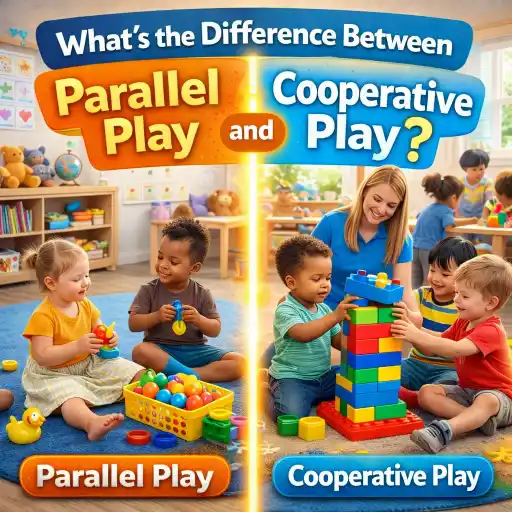 wth and social-emotional learning (see ChildCareEd: How Play Supports Brain Development). Also, remember: state requirements vary - check your state licensing agency.
1) What is parallel play, and when do children do it?
Parallel play is when children play side-by-side, using similar materials, but they do not play together with shared goals. They might build towers next to one another or push cars along the same rug without talking about the same story. This stage often shows up in toddlers and early preschoolers and is a normal step in learning to share space and ideas. Experts say parallel play helps children practice motor skills and begin to notice others' ideas before they join in (Study.com: Parallel Play).
Why caregivers should value it:
- It teaches boundary skills—children learn how close is okay and how to use shared materials.
- It builds confidence—each child practices an activity without pressure to perform together.
- It’s a bridge—parallel play prepares kids for talk, sharing, and pretending together later.
Tip: Watch closely. A child moving from parallel play to talking about what they are doing is ready for small steps toward cooperative play.
2) What is cooperative play, and why is it important?
Cooperative play is when children work toward a shared plan, story, or game. They take roles, follow simple rules, and solve problems together. Cooperative play usually grows after children practice parallel and associative play. It supports language, turn-taking, planning, and empathy. Programs that teach friendship and social skills show lasting benefits for school behavior and learning
How it helps your classroom:
- It builds communication: children must name ideas, listen, and agree on roles.
- It teaches self-control: waiting for turns and following simple group rules.
- It encourages problem-solving: kids figure out how to reach a shared goal.
Use guided dramatic play and group games to support these skills. See ideas for pretend and dramatic play in practice (WGU: Dramatic Play) and how guided play builds friendships (ChildCareEd: Foster Friendship Skills Through Guided Play).
3) How can caregivers help children move from parallel to cooperative play?
Caregivers act as guides. Small steps and steady practice help children build the skills to play together. Try these strategies in your classroom or when coaching parents.
- 😊 Set simple shared goals. Example: two children build one house from blocks instead of separate towers.
- 👀 Model and narrate. Describe what each child is doing and how they can work together. Adults should use short, clear language and praise attempts to share (CSEFEL: Teaching Peer Interaction).
- 🧩 Use role prompts. Give one child a role card (chef, cashier) so roles are clear during pretend play (ChildCareEd: Guided Play).
- 🔁 Create routines with peer jobs. Use daily routines (snack helper, prop passer) to create many short chances to practice asking, sharing, and handing things to friends (CSEFEL: Routines to Support Peer Interaction).
- 🎲 Provide cooperative toys and games. Choose toys that invite teamwork like building sets, dramatic play props, or cooperative board games (Thoughtful Parent: Best Toys for Social Play).
Try these teaching moves every day for 10–15 minutes in focused teaching moments, then watch for natural use during free time. Use praise and small rewards (like a job necklace) to reinforce success (CSEFEL strategies).
Remember to watch for differences: some children need slow, one-on-one coaching (for example, children with language delays or autism). Use play to support communication—ChildCareEd offers resources on play with purpose for children with autism (ChildCareEd: Play & Autism).
4) What common mistakes should providers avoid and how can you fix them? (FAQs included)
Common mistakes and fixes:
- 🚫 Mistake: Pushing children too fast into group play. Fix: Use gradual steps—first watch, then do paired play, then small group play.
- 🚫 Mistake: Using difficult language or too many rules. Fix: Keep directions short and show actions instead of many words. Use visuals or props when needed (ChildCareEd: Developmental Milestones).
- 🚫 Mistake: Not planning for children who need help. Fix: Plan adult prompts and peer buddies. Teach peers how to include others and praise inclusion (CSEFEL).
- 🚫 Mistake: No follow-up after teaching a skill. Fix: Embed the skill in routines and praise it when you see it. Small daily practice matters.
-
For communication strategies + involving families (and guidance for separation/attachment), add Let’s Talk: Effective Communication
 Buy Now $24.00 — it specifically covers building productive parent-provider relationships, consistent responsive communication, and helping families and children through separation and attachment.
 -
For infant/toddler parent partnerships and separation support, include CDA Infant/Toddler: Parent Relationships
Buy Now $16.00 — it focuses on strengthening relationships with families in infant/toddler care and supporting families during separation.
FAQ (short answers you can share with parents):
- Q: Is parallel play a problem? A: No. It is normal and helpful for many toddlers and preschoolers (Study.com).
- Q: When should I expect cooperative play? A: Often between ages 3–5, but children move at different paces. Use guided practice and routines to help.
- Q: What if a child has trouble joining play? A: Try pairing them with a buddy, using role cards, and offering one small, clear job to make joining easier (CSEFEL).
- Q: Should we remove toys that cause fights? A: Not always. Use turn-taking tools (timers, job cards) and teach asking skills before removing materials.
- Q: Where can I learn more? A: ChildCareEd has helpful courses and articles on guided play, milestones, and supporting children with special needs (ChildCareEd).
Conclusion
In short, parallel play is a healthy stage where children play near each other; cooperative play is when they work together toward shared goals. Both are important steps in early learning. As a provider or director, you can:
- Value parallel moments and watch for signs a child is ready to join.
- Plan short lessons and routines that teach sharing, asking, and role-taking.
- Offer guided play, clear roles, and cooperative toys so children can practice together.
- Remember to adapt support for children with language or sensory needs and to tell parents why each step matters.
Using these simple, daily moves will help children move from side-by-side play into shared stories and teamwork. For teaching tools and deeper training, see ChildCareEd resources on play, milestones, and inclusion (ChildCareEd).
- The Best Promotion is Play
- From Play to Planning: Building Culturally Competent, Child-Centered Curriculum
- Play Safe, Think Big: Literacy Through Play
- The Best Promotion is Play
- Play, Learn, Grow
- Play with Purpose: Supporting Children with Autism
- Creating Engaging and Meaningful Learning Experiences
- Texas Director Credential
- Montessori Cultural Activities: Exploring the World Through Play and Learning
- IEPs and IFSPs in Family Child Care
- ¿Cuáles son las mejores actividades del Día de la Tierra para niños en casa o en el aula?
- 10 Ejemplos de Cómo la Cultura Influye en el Desarrollo Infantil
- Actividades de Otoño Fáciles para Preescolares esta Temporada
- How can indoor creative play encourage teamwork for preschoolers in California?
- Celebrando la amistad en el cuidado infantil durante el Día de los Mejores Amigos
- Canciones, juegos y preguntas de círculo para niños
- Cooperative Play vs. Parallel Play: What’s the Difference?
- Define Cooperative Play: Examples for Preschool and Child Care
- How can child care providers encourage cooperative play among preschool children?
- Team-Building Games for Preschoolers That Teach Cooperation
- Preschool Team-Building Activities for Better Communication and Friendship
- First Week of Pre-K Activities That Help Children Feel Comfortable
- How Can Bingo Games Support Turn-Taking and Social Skills?
- What Developmental Milestones Should Teachers Know From Birth to Age 5?
- How Do Children Learn Through Play?
- How Can Child Care Providers Teach Sharing Without Forcing It?
- How Can Child Care Providers Support Children Who Use More Than One Language During Play?
- How Do Parallel Play, Associative Play, and Cooperative Play Differ?
- At What Age Do Children Start Playing Together?
- What Is the Difference Between Parallel Play and Cooperative Play?
