Every day in your program there are small chances to help children grow strong #language skills and early #literacy. You do not need long lessons. Use short moments to talk, read, sing, and play with children. Simple actions build big results for little learners: #read, #play, and work with #families to make learning happen.
Why it matters: Early language and literacy help children feel confident, follow directions, make friends, and get ready for school. Research and practical guidance from ChildCareEd and other sources show that daily, warm interactions build vocabulary, phonological skills, and print awareness.
1) What small routines can teachers use every day to grow language and literacy?
- 📚 Read a short book during arrival or snack. Pick 1–2 words to teach and say them again. See tips from ChildCareEd.
- 🗣️ Narrate routines: say what you do and what children do (“I am pouring juice. You are stirring.”).
- 🧩 Use “talk while you work”: name colors, sizes, steps, and feelings during clean-up or cooking.
- ✍️ Add one label in a play area this week (toy shelf, book basket). Labels help children notice print; more ideas at Classroom Tools for Emergent Literacy
 Buy Now $16.00.
 - 🎵 Sing a short rhyme at transitions. Rhymes build sound awareness — a key early skill.
Tips to keep it working:
- Follow the child’s lead—talk about what they care about.
- Repeat new words 2–3 times across the day.
- Keep interactions short and warm so children enjoy them.
2) How do books, songs, and play boost language and reading skills?
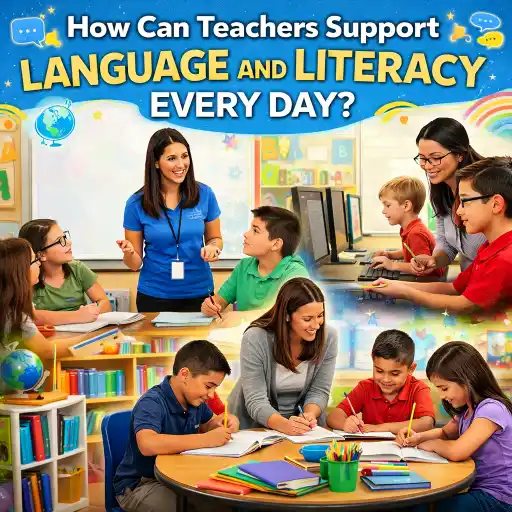
Books, songs, and play give children chances to hear words, try sounds, and practice telling stories. Use interactive reading: ask a question, listen, and add one new word. This approach is called dialogic reading and is recommended in ChildCareEd’s read-aloud guidance. For ready-made story prompts and simple, age-appropriate activities to celebrate storytelling and extend dialogic reading, see our World Storytelling Day ideas.
Try these classroom moves:
- 📖 Choose short picture books. Read once for the story, then read again and ask simple questions: “What do you see?”
- 🎵 Add short songs or rhymes during handwashing or lining up. Songs repeat sounds and make words easier to hear. See phonological tips at ChildCareEd.
- 🧸 Put books and writing tools inside play centers so children connect print and play. The course Classroom Tools for Emergent Literacy Buy Now $16.00 has practical ideas.
- 🔁 Reread favorites. Repetition builds memory and lets children join in.
Quick classroom games (1–5 minutes):
- 🔍 Sound hunt: find things that start with /m/.
- 👏 Syllable clap: clap the beats in names or animals.
- 🗂️ Vocabulary box: show a picture, name it, and let children repeat.
3) How can teachers include children who speak more than one language and partner with families?
Steps to try with families:
- 🤝 Invite families to share a favorite song or book in their home language.
- 📄 Send one simple home activity: “Read one page tonight” or “sing this rhyme.” Use resources like the Parent Handout Buy Now $0.00.
- 🗣️ Learn a few key words in the child’s home language (hello, bathroom, eat). Ask parents to write them phonetically.
- 🏷️ Add bilingual labels when possible so children see both languages in the room.
Why this matters: Keeping the home language gives children confidence and helps them learn English faster. For more research and practice ideas see the ChildCareEd resources and studies like the survey of center practices at ECRP.
4) How can teachers track progress and avoid common mistakes?
Watching and noting what children say and do tells you what to teach next. Short, regular observations help you set simple goals. ChildCareEd’s course on Assessment of Language and Literacy Skills Buy Now $24.00 explains how to turn observations into next steps.
Simple ways to track progress:
- 📝 Quick notes: write one sentence after a group time: what words children used.
- 📷 Photo prompts: take pictures of work and write a few child quotes under them.
- ✅ One-week goal: pick one child and try one strategy (read a favorite book each day); note changes.
Common mistakes and how to avoid them:
- ❌ Teaching too many new words at once. ✅ Fix: teach 1–2 words and use them across the day.
- ❌ Long lessons that lose children. ✅ Fix: keep activities short and playful.
- ❌ Skipping family input. ✅ Fix: send one simple tip home and ask for a family song or book.
FAQ (short answers):
- Q: How long should story time be? A: 5–15 minutes for preschoolers. Keep it interactive.
- Q: What about a child who speaks another language? A: Use the home language when possible and invite family help.
- Q: Do I need special materials? A: No. Use objects, simple labels, and books you already have.
- Q: When should I get extra help? A: If a child is not talking by expected ages or seems to lose skills, talk with families and consider screening.
Conclusion — Quick plan to try tomorrow:
- 📘 Read one short book and teach one new word.
- 🎶 Sing one rhyme during a routine.
- 🏷️ Add one label in a play area and point to it as children play.
Use ChildCareEd courses like Classroom Tools for Emergent Literacy Buy Now $16.00 and Reading Aloud and Storytelling Buy Now $16.00 for step-by-step ideas. Remember: state requirements vary - check your state licensing agency. Small, steady steps help children become confident communicators and readers. You are making a big difference with everyday choices.
- Language Development in Early Childhood
- Language Development in School Age
- Reading Aloud and Storytelling
- Language and Literacy Foundations in Pre-K
- Play Safe, Think Big: Literacy Through Play
- Equity in Action with Head Start
- Texas Director Credential
- Classroom Tools for Emergent Literacy
- Classroom Tools for Emergent Literacy
- Read Across America Day
- Language and Literacy Preschool Curriculum
- How Can Teachers Support Language and Literacy Every Day?
- How can child care providers use the science of reading to boost early literacy in New York?
- Celebrando la amistad en el cuidado infantil durante el Día de los Mejores Amigos
- What skills do preschoolers need to be ready for school?
- Dr. Seuss Book List for Teachers: Easy Ways to Use It for Story Time and Learning
- Building a Better Head Start Lesson Plan: 7 Things Every Teacher Should Include
- What No-Prep Activities Can Busy Early Childhood Teachers Use Tomorrow?
- How Can Child Care Programs Build Meaningful School Readiness?
- What Are the Best Print-and-Play Activities for Substitute Teachers?
- How Can Teachers Support Children Starting Kindergarten This Fall?
- How Can Child Care Providers Use Project-Based Learning to Deepen Young Children’s Learning?
- How Can Teachers Build Early Literacy Without Screens or Worksheets?
- How Can Child Care Providers Support Kindergarten Emotions on the First Day of School?
- How Can Camping Themes Expand Preschool Vocabulary?
- How Can Child Care Providers Teach Holiday Vocabulary with Context and Care?
- How Can Teachers Support Language Development in Toddlers?
- How Can Teachers Balance Alphabet Worksheets with Preschool Conversation?
- How Can Preschool Teachers Balance Alphabet Worksheets with Conversation?
