A pretend farmers market can turn a simple picture list into a lively lesson in noticing, matching, talking, and working together. With a few baskets, produce pictures, and thoughtful prompts, you can make everyday dramatic play purposeful without taking the fun out of it. Bring this experience into your classroom with ChildCareEd’s Farmers Market Shopping Lists: Produce Picture-Matching Activity for Preschool Buy Now $2.00, a hands-on printable featuring picture shopping lists and matching fruit and vegetable cards that help children practice visual recognition, matching, vocabulary, and cooperative play. For deeper professional learning, explore The Best Promotion is Play  Buy Now $24.00, which offers practical strategies for supporting child-led learning and creating engaging play environments that encourage exploration and meaningful interactions.
Why does pretend market play matter for preschool learning?
Grocery shopping is familiar to many children, making it a welcoming starting point for imaginative play. A farmers market center gives children a meaningful reason to choose, search, compare, communicate, and collaborate. Rather than treating picture matching as a worksheet task, educators can embed it in an activity with a clear purpose: “I have a list. Can I find the foods I need?”
That purpose helps connect early thinking skills to real-life experiences. Children interpret images, remember a target, scan a display, and decide whether an item matches. They may also plan a sequence—choose a list, find the produce, place it in a basket, and check what remains. These small decisions invite flexible thinking and persistence.
Play also offers a comfortable context for social communication. Children can act as shoppers or sellers, negotiate turns, ask for help, and share discoveries. Educators do not need to deliver a formal lesson at every moment. Preparing accessible materials, observing closely, and responding to children’s interests can make the learning visible while preserving their ownership of the play. As the picture-based farmers market activity Buy Now $2.00 illustrates, short matching turns can be a practical entry point to a broader dramatic-play center.
How do picture lists strengthen visual discrimination and matching?
Visual discrimination is the ability to notice similarities and differences in what we see. When a child looks at a picture of a pear and scans a group of produce cards, they attend to details such as shape, color, size, and distinctive features. Finding the corresponding card builds the habit of comparing visual information rather than selecting at random.
Picture lists also support matching, an early cognitive skill used in sorting, categorizing, and later classroom tasks. A child may match identical pictures first, then progress to a photograph and a toy representation of the same food. These variations invite more careful observation: the toy banana may be curved differently or a printed image may show another angle.
- Begin with one pictured item on a list and a small selection of cards.
- Increase the number of pictures or choices when children are ready.
- Invite children to explain, point, gesture, or demonstrate how they know an item matches.
- Offer duplicates, realistic photos, or play food as alternative matching materials.
Adjust the challenge to support success without making the task automatic. A child who is still learning to scan can use a single-picture list; a confident child can manage several items and return to the list to check progress. The goal is not speed. It is purposeful noticing, with adults valuing each child’s strategy and effort.
How can market play grow vocabulary and conversation?
A market gives words a concrete setting. Children can hear and use names for familiar produce—apple, corn, pepper—and descriptive terms such as smooth, bumpy, ripe, round, leafy, and heavy. The shopping list itself can prompt language: “What do you need?” “Where might the carrots be?” “You found a red pepper that looks like the picture.”
Educators can expand language through brief, natural descriptions rather than constant correction. If a child points to an item, name it and add one useful detail: “That is a zucchini. It is long and green.” Then pause so the child can respond in their own way. Gestures, home-language words, signs, and communication devices can all be meaningful contributions to the interaction.
Role play creates authentic reasons to communicate. A shopper may request an item, a vendor may explain where it is, and a cashier may ask whether the basket is complete. These exchanges let children practice turn-taking, listening, asking questions, and building short narratives around familiar routines. Educators can include bilingual labels and foods that reflect children’s families and communities. As NAEYC’s guidance on culturally rich dramatic play emphasizes, familiar cultural experiences can make play more meaningful and create natural opportunities to introduce vocabulary.
How can educators make the shopping list purposeful but child-led?
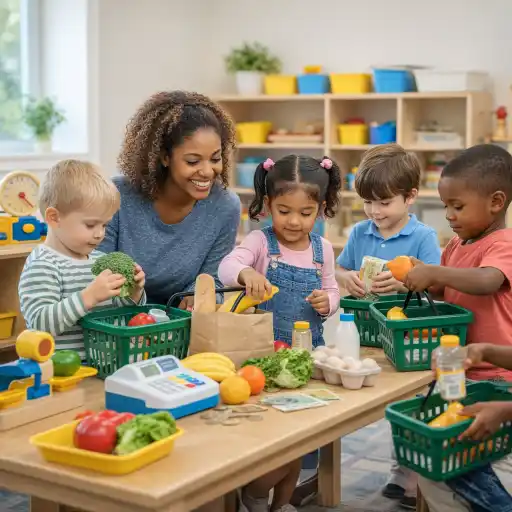
A picture list gives children a clear play goal without prescribing every move. Children choose a list, locate its pictured items, and decide how to carry or organize them. The market can be simple: a low shelf or table, baskets, reusable picture cards, and a few pretend fruits and vegetables are enough. Keep materials visible and within children’s reach so they can begin independently.
Set up the center with a small number of lists at different levels. One-picture lists are useful for children who are new to matching; lists with several items invite children to sustain attention and check their own work. Keep turns short if that supports engagement, and allow children to revisit the center later. The resource describes 5–10-minute turns as one practical option, not a fixed requirement.
- Place picture lists on clipboards or in a basket near the produce.
- Use matching cards, play food, or both; children can point, pick up, or name an item.
- Rotate produce images to include seasonal foods and items familiar to families.
- Invite children to help organize the market and create new lists from classroom materials.
Stay responsive rather than turning the center into a test. Ask open-ended questions when children seem ready, then step back. For educators seeking further guidance on planning play-based experiences, From Play to Planning: Building Culturally Competent, Child-Centered Curriculum Buy Now $55.00$45.00 explores child-centered curriculum, scaffolding, and inclusive environments.
How can providers include every child and observe learning?
Children may participate in different ways, and each can provide evidence of thinking. One child may name every fruit; another may point accurately, use a picture symbol, or carry the matching object to the basket. Offer different entry points: larger cards, fewer choices, high-contrast images, stable surfaces, reachable shelves, and enough time to respond. Provide a communication board or simple choice cards when helpful, and include home-language labels when possible.
Observe without interrupting the play. Brief notes can record what the child did and what support was useful: “Matched three produce pictures independently,” or “Scanned the cards after an adult named the target.” Look across repeated opportunities rather than drawing conclusions from one turn. Documentation can guide the next adjustment—for example, adding more choices, using clearer images, or modeling a new descriptive word.
Remember that participation does not have to mean speaking or completing every item. Respect children’s preferences, sensory needs, and developmental pace. Keep props clean, intact, and large enough to avoid choking hazards; supervise closely, especially when using small materials. If real produce is introduced, review allergies and program food-safety procedures. State requirements vary - check your state licensing agency.
For professional learning on language and vocabulary strategies that can extend these interactions, see Building Vocabulary Buy Now $16.00 and Language and Literacy Foundations in Pre-K Buy Now $16.00. Both are relevant options for strengthening classroom practice beyond this activity.
Conclusion: What can preschoolers learn from pretend grocery shopping?
Pretend grocery shopping can support far more than identifying fruits and vegetables. With picture-based shopping lists, preschoolers practice visual discrimination, matching, attention, vocabulary, communication, cooperation, and purposeful play. The learning grows from a clear, child-friendly goal: find the pictured item and use it in an imagined shopping trip.
Start with a few familiar pictures and accessible materials. Offer simpler and more challenging lists, welcome pointing and other communication, and let children shape the roles and story. Observe what they notice and say, then use those observations to decide what to add next. Most importantly, keep the center playful and responsive: the list is a helpful invitation, not a script. A thoughtfully prepared farmers market can help children connect images, words, relationships, and everyday experiences while enjoying the freedom to imagine.
- 45 Hour Child Growth and Development
- Children at the Wheel: Emergent Curriculum
- CDA Bridge Bundle: Preschool
- Pediatric RSV First Aid & CPR/AED
- CDA Bridge Bundle: Family Child Care without Portfolio Review
- CDA Bridge Bundle: Infant/Toddler without Portfolio Review
- CDA Bridge Bundle: Preschool without Portfolio Review
- Lesson Planning for Preschoolers
- Texas Director Credential
- The power of Imagination: How to add it to your classroom
- CDA Certification en Español: Recursos y Consejos para Educadores Bilingües
- Proporciones de Cuidado Infantil y Tamaños de Grupo por Edad en Maryland (Guía Rápida para Centros y Hogares)
- How can we bring a farmers market and fresh fruit activities to preschoolers in California?
- How can North Dakota childcare programs plan healthy meals and follow CACFP?
- Celebrando la amistad en el cuidado infantil durante el Día de los Mejores Amigos
- How can North Dakota providers stretch food costs with CACFP?
- Social Studies Activities for Toddlers: Start With Home, Helpers, and Their Little World
- How Can Living vs. Non-Living Sorting Spark Early Science Thinking?
- How Can Food and Kitchen Words Build Early Reading Skills?
- How Can Classroom Labels Help Children Understand Print?
- How Can Pretend Store Play Teach School-Age Children Money Skills?
- How Can November Classroom Activities Help Preschoolers Build School Readiness Skills?
- How Can Child Care Providers Build Early Writing Skills Without Relying on Worksheets?
- How Can You Create a Pumpkin Patch Pretend-Play Experience Without a Field Trip?
- How Can You Extend Fall Dramatic Play into November Without Starting Over?
- What Can Preschoolers Learn From Pretend Grocery Shopping?
- How Can You Build a Preschool Pumpkin Market Without a Field Trip?
- How Can One Cardboard Box Become Four Fall Dramatic-Play Settings?
- How Can District of Columbia Preschool Teachers Develop Print Awareness Through Everyday Activities?
