A lively pumpkin market can bring the excitement of a fall outing into your preschool classroom—and give children real reasons to talk, count, write, and cooperate. The Lesson Planning for Preschoolers course  Buy Now $24.00 can help you connect playful ideas to developmentally appropriate goals, while the Facilitating Learning in the Preschool Classroom course Buy Now $35.00 offers strategies for supporting child-led exploration. Read on for a practical way to turn a classroom corner into a purposeful market using signs, order forms, price tags, and children’s own ideas.
Why create a pretend pumpkin market in the classroom?
A market center is more than a seasonal display. It gives preschoolers a shared scenario to imagine and shape: one child may arrange pumpkins, another may welcome customers, and a third may write an order or ring up a sale. These roles create natural opportunities for communication, negotiation, planning, and problem-solving.
Pretend buying and selling also connects familiar experiences to emerging academic concepts. Children encounter numerals and written symbols in a meaningful context, compare objects, count items into baskets, and make marks to communicate an order. As NAEYC explains in its guidance on creating dramatic-play areas that support literacy development, signs, lists, and other purposeful print can help children explore how written language works.
The theme can be adapted to children’s interests and family experiences. Present it as a market exploring pumpkins, gardens, food, and community work—not as a tradition every family is expected to celebrate. A few simple props can support rich play; the value comes from children’s ideas and the responsive adult support around them.
- 🧡 Children practice #language as they describe produce, ask questions, and negotiate roles.
- Counting, matching, and comparing bring #math into a familiar play story.
- Signs, lists, and receipts give #literacy a genuine purpose.
- Shared decisions encourage #cooperation and flexible thinking.
How can you set up the market with simple materials?
Choose a clearly defined space that adults can supervise and children can access independently. A low shelf, table, or a few sturdy crates can become the counter. Baskets or boxes can display pumpkins; a nearby clipboard station can hold paper, pencils, and order forms. Avoid filling every surface: children need room to move, find props, and develop their own story.
Use what your program already has. Artificial or paper-bag pumpkins, reusable shopping bags, fabric leaves, play money, a toy register, clipboards, and crayons can be enough. Add visual labels to storage containers so children can help return items. The ChildCareEd resource Preschool Harvest Market Dramatic Play Setup and Play Guide Buy Now $2.00 describes printable market materials such as food cards, price tags, shopping lists, role cards, and signs that can be adapted to your room.
Include children in making the center. They can draw signs, decorate paper-bag pumpkins, label baskets, or decide where the checkout belongs. This preparation builds ownership and gives children meaningful chances to plan, create, and communicate.
- Set up a pumpkin display with baskets, lightweight produce, and a “Market” sign.
- Add price tags, pretend money, a register, and shopping bags if available.
- Provide paper, crayons, clipboards, and order forms for writing and drawing.
- Offer optional role badges or aprons, without assigning fixed jobs.
Which roles and prompts help children keep the story going?
Offer roles as invitations rather than requirements. Children may choose to be growers, shoppers, cashiers, sign makers, delivery helpers, or market organizers. Some may watch first or participate by sorting produce; these are valid ways to enter the play. Visual role cards can help children see possibilities without limiting their choices.
To extend a storyline, introduce a small, open-ended challenge that leaves the solution to children. For example, a customer might need three small pumpkins for a pretend recipe, the market may run out of bags, or a sign could be missing a price. Such situations make a reason to count, plan, explain, and collaborate without turning the center into a teacher-led task.
- “The market is opening. What should we get ready?”
- “A customer needs two small pumpkins. How can we find them?”
- “We’re out of shopping bags. What else could customers carry?”
- “How can we make sure this order has everything on the list?”
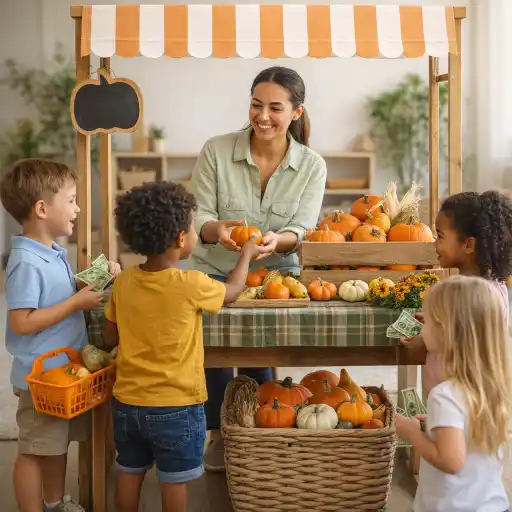
Observe before joining. A brief comment, new word, or useful prop can extend play; then step back and let children carry the story. If a child calls a pumpkin “bumpy,” you might add “rough” or “ribbed” naturally. Avoid correcting every detail, assigning every role, or asking a question after every action. The ChildCareEd overview of using dramatic play to support learning offers further ideas for scaffolding without taking control.
How can signs, order forms, and price tags support learning?
Market print works best when it serves a purpose in children’s play. A sign announces that the market is open; a price tag identifies an item’s pretend cost; an order form records what a customer wants. Children may scribble, draw, dictate, copy a numeral, or attempt spelling. Each is a meaningful effort to convey a message, and children do not need conventional writing to participate.
Mathematics can grow from the same materials. Children can match a numeral to a price tag, count pumpkins into an order, compare sizes, or sort produce by a feature they choose. The emphasis is on exploring ideas together, not on making every transaction numerically exact. Keep the challenge appropriate to the children’s interests and experience.
- Invite children to make a shopping list using pictures, marks, or words.
- Count the items in an order and check the basket together.
- Compare two pumpkins: Which is larger, heavier, or more rounded?
- Sort produce by size, color, shape, or another child-selected feature.
- Use a simple tally to show which pumpkin type customers choose most.
Keep writing materials easy to reach so children can use them when the play calls for them. Rather than requiring every child to complete a form, treat the forms as optional tools for communicating ideas. For focused professional learning on play-based math experiences, explore Early Mathematics Through Play Buy Now $24.00.
How can you make the center inclusive, safe, and responsive?
An inclusive market reflects the children in your program and makes participation flexible. Some children may prefer to speak in a role; others may point to a picture, sort produce, draw a sign, or observe before joining. Add picture cues and, when possible, familiar words in children’s home languages. Offer materials with varied textures and use pretend produce if real items are unsuitable for sensory, allergy, or sanitation reasons.
Keep the layout welcoming and manageable. Ensure that children can reach props, pathways remain clear, and the play area is visible to supervising adults. Choose sturdy, age-appropriate materials, inspect them regularly, and remove broken or sharp items. Avoid small loose parts when they pose a choking risk. If you use real produce, follow program procedures for allergies, sanitation, and family information.
- Provide more than one way to choose a role or communicate an order.
- Use lightweight props and keep walkways clear.
- Check materials routinely and adapt them to children’s access and sensory needs.
- Respect families who do not participate in seasonal traditions.
State requirements vary - check your state licensing agency. An accessible center does not need elaborate decorations; it needs thoughtful choices that allow children to participate safely and with dignity. The Inclusive Lessons for Preschoolers course Buy Now $16.00 provides additional strategies for adapting learning experiences to varied needs.
How can you plan, observe, and improve the market over time?
A short planning cycle keeps the experience intentional without scripting children’s play. Begin by observing what children already do: Are they sorting pumpkins, pretending to sell them, asking for bags, or making marks on paper? Choose one or two possible learning intentions—such as comparing sizes or using descriptive vocabulary—and add materials that connect with those interests.
During play, note what children actually say and do. An observation such as “Sam counted four pumpkins into a basket and asked a peer to check the order” is more useful than a broad label like “good at math.” These notes can guide a thoughtful next step: add a second order form, introduce a comparison basket, or simply preserve time for the play to develop.
- Notice language, storytelling, questions, and new vocabulary.
- Look for counting, sorting, matching, comparing, and mark-making.
- Observe turn-taking, role negotiation, helping, and problem-solving.
- After a few play sessions, decide what to add, remove, or adapt.
Common pitfalls include overcrowding the center, changing every prop at once, assigning roles, or turning pretend transactions into quizzes. Keep the setup manageable, protect uninterrupted play when possible, and follow children’s lead. For practical support in organizing learning centers, consider Spicing Up the Classroom: Learning Centers Buy Now $16.00.
Conclusion: What makes a classroom pumpkin market successful?
A successful preschool pumpkin market is not measured by how realistic or elaborate it looks. It succeeds when children can enter the story, make meaningful choices, communicate in their own ways, and revisit ideas through play. Signs, order forms, and price tags offer useful invitations to explore language and early math while children build a shared market narrative.
Start with a simple, safe setup; invite children to help shape it; and observe what captures their attention. Add or adapt materials in response, while keeping participation flexible and the play child-led. With thoughtful planning, your classroom can offer the curiosity and collaboration of a pumpkin patch visit—without leaving the building.
- 45 Hour Child Growth and Development
- 45 Hour Preschool Methods and Materials
- What Makes Me Special: An Overview of Autism and ADHD
- CDA Bridge Bundle: Preschool
- CDA Bridge Bundle: Family Child Care without Portfolio Review
- CDA Bridge Bundle: Infant/Toddler without Portfolio Review
- CDA Bridge Bundle: Preschool without Portfolio Review
- Lesson Planning for Preschoolers
- Pumpkin Party to Celebrate National Pumpkin Day with Your Students
- Field Trip Ideas in Florida: Fun, Educational Adventures for Children
- Exploring Oklahoma: A Guide to Educational Field Trips for Children
- 🚌❄️ Field Trip Ideas in North Dakota for Childcare Providers
- 🚌🌄 Engaging Field Trip Ideas in Nevada for Childcare Providers
- Fun Field Trip Ideas for Preschoolers, Elementary Kids, and Summer Camps
- Las Mejores Ideas de Excursiones para Guarderías en Dakota del Norte
- Las Mejores Ideas de Excursiones para Guarderías en Texas
- Best Daycare Field Trip Ideas in Illinois
- Las Mejores Ideas de Excursiones para Guarderías en Georgia
- How can we bring a farmers market and fresh fruit activities to preschoolers in California?
- How can Georgia farm field trips teach young children about animals and food?
- Which Oklahoma Farms and Ranches Offer Preschool Field Trips That Teach About Animals and Community?
- Summer Field Trips for Daycares in Nevada
- Calabazas, hojas y manzanas: actividades de otoño para preescolares
- Celebrando la amistad en el cuidado infantil durante el Día de los Mejores Amigos
- How Can You Choose a Field Trip That Extends What Children Are Already Investigating?
- How Can You Create a Pumpkin Patch Pretend-Play Experience Without a Field Trip?
- How Can You Extend Fall Dramatic Play into November Without Starting Over?
- How Can You Build a Preschool Pumpkin Market Without a Field Trip?
