Classroom labels help children see that print carries meaning when educators connect written words with familiar objects and daily routines. Use the Toddler Room Labels Buy Now $0.75 to introduce those connections, pointing to a label as you name an item or help children find where it belongs. For focused strategies to strengthen print awareness through routines, play, and shared reading, explore ChildCareEd’s Understanding Print Knowledge in Preschool  Buy Now $16.00. To build a broader range of teaching approaches, including labeling and interactive read-alouds, consider Classroom Tools for Emergent Literacy Buy Now $25.00. Read on for ways to make classroom print meaningful through everyday interactions.
Why do classroom labels matter for children’s understanding of print?
A label is a small piece of environmental print with a real job to do. A picture-word card on a basket can show children what belongs there; a sign can identify a learning center; a name card can help a child find a cubby or recognize a familiar word. These repeated encounters help children connect spoken language with written symbols and notice that print communicates information.
Print awareness is not the same as conventional reading. Children may recognize a familiar label by its image, shape, color, or context before they identify its letters. That is a valuable starting point. As educators point out the words and talk about what they mean, children can gradually notice that words are made of letters and that print—not only pictures—carries a message. Foundational guidance on print awareness recommends labeling classroom objects and centers with words and pictures and drawing children’s attention to the cues.
Useful labels can also support participation and classroom independence. Children have a visible reference for finding materials, making choices, and helping with cleanup. This does not mean expecting every child to manage routines alone; it means making the environment easier to understand while adults remain available to model and encourage.
- Use labels as communication tools, not just decoration.
- Connect each label to an actual classroom purpose and routine.
- Notice children’s attempts to interpret print, even when they rely on pictures or context.
What makes a classroom label clear and useful?
Effective labels are easy for children to see, interpret, and match with the materials or space they describe. For younger children and beginning readers, pair a simple image with a short word. When possible, use a photograph of the actual materials—a familiar basket of blocks, for example—so the visual cue closely matches what children encounter. Choose clear, readable lettering and avoid cluttered backgrounds that compete with the image.
Place labels where they help children act. Shelf labels should be near the relevant storage area, center signs should be visible from children’s height, and personal labels should be positioned where children can consult them. Consistency matters: if the same materials appear in more than one place, use the same picture and wording so children do not have to decode a new cue each time.
Keep the collection manageable and current. A room covered in labels may feel busy, while outdated labels can confuse children when materials have changed. Start with high-use locations and containers, then add or revise labels based on what children actually need. Picture-and-word labels can also be adapted to reflect the languages represented in the group. Families can help check translations and identify familiar words for classroom objects.
- Use one clear image and a brief, familiar name.
- Pair words with photographs or symbols that children can recognize.
- Position labels within children’s reach and line of sight, when appropriate.
- ✨ Check that each label still matches the contents and the classroom arrangement.
How can educators teach children to use labels?
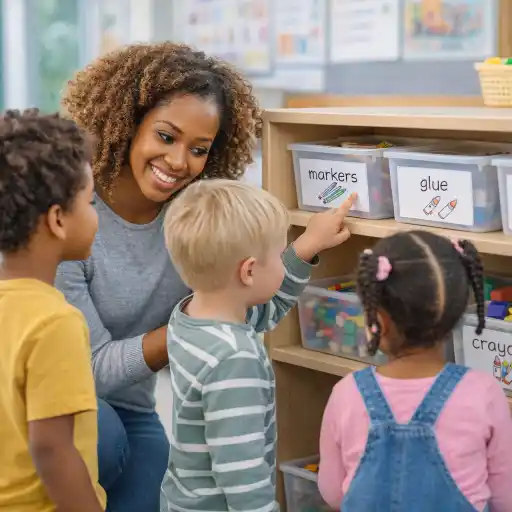
Children learn what labels mean through interaction, not by simply seeing them on a shelf. Introduce a label during the activity it supports. Point to the picture and word, name the material, and explain its purpose: “This says blocks. The picture shows the blocks that go in this basket.” During cleanup, invite children to compare the items with the label and decide where they belong.
Use short, conversational prompts rather than turning every label into a quiz. You might say, “What does this sign help us find?” or “Let’s look at the picture together.” During shared reading, briefly connect classroom labels with words in a book: “Here is the word ‘paint’ on our shelf. Can you find it on the page?” These small exchanges link print to meaning without taking the joy out of play or story time.
Model the thinking you want children to try. An educator might look at a shelf, locate its label, and say aloud, “I’m checking the picture so I know where the markers belong.” Invite children to make or update labels, dictate the words they want recorded, or help photograph classroom materials. Their participation can strengthen ownership and give them authentic reasons to notice print.
- Demonstrate how you use a label to find, choose, or return an item.
- Allow time for children to look, point, match, or respond in their own way.
- Celebrate the strategy: “You checked the picture to find the right basket.”
- Offer support without expecting every child to read the word independently.
How can labels connect print learning to play and routines?
Labels become especially meaningful when children encounter them in real activities. At arrival, name cards can help children locate their cubbies or sign in. During cleanup, picture-word labels can indicate where toys and art materials belong. A schedule or center sign can help children anticipate what happens next. These routines show that written language can guide action and organize shared life.
Learning centers offer opportunities to extend this understanding through imaginative play. A pretend restaurant can include labeled menus, order pads, and signs. A grocery area might feature familiar packages, shopping lists, and baskets identified by category. In the block center, children can use street signs, building labels, or simple maps. Educators can narrate how the print functions: “The menu tells customers what food is available,” or “This sign helps drivers know where to stop.”
Children should also have chances to create print, not just look at it. Invite them to dictate a new shelf label, draw a sign for a construction, or write a pretend list. Their marks may be drawings, scribbles, letter-like forms, copied words, or conventional spelling; each can serve a communicative purpose. Pairing print with meaningful classroom activity supports #literacy while keeping learning playful and connected to children’s interests.
- Use name labels for arrival, jobs, artwork, and personal belongings.
- Add functional print to dramatic play, blocks, art, and investigation areas.
- Invite children to dictate, draw, or write signs and lists for their play.
How can providers make labeling inclusive and avoid common pitfalls?
Labels should help every child access the classroom, so consider language, vision, motor skills, communication, and developmental differences. Include home-language words when useful, and ask families for help with accurate terms. Use high-contrast images, uncluttered layouts, larger print, tactile cues, or communication supports when they better fit a child’s needs. Some children may respond by pointing, gesturing, using a home language, or matching a photograph rather than saying or reading the word. Those responses are meaningful participation.
Several common problems are easy to prevent. A label that no longer matches its container gives confusing information; a word-only system may be difficult for children who are not yet reading; and too many signs can make important cues harder to notice. Avoid changing labels without showing children what has changed. When materials move between centers, update the visual cues and identify where the items return after use.
Directors can support consistent practice by helping teams agree on a simple format and a regular review routine. Observe whether children actually consult the labels and whether staff refer to them consistently. Keep clear pathways and sight lines, and ensure that labels or display materials do not create hazards. State requirements vary - check your state licensing agency, especially when changes affect room layout, safety, accessibility, or regulated equipment.
- Review labels when materials rotate, move, or change.
- Use pictures alongside text rather than relying only on written words.
- Prioritize a few accurate, useful cues over excessive signage.
- Make adjustments based on children’s use of the space, not assumptions about what they can do.
Conclusion: How can classroom labels help children understand print?
Classroom labels help children understand print when the cues are clear, purposeful, consistent, and connected to real experiences. Picture-word labels can show where materials belong, help identify familiar places, and make print visible as a form of communication. Their value increases when educators model how to use them, invite children to participate, and connect labels with stories, play, and routines.
Begin with a small set of labels in places children use every day. Check that each image and word matches its purpose, teach the cue in context, and observe how children respond. Adapt the design to reflect children’s languages and access needs, and revise labels as the classroom changes. If you would like structured professional learning to deepen your practice, explore Understanding Print Knowledge in Preschool Buy Now $16.00, Classroom Tools for Emergent Literacy Buy Now $25.00, Reading Aloud and Storytelling Buy Now $16.00, Science of Reading Foundations in the Pre-K Classroom Buy Now $16.00, and Creating Environments that Nurture Growth and Community Buy Now $55.00.
Ultimately, the goal is not a perfectly labeled room. It is an environment where children can encounter #print in meaningful ways, feel supported as they make sense of it, and participate with growing #confidence and #independence.
- Understanding Print Knowledge in Preschool
- CDA Subject Area 2
- CDA Home Visitor Subject Area 3 Part 3 Birth to 5
- CDA Home Visitor Subject Area 2 Part 3 Birth to 5
- Nutrition Essentials for Child Care Providers
- Birth to Five CDA Credential with Portfolio Review
- Texas Director Credential
- Classroom Tools for Emergent Literacy
- Classroom Tools for Emergent Literacy
- Every Moment Matters: Schedules and Transitions
- CDA Certification en Español: Recursos y Consejos para Educadores Bilingües
- 💛🧩 ¿Cómo puedo hacer que mi enseñanza sea inclusiva para los niños con autismo?
- 10 Ejemplos de Cómo la Cultura Influye en el Desarrollo Infantil
- Proporciones de Cuidado Infantil y Tamaños de Grupo por Edad en Maryland (Guía Rápida para Centros y Hogares)
- Proporciones de Cuidado Infantil y Tamaños de Grupo por Edad en Nueva Jersey (Guía Rápida para Centros y Hogares)
- Proporciones de Cuidado Infantil y Tamaños de Grupo por Edad en Virginia (Guía Rápida para Centros y Hogares)
- Cómo Trabajar en el Cuidado Infantil en Carolina del Norte: Requisitos y Pasos
- Celebrando la amistad en el cuidado infantil durante el Día de los Mejores Amigos
- Canciones, juegos y preguntas de círculo para niños
- How Can Picture Task Cards Support Emerging Readers?
- How Can Emergent Readers Support Vocabulary Growth?
- How Can Child Care Providers Help Children Recognize Letters Through Play?
- How Can Child Care Providers Create Print-Rich Early Childhood Environments?
- How Can Shape Vocabulary Strengthen Early Reading Practice?
- How Can Child Care Providers Teach Less-Frequent Letters Without Relying on Worksheets Alone?
- How Can Food and Kitchen Words Build Early Reading Skills?
- How Can Child Care Providers Build Food Vocabulary and Word Recognition Together?
- How Do Color-Word Activities Support Reading Automaticity?
- Does a Child Understand Where Reading Starts on the Page?
- How Can Classroom Labels Help Children Understand Print?
