A single sturdy box can become a pumpkin patch, harvest market, cozy campsite, or leaf-raking service—without a costly classroom makeover. Learn a simple, child-led way to refresh dramatic play while connecting pretend experiences to purposeful planning; Lesson Planning for Preschoolers  Buy Now $24.00 can help you build developmentally appropriate goals into everyday play, and The Best Promotion is Play Buy Now $24.00 offers further strategies for supporting rich play experiences. Both courses can deepen your planning practice; explore them as a next step while you consider how much learning can grow from one box.
Why does a simple box deserve a place in dramatic play?
Cardboard is inexpensive, easy to adapt, and open-ended: children can decide what it represents and change its meaning as their story develops. A box can be a market counter in the morning and a campsite later in the week. That flexibility supports agency and gives children a reason to plan, communicate, negotiate roles, and solve problems together.
Dramatic play is more than a seasonal display. In pretend scenarios, children explore familiar experiences, try out different perspectives, and use language to sustain a shared story. The Eastern Connecticut State University resource Supporting Children's Learning in Dramatic Play Centers describes pretend play as a context for development across domains, including language, social development, emotional well-being, motor coordination, and early academic learning.
Starting with a box also helps providers make budget-conscious decisions without sacrificing quality. Rather than buying separate props for every theme, you can repurpose the same base, add a few meaningful materials, and follow children’s interests. ChildCareEd’s low-cost fall classroom activities article likewise emphasizes connecting simple materials to clear learning intentions and allowing time for exploration.
- Keep the focus on children’s ideas, not on creating a perfect-looking seasonal display.
- Use the box to invite #dramaticplay, communication, cooperation, and flexible thinking.
- Offer a small, purposeful selection of props; a crowded center can make play and supervision harder.
How can one box transform into four fall play settings?
Choose a clean, sturdy box with no sharp edges, staples, or damaged panels. A large box might be the setting itself, while a smaller box can become a counter, oven, ticket booth, or storage crate. Keep the design simple enough for children to help transform it. Invite them to paint, draw, attach paper signs, or decide where the opening should go, using age-appropriate tools with supervision.
- Pumpkin patch: Add fabric leaves, lightweight pretend pumpkins, baskets, and a hand-drawn “Patch” sign. The box might be a farm stand or a small shed for gathering supplies.
- Harvest market: Turn the box on its side as a counter. Add clean containers, pretend produce, reusable bags, picture labels, and paper for shopping lists or receipts.
- Autumn campsite: Use the box as a ranger station, supply shed, or pretend tent entrance. Offer fabric, toy binoculars, a map, and picture cards for animals or trails.
- Leaf-raking service: Make the box a leaf-collection station or “yard crew” office. Add paper leaves, a clipboard, job cards, and child-sized tools that are safe for the group.
These settings build on familiar fall dramatic-play ideas, such as markets, pumpkin patches, camping, and leaf-raking. For inspiration, see fall dramatic-play ideas for toddlers and preschoolers and fall dramatic-play center ideas. You do not need to set up all four at once. Begin with the one that best connects to children’s questions and switch the story when interest shifts.
What learning can children practice through box-to-play transformations?
Children use meaningful language when they name roles, describe materials, explain a plan, and respond to one another. In a market, they might ask for a basket or make a sign; at a campsite, they might narrate a route or decide what supplies are needed. Adults can enrich vocabulary by describing what they notice or introducing a useful word, then allowing children to continue the story.
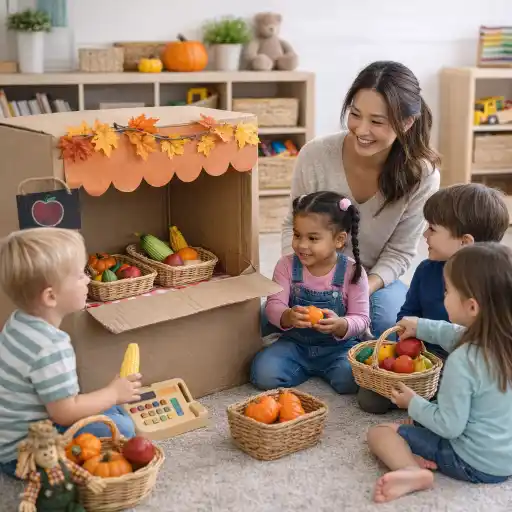
Early math and literacy can emerge naturally from the scenario. Children can count pretend produce, sort leaves by a feature they choose, compare box sizes, or make marks on a list. Signs, menus, maps, order slips, and labels give print a practical purpose. Children’s scribbles, drawings, dictated words, and emerging letter forms are all ways to communicate meaning within play.
Shared pretend play also provides practice with social problem-solving. Children may need to decide who will be the cashier, how to share the baskets, or what to do when the “camp” needs more supplies. Dramatic play can give children opportunities to experiment with roles and perspectives; Community Playthings’ overview of dramatic play discusses its relationship to empathy, emotional regulation, executive function, problem-solving, and creativity.
- Ask open questions such as, “What does this place need next?” or “How could we solve that together?”
- Observe children’s choices and language before deciding which props or challenge to add.
- Use #cardboard as a flexible prop, not as a template that every child must decorate in the same way.
How can educators plan and refresh the play without taking over?
A brief planning cycle can keep the experience intentional and responsive. First, notice what children already do and say. Next, select one or two possible learning intentions—perhaps using descriptive words, counting items, or negotiating roles. Prepare the box and a few adaptable props, then let the children lead the play. Afterward, reflect on what engaged them and what might support the next chapter.
- Observe: Record a specific comment, action, or question rather than making a broad judgment about a child’s ability.
- Plan: Select a small extension that follows the play, such as adding signs after children begin selling pretend pumpkins.
- Join briefly: Offer a word, prop, or open-ended question, then give children room to continue independently.
- Reflect: Note what children explored and decide whether to keep, adapt, or remove materials.
Children may return to an earlier storyline or use the box in an unexpected way. That flexibility is a strength, not a planning failure. A box might become a “bus” or a house after being set up as a market; listen for the ideas that matter to the children and adapt when practical. ChildCareEd’s guide to extending fall dramatic play recommends making gradual changes so a familiar play story can develop over time.
For more structured professional learning, Lesson Planning for Preschoolers Buy Now $24.00 covers lesson-plan components and developmentally appropriate practice. It can support your ability to connect emerging interests with intentional learning goals while keeping plans flexible.
How do you make box-based play safe and inclusive?
Inspect the box and every prop before use. Remove staples, sharp edges, loose tape, and any damaged or contaminated material. Make sure the box is stable and does not create a tip-over, entrapment, or blocked-exit hazard. Avoid placing children inside a box unless the design, supervision, and program policies make that use appropriate and safe. Keep clear walkways and maintain active supervision as children move props and take on roles.
Adapt participation so every child can enter the story in a way that works for them. A child might draw a sign, sort pretend produce, point to a role picture, dictate an order, watch before joining, or help arrange the setting. Use accessible materials, visual cues, familiar home-language words, and varied roles. Invite family knowledge or optional ideas without assuming every family shares the same seasonal traditions or experiences.
- Choose materials that are age-appropriate, clean, durable, and large enough to avoid choking risks for the children using them.
- Keep heavy boxes, unstable structures, and tools requiring close adult control out of children’s reach.
- Offer alternative props or roles when a texture, sound, or activity is uncomfortable for a child.
- State requirements vary - check your state licensing agency and follow your program’s health and safety policies.
Remember, inclusion does not require a complicated setup. Thoughtful choices, adaptable participation, and respectful observation help children feel welcome in the play.
How can you get started with one box this week?
Start with one box, one setting, and a few safe props. Ask children what the box might become, or observe their current play for a clue. Add just enough materials to help the story begin, then resist the urge to keep changing the setup before children have had time to explore. A focused invitation can be more engaging than an elaborate display.
Consider using the purposeful use of recycled classroom materials as a guide: keep items that are safe, useful, and connected to children’s play rather than collecting materials without a clear role. The Fall Box-to-Play Transformation Pack can serve as a practical resource for organizing ideas and preparing a seasonal invitation; adapt any suggestions to your children, space, and policies.
After play, jot down what children did or said and one possible next step. Perhaps the market needs signs, the campsite needs a map, or the leaf crew wants a schedule. For directors, a short team conversation about observations, safety checks, and accessible roles can make the approach consistent across classrooms. If your team wants more support in planning preschool experiences, explore Lesson Planning for Preschoolers Buy Now $24.00 and Spicing Up the Classroom: Learning Centers Buy Now $16.00.
Summary: What can one cardboard box make possible?
One cardboard box can anchor four fall dramatic-play settings—a pumpkin patch, harvest market, campsite, or leaf-raking service—when educators keep materials flexible and follow children’s interests. The strongest transformation is not the most elaborate one; it is the one that invites children to imagine, communicate, make decisions, and cooperate.
Prepare the box safely, offer accessible ways to participate, and use brief observations to decide what happens next. With intentional planning and a light adult touch, a low-cost material can support rich, evolving play. To strengthen your planning skills beyond this activity, consider ChildCareEd’s Lesson Planning for Preschoolers Buy Now $24.00 course.
- Many Colors, One Canvas: MD ECE Conference
- Birth to Five CDA Credential with Portfolio Review
- Pediatric RSV First Aid & CPR/AED
- The Best Promotion is Play
- Building Equity: Inclusionary Practices in Preschool
- Play with Purpose: Supporting Children with Autism
- Creating Engaging and Meaningful Learning Experiences
- Texas Director Credential
- Wellness in Action: Teaching Healthy Habits to Children
- Classroom Tools for Emergent Literacy
- Requisitos Para Ser Maestra Principal En Un Daycare: Lo Que Necesitas Para Empezar
- 10 Ejemplos de Cómo la Cultura Influye en el Desarrollo Infantil
- Proporciones de Cuidado Infantil y Tamaños de Grupo por Edad en Virginia (Guía Rápida para Centros y Hogares)
- Actividades de Otoño Fáciles para Preescolares esta Temporada
- Lista para Guardería en Casa en Texas: Cómo Iniciar una Guardería en el Hogar
- Cómo Ser Maestra de Preescolar en Maryland
- Celebrando la amistad en el cuidado infantil durante el Día de los Mejores Amigos
- Canciones, juegos y preguntas de círculo para niños
- La mejor manera de hacer seguimiento a la capacitación de su equipo de daycare How to Organize Staff Training for Your Child Care Center Cómo organizar la capacitación del personal para su centro de cuidado infantil
- Cómo simplificar la capacitación para sus empleados de daycare
- Why Does Old‑School Play (Blocks, Mud, Cardboard) Still Win?
- How Can You Turn a Superhero Theme Into a Full Week of Preschool Learning Centers?
- School-Age Activities With Everyday Materials: Big Fun on a Small Budget
- How Can Loose Parts Play Turn Everyday Objects Into Powerful Learning Opportunities?
- How Can Teachers Build Learning Centers on a Tight Budget?
- How Can Child Care Providers Design Learning Centers That Support Play and Development?
- How Can Child Care Providers Create Effective Learning Centers in Small Spaces?
- How Can Simple Sorting Activities Build Sustainable Habits in Early Childhood?
- How Can You Choose Recycled Classroom Materials With a Real Purpose for Play?
- How Can One Cardboard Box Become Four Fall Dramatic-Play Settings?
