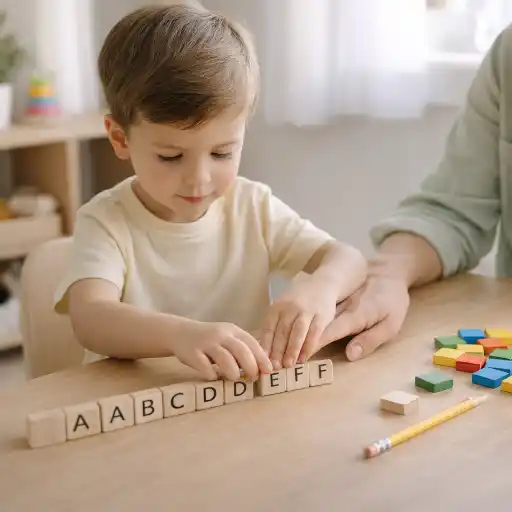
When children can say the alphabet but struggle to place letters in sequence, visual-motor practice offers a purposeful bridge between memory, movement, and print. Pairing a hands-on resource such as Dot to Dot - Alphabets Buy Now $1.49 with intentional observation helps providers make alphabet practice engaging while strengthening letter recognition and coordination; the Assessment of Language and Literacy Skills  Buy Now $24.00 course can further support objective documentation and individualized literacy goals.
Why does alphabet order matter in early childhood?
Alphabet order is more than reciting a familiar song. It is a form of alphabetic knowledge that helps children locate letters, use classroom references, organize information, and connect oral language with written symbols. Children who understand sequence can more readily find a letter on an alphabet strip, compare neighboring letters, and participate in games involving names, labels, and environmental print.
However, memorizing the alphabet song does not guarantee that a child can identify letters out of sequence or arrange them independently. Providers should therefore offer repeated opportunities to see, say, touch, move, and produce letters. Visual-motor activities are especially useful because they ask children to coordinate visual attention with controlled hand movements.
Early literacy learning is strongest when it is embedded in meaningful interaction. Research-informed guidance emphasizes language-rich conversations, print exposure, play, and developmentally appropriate practice rather than isolated drills. A dot-to-dot alphabet activity can be valuable when it is presented as one part of a broader literacy environment that includes books, songs, name writing, dramatic play, and conversation.
- Sequence supports efficient navigation of print.
- Letter practice can reinforce visual discrimination and motor planning.
- Short, playful repetitions reduce pressure and encourage persistence.
How does dot-to-dot practice build visual-motor coordination?
Connecting alphabet dots requires children to locate a visual target, remember what comes next, plan a line, control a writing tool, and monitor the result. This sequence integrates visual discrimination, eye-hand coordination, fine-motor control, and working memory. The completed image also provides immediate feedback, which can make sustained effort feel worthwhile.
The Do-A-Dot Alphabet Worksheet Buy Now $1.49 describes hands-on dot-marker practice across uppercase letters and can be used in literacy centers, letter-of-the-week experiences, morning work, or independent practice. Providers can adapt the resource by offering dot markers, stickers, cotton swabs, crayons, or paintbrushes. Changing the tool preserves the learning goal while accommodating children’s interests and motor abilities.
Begin with a brief demonstration: “We look for the next letter, say its name, and connect carefully.” Avoid emphasizing speed or perfect lines. Instead, narrate strategies such as scanning the page, stabilizing the paper, and checking the alphabet strip. For children who tire easily, complete only a portion of a page or use larger materials.
Remember that visual-motor practice supports alphabet learning; it does not replace explicit language interaction. Say letter names, discuss shapes, and connect selected letters to meaningful words without turning every mark into a test.
How can providers use Dot to Dot - Alphabets intentionally?
A sellable printable resource becomes most effective when the provider has a clear objective and a manageable routine. Select a small group of letters based on children’s current experiences rather than requiring every child to complete all pages. Names, classroom labels, favorite books, and current themes can guide selection.
- Introduce two to four target letters using large models, gestures, and verbal labels.
- Invite children to find the same letters on the activity page.
- Encourage children to say each letter as they connect or dot.
- Pause to ask what comes before or after a target letter.
- Display completed work and revisit the letters in books and classroom print.
For a child beginning to learn sequence, provide an alphabet strip and point to the next letter. For a child who is ready for greater independence, cover portions of the strip or offer mixed letter cards to arrange before beginning the page. Children can also work with a partner: one child identifies the next letter while the other connects the dots, then they switch roles.
Keep sessions brief and positive. A five-minute experience repeated across several days may be more productive than a long worksheet block. Offer choice of color and tool, and invite children to add drawings or dictate a sentence about the revealed image. These extensions connect motor practice to oral language, vocabulary, and print meaning.
How can visual-motor alphabet practice be differentiated?
Children differ in letter knowledge, attention, language background, visual processing, and hand strength. Differentiation does not mean lowering expectations; it means adjusting the pathway so children can participate meaningfully. Observe whether a difficulty comes from sequence knowledge, letter recognition, motor control, or the visual complexity of the page.
- Beginning: use two or three letters, large dots, an alphabet strip, and adult modeling.
- Developing: work with short sequences, encourage verbal rehearsal, and invite children to identify what comes next.
- Extending: remove some visual supports, compare uppercase and lowercase forms, or ask children to locate the letters in a familiar word.
- Access supports: use thicker tools, nonslip mats, high-contrast copies, larger print, adapted grips, or a pointing response.
Children learning more than one language may use different letter names or sound associations. Honor home-language knowledge and communicate with families about familiar names, songs, and print. A child’s successful participation may involve naming a letter in one language, pointing to a match, or explaining a strategy through drawing or gesture.
Supervise markers, stickers, and other small materials according to the children’s ages and program policies. State requirements vary - check your state licensing agency. Most importantly, protect the activity from becoming a performance comparison. Encourage effort, strategy, and curiosity.
How should providers observe and document progress?
Assessment is most useful when it informs the next experience. During visual-motor alphabet practice, record specific behaviors rather than general impressions. For example: “identified A, B, and C independently,” “used alphabet strip to locate D,” “connected dots with controlled movement,” or “needed help stabilizing the paper.” These notes distinguish literacy knowledge from motor access.
The Assessment of Language and Literacy Skills Buy Now $24.00 course focuses on objective observation, documentation, assessment methods, and meaningful learning goals. It can help providers interpret children’s responses without overgeneralizing from one worksheet or confusing a motor challenge with a language delay.
Use multiple contexts to confirm learning:
- Ask children to identify target letters in books or signs.
- Invite them to arrange a small set of letter cards.
- Notice whether they recognize letters in their names.
- Observe whether they can explain what comes before or after a letter.
- Compare independent performance with performance after modeling.
Avoid treating a printable as a formal diagnostic tool. Instead, combine observations, work samples, conversations, and family perspectives. If concerns persist across settings, follow program procedures for consultation and referral. Documentation should describe what was seen, what support was provided, and what opportunity will come next.
What common mistakes can providers avoid?
One common mistake is assuming that alphabet recitation equals alphabet knowledge. A child may sing confidently yet need support identifying letters in random order. Another is presenting all 26 letters at once when a smaller set would allow deeper attention. Overcorrection can also reduce willingness to try, especially when children are still developing pencil or marker control.
Use these practical safeguards:
- Focus on one observable goal at a time.
- Model the process, then gradually reduce prompts.
- Give children time to scan and think before responding.
- Use consistent letter forms and avoid distracting fonts.
- Connect practice to names, books, signs, and meaningful words.
- Celebrate careful strategies rather than speed or neatness.
Another pitfall is allowing worksheets to replace play. Dot-to-dot pages work best alongside magnetic letters, sensory writing, movement games, read-alouds, and dramatic-play print. Providers can invite children to “deliver” letters in a pretend post office, hop through an alphabet path, or build a name with blocks after completing a page. These varied experiences strengthen transfer and keep literacy joyful.
Finally, do not assume every child must hold a marker in the same way or complete the entire page. Adapt the motor demand while preserving the cognitive goal. A child who points, places stickers, or dictates letter names is still engaging in meaningful alphabet learning.
Conclusion: How can visual-motor practice strengthen alphabet order?
Visual-motor practice strengthens alphabet order when children repeatedly coordinate seeing, remembering, saying, and moving through letters in a supportive context. Dot-to-dot activities offer a practical bridge between sequence knowledge and fine-motor action, especially when providers use them briefly, intentionally, and alongside rich oral-language and print experiences.
The most effective approach is responsive: select meaningful letters, provide appropriate supports, observe the process, and use documentation to plan the next step. Pairing the Dot to Dot - Alphabets Buy Now $1.49 resource with professional learning such as Assessment of Language and Literacy Skills Buy Now $24.00 helps providers connect engaging practice with informed instruction. When children are given time to explore, repeat, and succeed, alphabet order becomes less a memorized sequence and more a meaningful tool for navigating print.
Additional ChildCareEd courses to explore
- Science of Reading Foundations in the Pre-K Classroom Buy Now $16.00 - explores alphabet knowledge, print knowledge, phonological awareness, vocabulary, and emergent writing.
- Classroom Tools for Emergent Literacy Buy Now $16.00 - offers practical strategies and materials for language- and literacy-rich classrooms.
- Preschool Assessments & Observations Buy Now $24.00 - supports objective observation and individualized learning experiences.
- Science of Reading Foundations in the Pre-K Classroom
- Birth to Five CDA Credential with Portfolio Review
- Money Matters in Medicine
- CDA Bridge Bundle: Family Child Care without Portfolio Review
- CDA Bridge Bundle: Infant/Toddler without Portfolio Review
- CDA Bridge Bundle: Preschool without Portfolio Review
- Creating Environments that Nurture Growth and Community
- Every Moment Matters: Schedules and Transitions
- Family Child Care: Building, Premises, and Outdoor Safety
- Thanksgiving Booklet Activity
- 💛🧩 ¿Cómo puedo hacer que mi enseñanza sea inclusiva para los niños con autismo?
- Cuáles Son las Señales de Alerta en el Desarrollo Infantil que Todo Educador Debe Conocer?
- Actividades de Motricidad Gruesa que Desarrollan el Equilibrio, la Coordinación y la Fuerza
- 10 Ejemplos de Cómo la Cultura Influye en el Desarrollo Infantil
- Proporciones de Cuidado Infantil y Tamaños de Grupo por Edad en Virginia (Guía Rápida para Centros y Hogares)
- Celebrando la amistad en el cuidado infantil durante el Día de los Mejores Amigos
- Canciones, juegos y preguntas de círculo para niños
- Cómo simplificar la capacitación para sus empleados de daycare
- How Can Clip Cards Prepare Little Hands for Writing?
- Why Is Upper- versus Lowercase Sorting Great for Letter Recognition?
- How Can Child Care Providers Support Early Writing Without Using Worksheets?
- How Can Child Care Providers Help Children Recognize Letters Through Play?
- How Can Clip Cards Build Focus and Fine Motor Skills?
- How Can Play Help Children Distinguish Uppercase and Lowercase Letters?
- How Can Visual-Motor Practice Strengthen Alphabet Order?
- How Do Dot-to-Dot Activities Support Number Order and Pencil Control?
- How Can Hands-On Dot-Marker Activities Build Alphabet Knowledge?
- How Can Holiday Word Games Strengthen Visual Scanning and Spelling?
