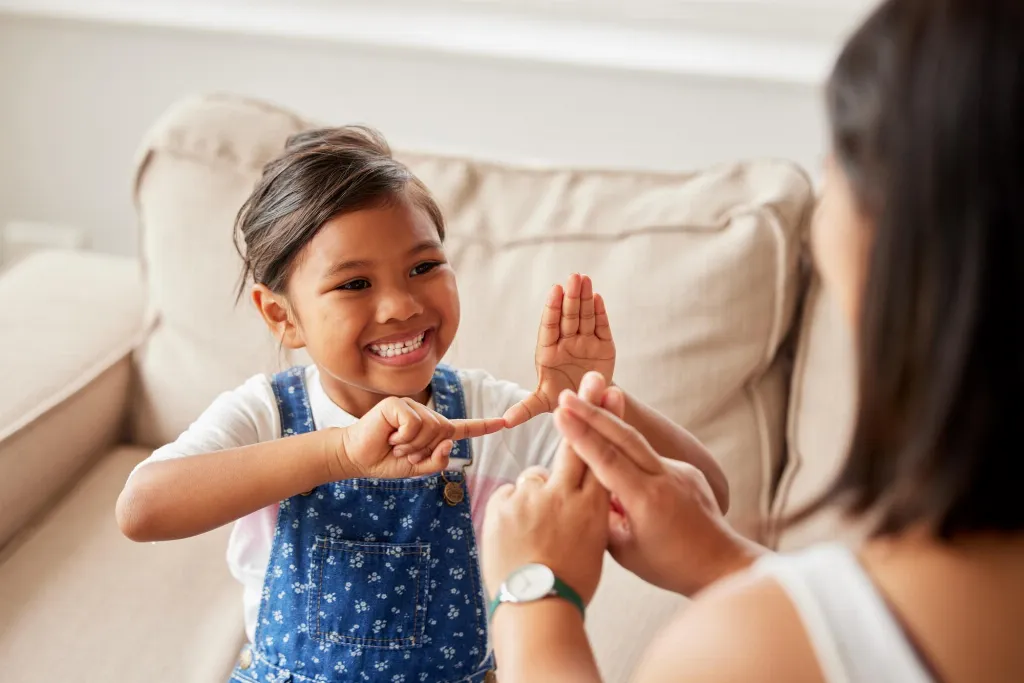
 Teaching sign language through music and play is fun, simple, and powerful. This article gives child care providers clear steps to add signs to songs, games, and daily routines. You will find practical ideas, short games, and ways to include families and every learner. Use a few signs at a time, repeat them, and celebrate attempts — small moves lead to big gains for children’s #communication and confidence.
For background and classroom tips see Babies and Sign Language.
How can songs help children learn sign language?
Songs make signs stick. When you pair a sign with a tune, children remember the motion and the word. Try these steps:
- 🎵 Start small: pick 1–3 signs for the song (example: “eat,” “more,” “all done”).
- Play a short song you already use in circle time. Repeat the same song for several days so children learn the actions — see Circle Time Songs, Games, and Questions for Kids.
- During each key line, show the sign and say the word aloud at the same time (sign + word = best practice).
- 👏 Add movement: stomp, clap, or use fingerplay so signing is multisensory and fun — research-based ideas appear in Sing Move Play Create.
- Repeat and fade: after many repetitions, wait a beat to let children try the sign before you show it.
Quick examples you can use tomorrow:
- 🎶 Alphabet song: fingerspell or show the sign for the letter when you sing it.
- 🎶 Goodbye song: include the sign for “bye” so children use it at transitions.
- 🎶 Snack song: add the sign for “eat,” “more,” or “all done.”
Pairing signs with songs helps #signlanguage become a natural part of your #circle routine and supports early #language learning.
What games and play activities teach signs?
Games make learning fast and joyful. Pick short activities (2–7 minutes) that you can repeat. Below are games with steps you can try.
- 🔢 Elephant (Silent Story Game) — from Sign Language Activities:
- 1) Leader shows a sign silently.
- 2) Children guess or copy the sign.
- 3) Speed up and make it silly to keep energy up.
- 🔎 Mystery Bag Sign:
- 1) Place an object in a bag (toy spoon, cup).
- 2) Sign the word and give 1–2 verbal clues.
- 3) Child reaches in, names the item, and shows the sign.
- 🎲 Sign-and-Say Roll (playful version of Roll & Rhyme):
- 1) Roll a die with picture cards attached.
- 2) Child picks a picture, says the word and shows the sign.
- 3) Class repeats the sign and word.
- 🕺 Sign Charades:
- 1) Child picks a card (action, animal, feeling).
- 2) Child acts silently using sign and motion; classmates guess.
- 3) Celebrate each attempt — all guesses earn a cheer.
- 📚 Sign Story Stones (story starters): use stones or picture cards. Pull 1–3 stones and have children sign and tell a short sentence for each.
For more game ideas and printable activities see What are fun language-learning games preschool teachers can use? and the sign activity list at Baby Signing Activities. Games help toddlers and preschoolers learn signs while they play — it’s learning that feels like play. #games #play
How do I include every child and family and avoid common mistakes?
Inclusion and family partnerships make sign teaching stronger. Use these numbered steps and common-pitfall fixes.
- 🤝 Invite families:
- 1) Share 2–3 signs each week with families (send a picture or quick note).
- 2) Ask families what words they use at home and match signs when possible — see tips in Training Guide for Families from Diverse Language and Cultural Backgrounds.
- 🖼️ Use visuals and props:
- 1) Add picture cards, toys, and real objects so nonverbal children can point or hold.
- 2) Keep a small bin of “sign props” near circle time.
- ✅ Be consistent and brief:
- 1) Teach 1–3 signs for two weeks before adding more.
- 2) Model the sign + word together every time.
- ♿ Offer choices (UDL approach): children can respond by signing, pointing, speaking, or using a picture — see ideas at The Power of International Sign Language.
Common mistakes & fixes
- 🚫 Mistake: Trying too many signs. ✅ Fix: Start with 3 and repeat them in real moments.
- 🚫 Mistake: Not pairing words with signs. ✅ Fix: Always say the word when you sign.
- 🚫 Mistake: Skipping family input. ✅ Fix: Send one simple activity home and ask for family words.
Remember: state requirements vary - check your state licensing agency. When you partner with families and keep signs simple, children gain communication skills and feel seen. #signlanguage #communication
How do I bring sign practice into daily routines and circle time?
Routines are perfect for practice because they repeat. Use this short plan to add signs into your day.
- 🌞 Morning welcome (2 minutes):
- 1) Sing a hello song and include 1 sign (e.g., "hello" or "name").
- 2) Give each child a quick job: sign helper, picture holder, or prop passer.
- 🍽️ Mealtime practice:
- 1) Use signs for “eat,” “more,” and “all done.”
- 2) Wait a beat so children can respond with sign or word.
- 🎶 Song + sign mini-lesson (5 minutes):
- 1) Pick one favorite song — add the week’s “sign of the week.”
- 2) Repeat the song over two days and use the sign in play centers.
- 📚 Centers and transitions:
- 1) Put sign cards in centers (blocks, sensory bin) so children encounter words in many places.
- 2) Use a 2-minute and 30-second warning with a sign for “stop” or “line up.”
For circle time scripts and short songs see Circle Time Songs, Games, and Questions. You can also extend learning with a short course like Language Development in Early Childhood  Buy Now $16.00 for research-based techniques. Celebrating International Day of Sign Languages is a great time to highlight signs and culture (International Day of Sign Languages). For ready-to-use classroom activities and culturally responsive lesson ideas for September 23, see International Day of Sign Languages activities. Similarly, celebrating the International Day of Non-Violence (October 2) offers a natural opportunity to teach peace-related signs and model nonviolent communication through songs, role-play, and classroom routines.
Conclusion
Teaching sign language with songs, games, and play is practical and joyful. Use small steps: choose a few signs, add them to songs, play short games, and invite families to join. Track progress with quick notes and photos. You don’t need to be an expert—consistency and warmth matter most.
Quick FAQ:
- Q1: When should I start? A: You can model signs as early as infancy; children often use signs around 8–12 months. See Babies and Sign Language.
- Q2: Will signing delay speech? A: No—signing + talking supports speech and reduces frustration.
- Q3: How many signs? A: Start with 3–5 signs and use them for a few weeks.
- Q4: Where to learn more? A: See ChildCareEd articles and courses linked above.
You’re building communication, inclusion, and joy—one song and one game at a time. Keep it playful and celebrate every try. #songs #play
- CDA Subject Area 2
- Language Development in Early Childhood
- Diversity, Equity, and Inclusion in Education: For Workforce Solutions
- Recognize, Respond, Respect: Supporting Diverse Learners
- The Best Promotion is Play
- Play, Learn, Grow
- What Makes Me Special: An Overview of Autism and ADHD: For Workforce Solutions
- Building Bridges for Dual Language Learners
- Montessori Cultural Activities: Exploring the World Through Play and Learning
- Supporting Families and Caregivers in Language and Literacy
- Terrible Two's Can Be Terribly Fun!
- The Power of International Sign Language in Early Childhood Education
- A Path to Engaged Learning: Play!
- Boosting Language Through Play
- ¿Cómo puedo usar escenarios de juego de roles de primeros auxilios en mi aula?
- Actividades de Otoño Fáciles para Preescolares esta Temporada
- What are fun language-learning games preschool teachers can use?
- Circle Time Songs, Games, and Questions for Kids
- Canciones, juegos y preguntas de círculo para niños
- Sign Language Activities That Help Children Communicate
- Teaching Sign Language Through Songs, Games, and Play
- How can music and movement help New York preschoolers?
- How Does Singing Together Build Community in the Classroom?
- How can songs and stories encourage toddler language development?
- Can we build early literacy skills through play in high-quality child care?
- How do singing, rhythm, movement and musical play support language, memory and social development in young children?
- How can child care providers build early literacy skills through play?
- What Toddler Activities Encourage Language and Communication?
- How Much Structured Learning Do Preschoolers Really Need?
- How Can Child Care Providers Teach Sharing Without Forcing It?
