What should a 3-year-old actually be learning at preschool—and how can providers offer meaningful growth without turning the day into worksheets? A strong program builds the whole child through play, relationships, routines, and intentional experiences; Emergent Learning & Development Buy Now $35.00 can help educators connect age-appropriate objectives to daily classroom practice. For a broader planning foundation, explore Lesson Planning for Preschoolers  Buy Now $24.00, which supports developmentally appropriate instruction and practical classroom goals.
Why should preschool learning focus on the whole child?
At age three, learning does not occur in isolated subjects. A child develops language while pretending to run a restaurant, mathematical thinking while distributing plates, motor coordination while carrying materials, and social competence while negotiating roles with peers. The most effective preschool curriculum recognizes these connections rather than separating children’s experiences into narrow academic blocks.
Whole-child learning matters because three-year-olds are still developing attention, working memory, impulse control, communication, and independence. They need repeated opportunities to practice skills in emotionally safe, active contexts. Play is not a break from learning; it is one of the primary ways young children investigate ideas, test hypotheses, rehearse social roles, and make meaning.
Providers can use developmental expectations as planning guides, not as pass-or-fail standards. The milestones guide for 3-year-olds emphasizes that children progress at different rates and that observation should lead to responsive support rather than labels.
- Plan for language, cognitive, social-emotional, physical, and creative growth.
- Offer hands-on experiences with multiple ways to participate.
- Build learning into routines, transitions, meals, outdoor play, and centers.
- Adjust expectations based on each child’s strengths, interests, culture, and support needs.
What language and early literacy skills should a 3-year-old develop?
Three-year-olds should experience a rich language environment every day. The goal is not to require conventional reading, but to build the oral language, vocabulary, listening, comprehension, print awareness, and sound-play skills that support later literacy. Children may engage in short conversations, ask questions, describe experiences, retell familiar events, and use increasingly complex sentences.
Intentional conversation is more powerful than simply displaying books or alphabet materials. During shared reading, pause to ask, “What do you notice?” “Why do you think that happened?” or “What might happen next?” Accept gestures, home-language responses, drawings, and dramatic enactments as meaningful communication. Repeat and expand children’s words: if a child says, “Big truck,” respond, “Yes, the enormous blue truck is carrying blocks.”
Provide literacy experiences that are playful and embedded in children’s interests:
- Read aloud daily, revisiting favorite books and inviting children to join repeated phrases.
- Sing songs, recite rhymes, clap syllables, and play with beginning sounds.
- Label meaningful classroom materials and invite children to recognize names and familiar symbols.
- Offer writing tools, clipboards, envelopes, menus, signs, and varied paper for purposeful mark-making.
- Use puppets, props, and dramatic play to support storytelling and sequencing.
For additional professional learning, Building Vocabulary Buy Now $16.00 helps providers intentionally support language growth across content areas.
Which early math, science, and thinking skills belong in preschool?
Early mathematics at age three is concrete, conversational, and connected to play. Children can explore counting small groups, one-to-one correspondence, sorting, comparing, shapes, patterns, position words, and informal measurement. Rather than emphasizing memorized numerals, providers can help children understand quantity and relationships.
Everyday routines offer authentic opportunities: count children present, compare which container holds more, sort laundry by color, arrange sticks from shortest to longest, or notice shapes in the environment. Open-ended questions encourage reasoning: “How could we make sure everyone gets one?” “What do you notice about these two groups?” and “What should come next in your pattern?”
Science begins with curiosity. Three-year-olds can observe changes, make predictions, use simple tools, and describe what they notice. Providers might investigate which objects sink or float, observe a growing plant, track weather, mix colors, examine insects, or explore shadows. The emphasis is on inquiry and vocabulary—not producing a scientifically correct explanation immediately.
Useful experiences include:
- Sorting shells, buttons, blocks, or natural materials by more than one attribute.
- Building structures and revising them when they fall.
- Using puzzles, matching games, and loose parts to strengthen reasoning.
- Recording observations through drawings, dictated language, photographs, or simple charts.
- Integrating number and science language into sensory, cooking, block, and outdoor play.
Providers seeking focused math training may find Math Foundations in Early Childhood Buy Now $16.00 useful for developing hands-on, play-based instruction.
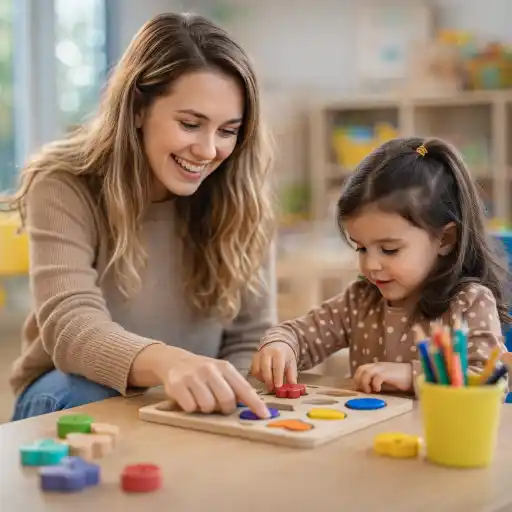
How do social-emotional learning and self-help skills shape preschool readiness?
For many three-year-olds, learning how to participate in a group is as significant as learning colors or numbers. Children are developing identity, empathy, emotional vocabulary, self-regulation, cooperation, and independence. They may play alongside peers, begin sustained cooperative play, practice turn-taking, and seek adult support when conflicts exceed their current abilities.
These skills require explicit teaching and patient repetition. Use visual schedules, predictable routines, songs, puppets, and role-play to demonstrate what happens next and how children can respond. Name emotions without judgment: “You wanted the truck, and you feel disappointed.” Then teach a manageable strategy, such as asking for a turn, choosing another material, breathing with an adult, or moving to a quiet space.
Self-help learning should be embedded in real responsibilities rather than treated as a test. Invite children to wash hands, open containers, put on outerwear, serve small portions, clean spills, return materials, and make limited choices. Allow enough time for effort; independence grows when adults resist doing every task for children.
- Offer two acceptable choices to support autonomy.
- Teach routines with modeling, practice, visuals, and encouragement.
- Use positive guidance instead of shame, threats, or lengthy lectures.
- Celebrate persistence, helping, communication, and repair after conflict.
The course From Tantrums to Triumphs Buy Now $25.00 offers practical strategies for supporting self-regulation and addressing challenging behavior in preschool settings.
How should teachers observe progress and plan meaningful experiences?
Assessment in a three-year-old classroom should be woven into play rather than delivered as a formal test. Observation helps teachers identify what children understand, what motivates them, where they need scaffolding, and which experiences should come next. The ChildCareEd observation resource emphasizes watching with intention, documenting objectively, reflecting, and planning.
A practical cycle is simple:
- Observe: Watch children during routines, centers, outdoor play, and peer interactions.
- Record: Write brief, factual notes that include the date, context, action, language, and support provided.
- Interpret: Consider which developmental domains, interests, strengths, or barriers the observation reveals.
- Plan: Add a small next step, such as new vocabulary, a more complex material, a visual cue, or additional practice.
- Partner: Share strengths and specific examples with families and invite their perspective.
A strong weekly plan might include one read-aloud, a sensory or science investigation, a counting or sorting experience, outdoor movement, process art, dramatic play, and time for uninterrupted child-led exploration. Avoid planning too many objectives at once. A single experience can support several domains, but children do not need an adult-directed lesson for every minute.
Common mistakes include relying on one observation, confusing developmental difference with defiance, rushing to worksheets, and measuring success only by finished products. Providers can avoid these pitfalls by collecting evidence across settings, using strengths-based language, offering repeated practice, and consulting families or specialists when concerns persist.
Conclusion: What should a 3-year-old be learning at preschool?
A three-year-old should be learning how to communicate, connect, investigate, move, create, solve problems, manage feelings with support, participate in routines, and gradually become more independent. Letters, numbers, shapes, science concepts, and pre-writing skills belong in the program—but they are most meaningful when introduced through relationships, play, conversation, movement, and real classroom experiences.
The provider’s role is not to make every child perform on the same schedule. It is to notice each child carefully, design accessible and engaging opportunities, scaffold emerging skills, and collaborate with families. When preschool classrooms balance intentional teaching with joyful exploration, children gain both foundational knowledge and the confidence to keep learning.
For continued professional growth, consider Roadmapping Preschool Curriculum Buy Now $24.00, Assessing through Observation Buy Now $35.00, DAP for Preschool Buy Now $24.00, and Social Foundations and Responsive Classrooms Buy Now $24.00. Together, these resources can help turn developmental knowledge into responsive daily practice.
- 45 Hour Child Growth and Development
- 45 Hour Preschool Methods and Materials
- CDA Bridge Bundle: Preschool
- Pediatric RSV First Aid & CPR/AED
- CDA Bridge Bundle: Family Child Care without Portfolio Review
- CDA Bridge Bundle: Infant/Toddler without Portfolio Review
- CDA Bridge Bundle: Preschool without Portfolio Review
- Texas Director Credential
- 45 hour Growth and Development Birth-age 12 ONLINE
- 45 Hour Pre-School and Child Growth and Development Training to be a Preschool Teacher in a Daycare
- What you need to be a Preschool Teacher in Child Care
- How to become a lead teacher
- Child Development Associate Certification
- CDA Certification en Español: Recursos y Consejos para Educadores Bilingües
- How Old Do You Have to Be to Work at a Daycare?
- Child Care Licensing in Texas: What You Need to Know to Stay Compliant
- Child Care Licensing in Texas: Requirements, Updates, and Compliance Tips
- 😫🧸 ¿Qué hacer cuando un bebé no quiere dormir la siesta en el aula?
- 👶 What Child-to-Staff Ratios and Group Sizes Are Required in North Dakota Childcare? 🏫
- Nevada Child Care Ratios and Group Sizes by Age (Center + Home Quick Guide)
- ¿Cuál es la diferencia entre un certificado CDA y la credencial CDA?
- Celebrando la amistad en el cuidado infantil durante el Día de los Mejores Amigos
- Nevada Child Care Ratios and Group Sizes by Age: Home Daycare Guide
- Washington Child Care Ratios and Group Sizes by Age: Home Daycare Guide
- Does the 90-Hour Child Care Certification Automatically Give You Maryland Credential Level 3?
