A child spots a tiny creature and asks, “Is it a bug?” That question can open the door to careful observation, early classification, and a lasting sense of wonder about nature. Explore Basic Science in Early Childhood Buy Now $25.00 to strengthen your approach to inquiry-based lessons, and consider Creating the Natural Outdoor Classroom  Buy Now $16.00 for practical ideas that make outdoor discovery part of children’s learning.
For a ready-to-use activity, the ChildCareEd printable Tiny Creature Classification: Insect & Spider Sorting and Body Parts Buy Now $0.00 offers creature cards, sorting, body-part counting, and observation prompts for children ages 4–7. The ideas below show how to build a meaningful investigation around children’s questions, whether you use the resource, photographs, toys, or an outdoor encounter.
Why does distinguishing insects from spiders matter?
Young children often use “bug” for any small creature they notice. Rather than correcting them abruptly, educators can treat this everyday label as a starting point for developing scientific language and reasoning. Children learn that living things can be grouped by observable traits, and that a good explanation is based on what they can see—not simply on whether an animal seems creepy or familiar.
Classification is more than sorting cards into piles. It invites children to notice, compare, count, describe, and revise an idea when new evidence appears. These habits support early science and also connect naturally with math, language, drawing, and cooperative discussion. As Head Start’s bug hunt guidance suggests, educators can follow children’s interests while encouraging careful, respectful observation.
A small creature can make a big idea tangible: children can compare leg counts, look for antennae, and discuss whether a creature has wings. When educators make room for children’s predictions and explanations, curiosity becomes active learning rather than a quick naming exercise.
What visible features help children tell them apart?
Begin with a few clear characteristics. Insects have three main body regions—head, thorax, and abdomen—and six legs. Spiders, which are arachnids, have two main body regions and eight legs. Insects have a pair of antennae; spiders do not. Some insects have wings, but wings are not required for an animal to be an insect, so avoid using “has wings” as the deciding rule.
Keep the vocabulary accurate while making it accessible. You might say, “The thorax is the middle part of an insect’s body. Its legs attach there.” For spiders, “The front body section is called the cephalothorax” is useful language, but children can first describe it as the front section where the legs attach. Use photographs, diagrams, models, or the Berkeley lesson on insect and spider body parts to help staff prepare explanations.
- Insect: six legs, three main body regions, and two antennae.
- Spider: eight legs and two main body regions, with no antennae.
- Other small animals may fit neither group; “not an insect or spider” is a useful category.
Use these traits as a simple classroom model, not an invitation to handle every creature. Looking closely at pictures or plastic models can make the features easier to see.
How can you turn a child’s sighting into a science investigation?
Start with the child’s observation rather than launching immediately into a prepared lecture. Pause, come close, and ask what the group already notices. “What do you see?” and “How is it moving?” help children attend to evidence; “What makes you think it might be an insect?” invites them to explain a guess.
Offer magnifiers, picture cards, clipboards, or a simple observation sheet. Children can sketch the creature, count visible legs, mark whether antennae or wings appear, and dictate a sentence about its movement or location. If a feature is hidden, record “not sure” rather than encouraging children to guess. The California Academy of Sciences investigation recommends modeling phrases such as “I notice,” “I wonder,” and “It reminds me of”—language that makes scientific thinking visible.
Questions can guide attention without turning exploration into a quiz:
- “What can we count?”
- “Which parts look similar to the picture?”
- “What would you like to find out next?”
- “What evidence could help us decide?”
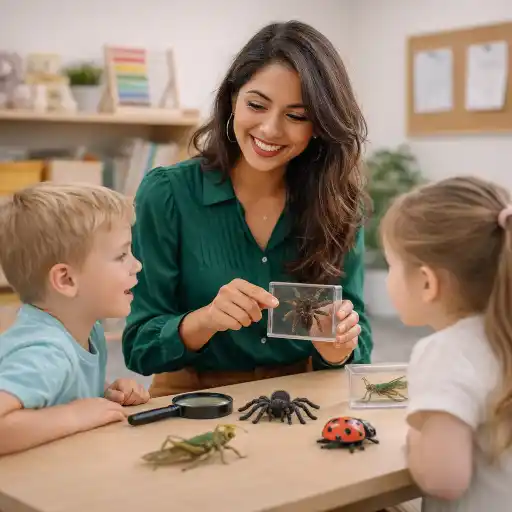
Document children’s words and drawings. Returning to them later lets children compare initial ideas with new observations and see that science involves building explanations over time.
Which hands-on activities make classification meaningful?
Use a short sequence that moves from noticing to comparing, sorting, and explaining. Begin with familiar images—an ant, butterfly, beetle, spider, and a creature that is neither an insect nor a spider. Invite children to sort them using what they can see, then discuss the evidence behind each choice. The Pre-K Pages classification activity similarly encourages children to explain why they placed a creature in a category.
Next, give children a way to represent their thinking. A three-column mat labeled “insect,” “spider,” and “another small animal” can be paired with counters or body-part marks. Children may count legs on a model, draw antennae, or use yarn and loose parts to build a creature. Keep the emphasis on describing observable features rather than making a perfectly realistic craft.
- Compare two pictures and name one similarity and one difference.
- Sort photo or model cards, then invite a child to explain a choice.
- Make a class chart of observed traits and revisit it as new examples appear.
- Pair a nature walk with a drawing or “I noticed…” note after returning indoors.
🕷️ Try a “mystery creature” prompt: describe a creature’s visible features and invite children to predict its group, then reveal an image and check the evidence together.
How can educators keep exploration safe, inclusive, and respectful?
Children can investigate nature without touching or collecting living creatures. Before going outside, choose an appropriate area, establish clear boundaries, check for hazards, and make sure active supervision is in place. Model looking gently, leaving creatures and habitats undisturbed, and returning any animal viewed briefly in a container to the exact place it was found. Follow program procedures and local guidance for outdoor exploration; Field Studies Council spotting suggestions can help children record discoveries through drawing and notes.
Participation should not depend on touching, crouching, or seeing a tiny detail. Offer photographs, models, tools, verbal descriptions, or a partner’s observations. Children who prefer distance can still classify a picture or dictate a question. Consider accessible locations and different ways to hold tools or document discoveries. Respecting comfort levels supports belonging while keeping the inquiry open to everyone.
Use calm, neutral language about insects and spiders. If a child feels uneasy, validate that response and offer a choice: observe from farther away, look at a picture, or join another part of the activity. Avoid promising that an unknown creature is harmless; instead, teach children to alert an adult and not touch unfamiliar animals. State requirements vary—check your state licensing agency and program policies for relevant outdoor supervision and safety expectations.
How can you extend the learning beyond one activity?
Children’s questions may continue long after the outdoor encounter. Bring their drawings and photos into the classroom, add nonfiction books and labeled models to the discovery area, and revisit the class chart as children learn new details. A spider found near a web, for example, can prompt questions about where creatures live and how their body features relate to movement or food—without requiring children to identify a species.
Connect the investigation with other areas of the curriculum. Children can count and compare legs, use descriptive words, create a creature from clay, or dictate a short observation for a classroom display. Invite families to share local names, stories, or experiences with small creatures, while recognizing that knowledge and comfort with nature differ among families. A simple take-home prompt might ask children to draw a tiny creature they noticed, rather than collect one.
Keep the inquiry responsive: follow children’s interests, offer accurate information at the right level, and allow questions to remain open when evidence is limited. A useful companion for planning is ChildCareEd’s Building Early Science Foundations Buy Now $16.00, which focuses on nurturing young children’s curiosity and inquiry through developmentally appropriate experiences.
Conclusion: What should educators remember?
Helping children answer “Insect or spider?” is less about memorizing labels and more about learning to notice evidence. Insects have six legs, three main body regions, and antennae; spiders have eight legs and two main body regions. With photographs, models, outdoor observations, and open-ended questions, educators can help children compare these traits, explain their thinking, and revise ideas when they discover something new.
Keep the experience safe, inclusive, and respectful of living things. Offer children multiple ways to participate, document their observations, and return to their questions through books, art, counting, and classroom conversation. The goal is not to turn every child into an entomologist overnight; it is to nurture careful looking, thoughtful language, and confidence in exploring the natural world.
Explore these English-language ChildCareEd courses for further professional learning:
- Basic Science in Early Childhood Buy Now $25.00 — strategies for meaningful early science experiences.
- Creating the Natural Outdoor Classroom Buy Now $16.00 — planning nature-rich outdoor learning environments.
- Building Early Science Foundations Buy Now $16.00 — supporting inquiry and discovery in young children.
- A Watchful Eye: Supervision in Early Childhood Buy Now $16.00 — strengthening supervision across settings and activities.
- Lesson Planning for Preschoolers Buy Now $24.00 — designing developmentally appropriate preschool learning experiences.
- 45 Hour Child Growth and Development
- CDA Home Visitor Subject Area 3 Part 3 Birth to 5
- 45 Hour Infant and Toddler Methods and Materials
- CDA Bridge Bundle: Family Child Care without Portfolio Review
- CDA Bridge Bundle: Infant/Toddler without Portfolio Review
- CDA Bridge Bundle: Preschool without Portfolio Review
- Emergent Learning & Development
- Texas Director Credential
- CDA Certification en Español: Recursos y Consejos para Educadores Bilingües
- 🔍 ¿Qué ves cuando observas a un niño aprender?
- 💛🧩 ¿Cómo puedo hacer que mi enseñanza sea inclusiva para los niños con autismo?
- 10 Ejemplos de Cómo la Cultura Influye en el Desarrollo Infantil
- Proporciones de Cuidado Infantil y Tamaños de Grupo por Edad en Maryland (Guía Rápida para Centros y Hogares)
- Proporciones de Cuidado Infantil y Tamaños de Grupo por Edad en Nueva Jersey (Guía Rápida para Centros y Hogares)
- Proporciones de Cuidado Infantil y Tamaños de Grupo por Edad en Virginia (Guía Rápida para Centros y Hogares)
- Cómo Celebrar el Día Nacional del Kindergarten
- Cómo Trabajar en el Cuidado Infantil en Carolina del Norte: Requisitos y Pasos
- How can Florida early childhood educators protect children from poisonous plants, bugs, and outdoor hazards?
- How can Oklahoma early childhood educators keep children safe from poisonous plants, spiders, and snakes outdoors?
- How can Florida child care programs keep kids safe from snakes, insects, and harmful plants on the playground?
- Celebrando la amistad en el cuidado infantil durante el Día de los Mejores Amigos
- Canciones, juegos y preguntas de círculo para niños
- Cómo simplificar la capacitación para sus empleados de daycare
- How Can Child Care Providers Teach Summer Safety Lessons Young Children Can Remember?
- How Can Educators Turn Indoor Insect Interest into Outdoor Investigation?
- How Can AI Help Turn Children’s Interests Into Meaningful Classroom Activities?
- How Can Educators Help Young Children Tell Insects from Spiders?
