A well-planned center can turn a corner of your room into an invitation to investigate, collaborate, and grow. Explore practical steps for designing engaging, safe spaces, and consider Spicing Up the Classroom: Learning Centers  Buy Now $16.00 to deepen your planning skills and strengthen your understanding of how centers support instruction and children’s development.
Why do thoughtfully designed learning centers matter?
Learning centers are more than furniture groupings or places to keep toys. They are intentional areas where children can make choices, work with open-ended materials, revisit ideas, and develop understanding through play. The Texas Education Agency describes centers as hands-on areas where children freely choose activities and use varied materials to explore meaningful learning experiences.
When children can access materials and understand how a space works, they have more opportunities to practice independence and responsibility. Collaborative play supports language, negotiation, and problem-solving; sustained exploration encourages curiosity, creativity, and persistence. For educators, center time offers a natural setting to observe children’s ideas and skills, join their play, and decide when a question or added material could extend learning.
The room itself can help communicate routines and possibilities. A calm book nook, a clearly organized block area, or a visible art invitation signals what children can do without requiring constant adult direction. This does not mean every area needs elaborate décor or costly supplies. Clear purpose, accessible materials, and responsive teaching matter more than a picture-perfect display. A thoughtfully prepared environment makes more time for meaningful #play, #learning, and relationships.
How should you plan centers around children and goals?
Start with the children, not a shopping list. Consider their ages, developmental abilities, interests, languages, cultural backgrounds, sensory preferences, mobility, and support needs. A center should offer an appropriate level of challenge while allowing children to participate in different ways. Ask families and staff what themes, materials, or everyday experiences are meaningful to the children.
Before arranging furniture, sketch the room and mark entrances, exits, windows, sinks, storage, and staff sightlines. Then identify the main purpose of each proposed center. A simple planning note can keep decisions intentional:
- What might children explore or practice here—such as storytelling, counting, building, or cooperating?
- How many children can use the area safely and comfortably?
- Which materials are accessible, age-appropriate, and adaptable for different abilities?
- How will staff supervise, observe, and support play?
Most preschool rooms benefit from a balanced selection of centers, but there is no single required number that fits every space. Begin with a manageable set of core areas—perhaps blocks, dramatic play, books, art, math or manipulatives, and science or sensory exploration—and adjust based on children’s needs and room size. The Texas Education Agency notes that centers can vary in name and arrangement; the goal is to integrate meaningful experiences and concepts. State requirements vary - check your state licensing agency.
Which centers and materials invite meaningful exploration?
Choose sturdy, open-ended materials that children can use in more than one way. Blocks can become a home, a bridge, or a map; fabric can become a costume, a picnic blanket, or a structure. These possibilities invite children to make plans, test ideas, and share meanings rather than follow a single prescribed outcome.
- 🏗️ Construction: blocks, ramps, vehicles, cardboard tubes, and loose parts encourage spatial reasoning, early mathematics, and cooperation.
- Dramatic play: pretend food, dolls, dress-up items, menus, and writing tools support storytelling, role-play, and social understanding.
- Literacy and writing: diverse books, puppets, blank paper, clipboards, markers, and story props create authentic reasons to communicate, draw, and write.
- Art and creativity: paint, clay, collage materials, and varied tools offer opportunities for self-expression and experimentation.
- Science, math, and sensory exploration: magnifiers, natural objects, measuring tools, puzzles, water, or play dough can prompt observation, comparison, counting, and discovery.
Reflect children’s families and communities in books, images, languages, and play materials. Keep selections inviting rather than overwhelming; a few purposeful choices can encourage deeper engagement than a crowded shelf. Inspect materials regularly for damage, hygiene needs, and age-related hazards. Consider allergies, choking risks, and supervision requirements when introducing small objects or sensory materials. Provide adaptations—such as larger tools, visual labels, or reachable surfaces—so all children can participate in ways that work for them.
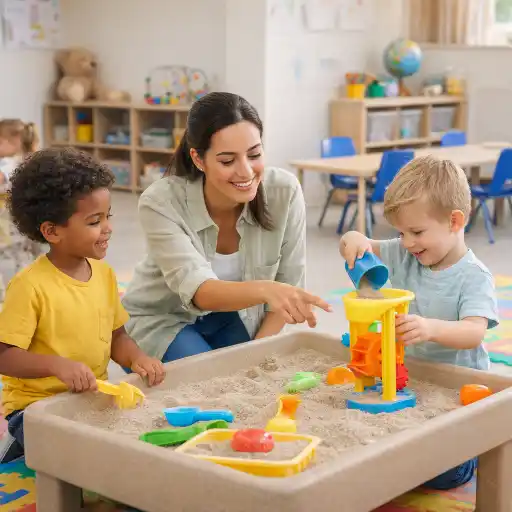
How can you arrange the room for access, safety, and calm?
Define each area with child-sized furniture, low shelves, rugs, or simple visual cues. Put materials where children can see and reach them, and use picture-and-word labels to show where items belong. Clear organization supports independence: children can make choices, gather what they need, and help return materials. Leave wide, uncluttered paths so children and adults can move safely and staff can maintain effective supervision.
Think about sound, movement, and cleanup when placing centers. Blocks and dramatic play are often active and noisy, while books, writing, and puzzles tend to need quieter surroundings. When possible, keep quieter areas away from high-traffic play. Place messy activities near a sink or on a washable floor. Use open layouts and low dividers so spaces feel distinct without creating hidden corners or blocked sightlines.
Teach the routines that make a center usable, rather than expecting children to infer them. Demonstrate how to select a limited number of materials, handle tools, share a space, ask for help, and clean up. Practice when the room is calm, and add photos, icons, or short visual reminders for children who benefit from them. For practical ideas on arranging child-accessible environments, see ChildCareEd’s classroom spaces that support learning and play. Revisit the layout as the group changes; even a small furniture adjustment can improve traffic flow and participation.
How can teachers connect child-led play with learning goals?
Intentional planning and child choice work well together. Begin with a broad learning intention—perhaps comparing quantities, building vocabulary, noticing patterns, or collaborating on a shared plan—then arrange materials that invite children to explore it. Keep the goal in mind without insisting on one product or directing every step.
A small provocation can spark investigation: place toy animals beside blocks and ask, “How could you make a place for them to cross the river?” Add magnifiers to a nature display and invite children to notice what they see. In a pretend restaurant, menus, order pads, and play money make room for writing, counting, and conversation.
During play, use a responsive sequence:
- Observe what children choose, repeat, wonder about, or find challenging.
- Listen for their explanations and record brief notes or quotations.
- Ask an open question, then allow time for children to think and respond.
- Offer a related material or manageable challenge when it can extend their idea.
- Use what you notice to plan future invitations and share meaningful learning with families.
Protect uninterrupted center time when the schedule allows. Longer stretches can help children develop an idea, negotiate roles, and return to a project. Adults remain responsible for active supervision while balancing safety with space for children’s own investigations.
What common setup challenges can you prevent?
Even experienced teams find that a new layout needs adjustment. Instead of treating a challenging center as a sign of failure, look for information: Are materials too difficult to reach? Is the area crowded or noisy? Are expectations unclear? A few targeted changes are often more useful than replacing everything.
- Too many materials: simplify the display and rotate a small selection to renew interest.
- Centers that feel crowded: adjust the number of children who can comfortably participate, or split the materials across nearby areas.
- Conflicts over tools or space: teach turn-taking and problem-solving language, and make duplicates of frequently contested materials when feasible.
- Play that is overly adult-directed: demonstrate safe use and offer an invitation, then give children room to make their own choices.
- Materials that some children cannot access: adapt the height, size, placement, or visual cues, and consult families or specialists when helpful.
Invite colleagues to observe how children move through the room and share what they notice. A quick team check-in can reveal that a shelf blocks a sightline, a popular area needs more space, or a label is not meaningful to the children. Center quality grows through observation and revision—not from getting every choice right on day one.
Conclusion: What are the essentials of a successful center setup?
Setting up preschool learning centers begins with children’s needs and interests, then connects thoughtful goals with accessible materials and a safe, flexible layout. A balanced range of areas—such as construction, dramatic play, literacy, art, math, science, and sensory exploration—offers varied ways to investigate ideas. Clear labels, open pathways, active supervision, and explicitly taught routines help children use the room with growing independence.
Remember that centers should invite exploration rather than dictate a finished product. Observe children’s play, join their conversations, and use what you learn to make small, meaningful adjustments. Start with one change this week: simplify a shelf, add a useful prop, or create a visual cleanup cue. For focused professional learning on the purpose and planning of centers, explore Spicing Up the Classroom: Learning Centers Buy Now $16.00. With responsive planning, your classroom can become a welcoming place where children choose, imagine, and grow together.
Explore related ChildCareEd courses
- Spicing Up the Classroom: Learning Centers Buy Now $16.00 — focuses on planning and using learning centers to support instruction.
- Classroom Setup for Child Care Buy Now $24.00 — explores classroom arrangement and welcoming environments for young children.
- Facilitating Learning in the Preschool Classroom Buy Now $35.00 — addresses intentional planning and child-led learning experiences.
- Building Equity: Inclusionary Practices in Preschool Buy Now $10.00 — offers strategies for inclusive preschool environments.
- Lesson Planning for Preschoolers Buy Now $24.00 — supports developmentally appropriate preschool planning.
- Proporciones de Cuidado Infantil y Tamaños de Grupo por Edad en Nueva Jersey (Guía Rápida para Centros y Hogares)
- How can preschool teachers use simple classroom management techniques that really work?
- Learning Through Creative Daycare Activities
- How can I create engaging learning centers in my classroom?
- How can we use play-based learning in preschool?
- How can I create engaging learning centers for preschoolers?
- Preschool Schedule That Works: When to Plan Centers, Circle Time, and Outdoor Play
- How Can Child Care Providers Create a Preschool Schedule That Supports Learning and Well-Being?
- How Can Recycled Materials Create Engaging Learning Centers?
- Which Low-Cost Printables Make the Biggest Classroom Impact?
- How Can Child Care Providers Create Effective Learning Centers in Small Spaces?
- What Printables Should Every Preschool Classroom Have on Hand?
- Which Printable Activities Belong in Every Preschool Classroom?
- How Can You Link a Preschool Learning Center to a Clear Teaching Goal?
- How Can You Set Up Learning Centers in a Preschool Classroom?
- What Learning Centers Should Every Preschool Classroom Have?
- How Often Should You Rotate Preschool Learning Centers?
- What Should a Daily Preschool Schedule Include?
- What Learning Centers Should Every Preschool Classroom Have?
