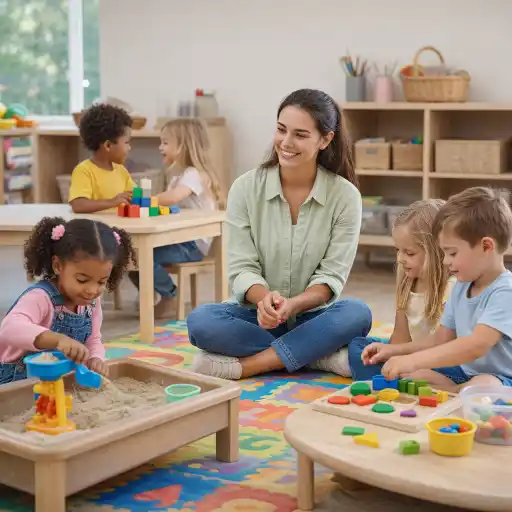
Well-planned learning centers turn the preschool classroom into an active partner in teaching by inviting children to make choices, explore ideas, practice skills, and learn through purposeful play. This guide gives child care providers and directors practical strategies for selecting center goals, arranging the classroom for accessibility and smooth traffic flow, choosing engaging materials, establishing clear routines, maintaining active supervision, and documenting children’s learning. It also offers quick solutions for common challenges such as overcrowded areas, unused materials, difficult transitions, and frequent conflicts. To strengthen staff practice, explore ChildCareEd’s self-paced online course Spicing Up the Classroom: Learning Centers  Buy Now $16.00, which focuses on the purpose, organization, and use of learning centers in early childhood education. Programs can also use the free Center Ideas for Your Preschool Classroom Buy Now $0.00 resource for practical ideas involving sensory play, dramatic play, blocks, literacy, art, math, and other classroom areas. Remember that state requirements vary, so always check with your state licensing agency when selecting materials and arranging learning spaces.
1) What should I plan before I set up centers?
- What 1–2 skills will this center support? (e.g., counting, turn-taking, fine motor)
- Who will use it? (age range, group size, special needs)
- How does it fit into routines and the daily schedule?
Use a drawn map to mark traffic flow and storage. Child-level access and low shelves are essential for independence—see ChildCareEd’s planning ideas in How can I create engaging learning centers in my classroom? and in How to Design Centers That Promote Both Play and Learning. When you plan materials, follow these rules:
- Choose open-ended, multi-use items (blocks, loose parts, fabric).
- Limit choices: 3–7 items per invitation to prevent overwhelm.
- Keep safety and age-appropriateness front and center.
Put rotated collections in labeled tubs so staff can swap quickly. For printable center templates and provocations, explore the ChildCareEd resource pack Spicing Up the Classroom: Learning Centers.
2) How should I arrange space and materials so that children explore and adults support?
- 🔸 Place noisy/active areas (blocks, dramatic play) away from quiet corners (books, puzzles).
- 🔹 Keep sightlines open and pathways wide for supervision and easy transitions.
- 🔸 Use trays and small baskets so children can carry materials and clean up quickly.
Model how one activity works, then step back. Rotate a small provocation weekly (new loose parts, a photo, a question) to renew interest; see concrete rotation ideas in the ChildCareEd centers guide. If space is tight, combine functions: a single table can host STEAM on Monday and art on Tuesday with clear labeling and stored kits.
3) How do I blend play with clear learning goals?
- Choose 1 target per center (e.g., Art → pincer grasp; Math → one-to-one counting).
- Set a short provocation question (e.g., "Can you make three towers of different heights?").
- Use teacher moves: observe, ask one open question, then add a tiny challenge.
Examples and ideas for provocations and materials are available in ChildCareEd’s design article How to Design Centers That Promote Both Play and Learning. Use documentation as part of the learning loop: take quick photos, write a 1-sentence observation, and plan the next provocation. For assessment and observation guidance, see How do we observe with purpose, which explains turning observations into goals and family-friendly notes.
4) How do I manage supervision, safety, and licensing while keeping play rich?
Safety and active supervision are non-negotiable—especially for water, sensory, and outdoor centers. Use these practical
 steps:
- 🩺 Ensure staff certifications (Pediatric First Aid/CPR) and clear emergency plans; ChildCareEd lists training courses that help teams stay current.
- 📋 Define staff zones: who actively supervises which center during each block.
- 🧰 Create quick checklists for setup, supervision, and cleanup so any staff member can run the center consistently.
For water and sensory safety, see ChildCareEd’s guidance in ocean-themed sensory and water play. Always follow your licensing rules—state requirements vary - check your state licensing agency—and document training and supervision routines in your daily logs.
5) What common mistakes should we avoid, and how can families be involved?
Common errors and simple fixes:
- ❌ Overcrowded shelves → ✅ Rotate and simplify; keep 3–7 items per invitation.
- ❌ Over-directed play → ✅ Model once, then give children leadership time (observe more; scaffold less).
- ❌ No clear cleanup plan → ✅ Teach cleanup steps and use child-sized tools; post a short checklist on the shelf.
Family engagement is a multiplier:
- 📣 Send a one-line learning note and a photo each week (e.g., "Luca counted to five at the sensory table!").
- 📦 Invite safe donations (towels, clean props) and ask families for cultural props to boost inclusion—see ChildCareEd’s multicultural resources in Classroom Management is Collaboration! resources.
- 🏫 Offer a short family handout on home extensions (quick games, book suggestions) from the ChildCareEd free packet Spicing Up the Classroom.
FAQ (short):
- Q: How many children per center? A: Aim for 2–4 for preschool; fewer for toddlers.
- Q: How often should materials be rotated? A: Every 1–3 weeks or when interest drops.
- Q: How long should center blocks be? A: 20–40 minutes for preschool; protect at least one long uninterrupted block daily.
Conclusion
Quick checklist to try this week:
- 🔹 Define and label 5–7 centers using low shelves and photo+word labels.
- 🔹 Add one open-ended provocation and attach one measurable learning goal to it.
- 🔹 Assign staff supervision zones and post a 3-step setup/cleanup checklist at each center.
- 🔹 Send one short family note with a photo to connect home and school.
- 🔹 Review safety and licensing items—state requirements vary - check your state licensing agency.
Small, steady changes produce big learning gains. Try one change this week—swap a tub, post a simple prompt, or protect a 30-minute play block—and notice how children use choice to practice skills. For worksheets, templates, and deeper training, explore the ChildCareEd links embedded above and the broader resources at ChildCareEd. Your colleagues will thank you—and so will the #learning #centers and the #children in your #classroom who get more time to #play and grow.
Design for independence, supervision, and calm flow. Aim for 5–7 predictable centers (e.g., art, blocks, sensory, dramatic play, literacy, math/STEAM, quiet). For concrete, developmentally appropriate literacy invitations, materials lists, and small-group routines that build emergent reading and writing skills, see activities that promote literacy skills. Use low shelving and photo+word labels so children find and return materials themselves. ChildCareEd’s room design tips in Designing Classroom Spaces That Support Learning and Play give practical diagrams. Make play purposeful by linking one measurable objective to each center. Steps:
- 45 Hour Child Growth and Development
- Lesson Planning for Preschoolers
- 45 Hour Preschool Methods and Materials
- Creating Engaging and Meaningful Learning Experiences
- Creating Environments that Nurture Growth and Community
- Texas Director Credential
- Wellness in Action: Teaching Healthy Habits to Children
- Montessori Cultural Activities: Exploring the World Through Play and Learning
- Spicing Up the Classroom: Learning Centers
- Tiny Hands, Big Dreams: Fostering Creativity in Preschoolers
- How motor skills shape child development and creative ways educators can foster them.
- Proporciones de Cuidado Infantil y Tamaños de Grupo por Edad en Maryland (Guía Rápida para Centros y Hogares)
- Proporciones de Cuidado Infantil y Tamaños de Grupo por Edad en Nueva Jersey (Guía Rápida para Centros y Hogares)
- Canciones, juegos y preguntas de círculo para niños
- Cómo simplificar la capacitación para sus empleados de daycare
- How can New York providers bridge the summer gap with year-round learning?
- How can I create a daily schedule that meets Michigan's active learning expectations?
- How can we run a 'Movie Day' that balances screen time and learning in child care?
- How can I host a safe, engaging freeze-dance party in my daycare?
- What are safe, engaging non-candy Halloween ideas for daycares?
- How can I create engaging learning centers for preschoolers?
- How does room arrangement shape behavior, engagement, supervision, and learning?
- How Can I Create Engaging Learning Centers for Preschoolers?
- How can preschool teachers explore weather in meaningful, safe, and playful ways?
- Preschool Schedule That Works: When to Plan Centers, Circle Time, and Outdoor Play
- How Can Recycled Materials Create Engaging Learning Centers?
- How Can Themed Activity Bundles Simplify Weekly Planning?
- What Should Providers Put in a Classroom Waiting Basket?
