A learning center becomes more purposeful when you know which skills children can explore there and what progress might look like during play. Use the Simple Daily Lesson Plan Template for Early Childhood Educators Buy Now $1.00 to identify a teaching goal, choose materials that support it, and plan what to observe while children make their own choices. For practical guidance on developing purposeful centers, explore ChildCareEd’s Spicing Up the Classroom: Learning Centers  Buy Now $16.00. Read on for a simple way to connect intentional teaching with the exploration and play already happening in your classroom.
Why connect a center to a teaching goal?
Children learn through active exploration, relationships, repetition, and play. A center gives them time and materials to pursue ideas, while a clear teaching goal helps educators make thoughtful choices about what to offer and what to notice. The goal is not to direct every move or turn play into a test. It is to make the environment intentionally useful while preserving children’s agency.
When a center has a well-defined purpose, staff can make learning visible and communicate it to families and colleagues. For example, a block area can support spatial reasoning and collaboration; a dramatic-play setup can invite storytelling, vocabulary, and negotiation. These experiences often span several developmental domains, so educators should identify a primary focus without overlooking the broader learning happening at the same time.
The Texas Education Agency describes preschool learning centers as hands-on, open-ended areas where children freely engage with varied materials and reinforce concepts through play (Learning Centers in Prekindergarten). NAEYC likewise frames curriculum as meaningful learning experiences that reflect both general knowledge of child development and what educators know about individual children (Developmentally Appropriate Practice: Planning and Implementing an Engaging Curriculum).
- Children get opportunities to make choices and revisit ideas.
- Educators have a practical focus for observing and scaffolding.
- Directors and teams can connect daily experiences with curriculum goals.
How do you choose a goal that is clear and developmentally appropriate?
Start with what you know about the children: their interests, strengths, languages, developmental progress, and questions. A useful goal identifies an observable action rather than a broad intention. “Explore math” is difficult to assess; “compare two towers using taller and shorter” gives teachers something concrete to notice while leaving children freedom in how they build.
Choose one primary goal for a center at a time. Keep it achievable, relevant to the group, and aligned with your curriculum or applicable early learning guidelines. Goals can address language and literacy, mathematics, scientific thinking, physical skills, social-emotional development, or approaches to learning. The Head Start Early Learning Outcomes Framework organizes development across interconnected domains and emphasizes observable indicators, while cautioning that it is not a curriculum or checklist (Interactive Head Start Early Learning Outcomes Framework).
Consider both what children may do independently and what they may do with a thoughtful prompt or accessible material. Adaptations, home-language resources, and multiple ways to participate can make a shared goal reachable for more children. NAEYC’s discussion of planning for individuality in preschool spaces highlights observation and family relationships as important sources for responsive decisions.
- Write the goal as an action: “Children will sort objects by one chosen attribute.”
- Name the evidence you might observe: words, choices, movements, or strategies.
- Offer multiple ways for children to participate and demonstrate understanding.
How can you match materials and center design to the goal?
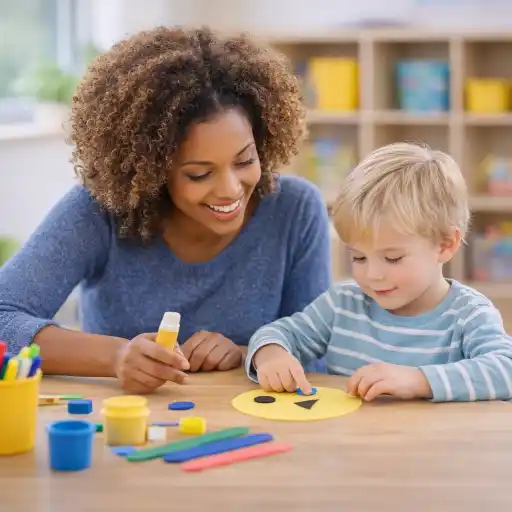
Choose materials that invite children to use the target skill for a meaningful purpose. If your goal is comparing quantity, provide small collections of counters, baskets, and number cards. If you want to encourage descriptive language, offer natural objects, magnifiers, and vocabulary-rich books. Open-ended materials—blocks, fabric, loose parts, art tools, and pretend-play props—can support many interests and approaches without prescribing a single finished product.
Make the layout work for both child independence and adult supervision. Keep commonly used materials within children’s reach, organize them in clearly labeled containers, and maintain safe pathways and adult sight lines. Introduce and model care routines before increasing the amount or complexity of materials. As the Texas Education Agency notes, routines for using, cleaning, and caring for center materials should be explicitly taught; centers can also connect across content areas, such as adding measurement tools to construction play.
Match the size and arrangement of the center to the activity and children’s needs. A quieter literacy nook may benefit from less traffic, while construction needs enough floor space for collaborative building. Ensure that books, visuals, props, and materials reflect children’s cultures, home languages, families, and abilities. State requirements vary - check your state licensing agency, especially when considering specialized equipment or materials with specific safety considerations.
- Use a small, intentional selection of materials to make choices manageable.
- 📚 Pair a center with books, photographs, or vocabulary connected to the goal.
- Make access, cleanup, and supervision part of the design from the beginning.
How can educators support play without taking it over?
Intentional teaching in a center starts with observing. Notice what children choose, repeat, explain, build, or negotiate. Then decide whether to join, narrate, ask a question, model a skill, or simply give uninterrupted time. The adult’s role is to support learning while protecting children’s ownership of the play.
Use open-ended prompts that invite thinking rather than demand a particular answer. In a science area, “What do you notice about these seeds?” encourages observation. In the block area, “How could we make the bridge hold more cars?” offers a manageable challenge. Wait for children to respond, and follow their ideas rather than firing off a series of questions.
Intentional teaching is responsive: educators draw on observation and knowledge of children to select strategies that fit the moment. The Center for Early Childhood Education at Eastern Connecticut State University describes observation and authentic assessment as foundations for planning effective teaching interactions (Intentional Teaching). The goal is not to make every child produce the same result; it is to offer just enough support for exploration to deepen.
- Observe first, then decide whether an adult contribution would be helpful.
- Use comments and open prompts rather than rapid-fire questions.
- Model a tool or strategy when it extends play, not as a required script.
- Leave space for children to combine materials and develop their own ideas.
How do observation and reflection help you refine the goal?
Observation links a teaching goal to what children actually do. Collect brief, factual notes, work samples, child quotations, or photographs according to program policy. Record actions and words before interpreting them. For instance, “Lina placed three small blocks beside the ramp and said, ‘This one goes farther’” offers useful evidence of comparison and prediction without labeling the child’s ability.
Review what you notice: Did children engage with the materials? Did the intended skill emerge naturally? Who participated, and what helped or hindered access? These questions can guide a small adjustment—adding a visual, changing the material arrangement, introducing new vocabulary, or providing more time. Assessment in familiar daily contexts can inform instruction and track progress, as described in the Kansas Inservice Training System resource on embedding assessment into daily activities and routines.
Share concrete examples with families and colleagues, inviting their perspectives where appropriate. Documentation should support learning and planning, not become a collection exercise or a reason to interrupt children’s play. Keep supervision and confidentiality at the forefront, and follow program procedures for photos and records.
- Set one observation question that matches the center’s goal.
- Gather short, authentic evidence over time rather than relying on one moment.
- Use the evidence to decide what to repeat, adapt, or offer next.
What common pitfalls should you avoid when aligning centers and goals?
A center can lose its purpose if the goal is too broad, the materials do not invite the target skill, or the adult’s directions leave little room for child choice. Avoid assigning a separate worksheet or identical product simply to prove that a goal was addressed. Preschool learning centers are most powerful when children can make meaningful decisions, experiment, and sustain play.
Another common pitfall is treating one observation as a complete picture of a child. Children’s participation varies with context, language, relationships, comfort, and access to materials. Look for patterns across time and settings, note the support available, and be alert to assumptions. Also avoid trying to address too many goals in one center at once; a manageable focus makes planning and reflection clearer.
Directors can help by giving staff time to plan together, sharing a simple center-planning template, and encouraging reflective conversation rather than compliance-only paperwork. A useful template includes the goal, materials, likely child actions, adult strategies, safety considerations, and observation question. For further practical learning, explore Spicing Up the Classroom: Learning Centers Buy Now $16.00 or the course Lesson Planning for Preschoolers Buy Now $24.00, which focuses on purposeful, developmentally appropriate lesson planning.
Conclusion: How do you keep the goal clear while keeping play joyful?
Linking a preschool learning center to a clear teaching goal begins with a focused, observable intention grounded in children’s strengths and interests. Choose materials and an arrangement that invite the goal naturally, provide responsive support without taking over play, and observe what children do to inform the next step.
A simple cycle can guide the work: identify a goal, prepare an inviting center, observe children’s exploration, and reflect on what to adjust. The goal gives educators direction; children’s ideas give the experience life. When both are honored, centers become meaningful places for agency, discovery, and development.
Five related ChildCareEd courses:
- Spicing Up the Classroom: Learning Centers Buy Now $16.00
- Lesson Planning for Preschoolers Buy Now $24.00
- Classroom Setup for Child Care Buy Now $24.00
- Emergent Learning & Development Buy Now $24.00
- Assessing through Observation Buy Now $35.00
- CDA Certification en Español: Recursos y Consejos para Educadores Bilingües
- 💛🧩 ¿Cómo puedo hacer que mi enseñanza sea inclusiva para los niños con autismo?
- 😅❌ ¿Cómo Puedo Manejar a un Niño que Dice “¡NO!” a Todo en el Aula?
- Celebrate Together: Fun Activities for Kwanzaa Week
- What are 25 easy fine motor activities I can use in my preschool?
- 10 Ejemplos de Cómo la Cultura Influye en el Desarrollo Infantil
- Proporciones de Cuidado Infantil y Tamaños de Grupo por Edad en Virginia (Guía Rápida para Centros y Hogares)
- Cómo Ser Maestra de Preescolar en Illinois
- Cómo Ser Maestra de Preescolar en Maryland
- Best Daycare Field Trip Ideas in Illinois
- Capacitación CDA gratuita en Illinois
- Celebrando la amistad en el cuidado infantil durante el Día de los Mejores Amigos
- Canciones, juegos y preguntas de círculo para niños
- What Does Quality Documentation Look Like for Step 3 in Bright & Early ND?
- How Can Child Care Providers Build a Strong Preschool Curriculum?
- How Much Structured Learning Do Preschoolers Really Need?
- What Makes a Preschool Curriculum Meaningful, Inclusive, and Effective?
- How Can You Link a Preschool Learning Center to a Clear Teaching Goal?
- How Do You Create Effective Lesson Plans for Preschoolers?
- How Can Low-Cost Preschool Materials Still Meet Your Learning Goals?
