A well-planned preschool day gives children dependable rhythms without squeezing out curiosity, movement, or rest. Explore a practical framework below, and consider Every Moment Matters: Schedules and Transitions  Buy Now $55.00 for a deeper look at planning routines, supporting different temperaments, and making transitions smoother. The course offers practical strategies you can bring back to your classroom and team.
Why does a predictable schedule matter?
A daily schedule is more than a list of activities and clock times. It is part of the learning environment: a reliable sequence helps children understand what comes next, build trust, and participate with greater confidence. When preschoolers know that arrival leads to play, play leads to cleanup, and rest follows lunch, they can spend more attention on relationships and exploration instead of trying to anticipate the day.
Predictability can be especially reassuring during the start of the year, after a break, or when a child is adjusting to a new classroom. It also supports teachers. A shared rhythm helps staff coordinate supervision, prepare materials, and make time for care routines. Yet a schedule should not become a rigid script. Children’s engagement, individual needs, weather, staffing, and special events may call for thoughtful adjustments.
- Use a consistent order of experiences as the day’s anchor.
- Balance child-led play with brief, purposeful teacher-guided experiences.
- Alternate active and quieter periods.
- Plan time for meals, rest, hygiene, cleanup, and transitions—not only instruction.
Think of the schedule as a dependable framework that supports #belonging and learning. A responsive routine says, “You can count on what happens next, and adults will notice what you need.”
What core experiences belong in a preschool day?
A strong preschool schedule offers varied experiences that support physical, cognitive, language, social, and emotional development. The order will depend on the program’s hours and children’s needs, but most days include a warm arrival, extended play or learning centers, group and small-group opportunities, outdoor movement, meals and snacks, rest or quiet time, and a calm departure routine.
Free-choice play deserves meaningful, uninterrupted time. In centers such as blocks, dramatic play, art, books, math, and sensory exploration, children make decisions, test ideas, solve problems, and interact with peers. Teachers can observe, introduce vocabulary, extend thinking, and provide individualized support without taking over the play. Brief group gatherings can welcome the class, share a story or song, and preview the day; small groups allow for focused interaction and hands-on learning.
- Arrival: Greet each child, support belongings and handwashing, and offer calm settling choices.
- Centers and play: Protect a substantial block for child choice, investigation, and teacher observation.
- Group experiences: Include concise, engaging circle or meeting times, stories, music, and discussion.
- Movement: Plan daily outdoor or gross-motor play, with a safe indoor alternative when needed.
- Care routines: Schedule nutritious meals and snacks, toileting, hygiene, rest, and departure.
These elements work best when they are connected rather than treated as isolated lessons. A garden story, for example, can lead to seed exploration at a center and observation outdoors.
How can a schedule balance play, learning, movement, and rest?
Balance is not achieved by giving every activity the same amount of time. It means attending to children’s energy, attention, interests, and developmental needs across the day. A long period of sustained play may be more valuable than several short rotations that repeatedly interrupt children’s ideas. Large-group experiences should be brief and active; many preschool groups participate more comfortably when gatherings are around 10–15 minutes, though the right length depends on the children and activity.
Alternate experiences that require listening or sitting with chances to move, choose, and explore. Outdoor play offers opportunities for gross-motor development, social negotiation, and contact with the natural world. After lunch, a calm transition into rest or quiet choices can help children reset. Children who do not sleep can still benefit from a restful period with books, drawing, puzzles, or other quiet materials, consistent with program policy and individual needs.
A sample full-day rhythm might look like this:
- Arrival, greeting, breakfast, and settling activities
- Brief morning meeting, followed by extended centers and small-group support
- Cleanup, handwashing, snack, and outdoor play
- Lunch, toileting, and a gradual transition to rest
- Nap or quiet choices, followed by afternoon play, inquiry, or movement
- Snack, closing routine, family communication, and departure
Use the sequence as a starting point, not a prescription. Protect opportunities for #play and movement while allowing activities to expand when children are deeply engaged.
How can teachers make transitions and visual schedules work?
Transitions include cleanup, handwashing, toileting, dressing for outdoors, moving between spaces, and waiting for others. They take real time and are also opportunities to practice language, cooperation, sequencing, and self-regulation. When transition time is missing from the written schedule, it does not disappear; it often cuts into play or leaves the whole group feeling rushed.
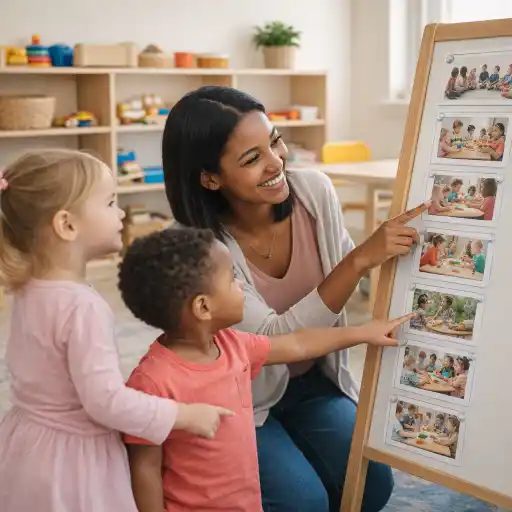
Use predictable cues and give children a chance to prepare. A simple visual schedule with photographs, symbols, or words at children’s eye level makes the order of the day concrete. Review it together, point to the next activity, and show children what changes when plans shift. A visual schedule should be used as a teaching tool, not simply displayed on a wall.
- Give a gentle advance warning and name what is coming next.
- Refer to the visual schedule and use a familiar cue, such as a song, rhyme, or bell.
- Offer manageable classroom jobs, such as returning blocks or carrying a basket.
- Move children in small groups when practical, reducing unnecessary waiting.
- Recognize specific helpful actions: “You checked the picture and put the books away.”
🔔 Invite a classroom helper to move the schedule marker or signal cleanup; shared responsibility can make the shift feel more purposeful. Individual children may need an extra preview, a first-then card, or another communication support.
How should directors adapt schedules and avoid common pitfalls?
There is no single schedule that works for every preschool. Consider the program’s operating hours, arrival patterns, staffing, room layout, meals, outdoor access, children’s ages and abilities, and family context. Build in realistic time for transitions and supervision. Assign staff roles clearly so that welcoming, active supervision, small-group teaching, meal routines, outdoor safety checks, and authorized release are covered throughout the day.
Review the schedule with staff and observe how it works in practice. If cleanup regularly takes longer than planned, or children are losing meaningful play to frequent transitions, revise the plan collaboratively. State requirements vary - check your state licensing agency for applicable rules about meals, rest, outdoor play, ratios, supervision, and posted schedules.
Common pitfalls to watch for include:
- Over-planning: Leave substantial time for sustained play and child interests.
- Long, passive group meetings: Keep gatherings brief, interactive, and developmentally appropriate.
- Unrealistic timing: Include cleanup, toileting, handwashing, clothing, and movement between spaces.
- Rigid adherence to the clock: Preserve the familiar sequence while adjusting timing to children’s needs.
- Visuals without instruction: Show children how to use the schedule and refer to it consistently.
These practical adjustments help make the schedule workable for adults and reassuring for children.
Conclusion: What should a daily preschool schedule include?
A daily preschool schedule should include warm arrival, ample child-led play and learning centers, brief group experiences, small-group learning, daily movement and outdoor opportunities, meals and snacks, rest or quiet time, and thoughtful transitions. Just as important, it should make room for hygiene, cleanup, supervision, and children’s individual needs.
The goal is a steady rhythm—not a day that runs like a stopwatch. Use visual supports, clear staff roles, and observation to make routines understandable and sustainable. When a plan repeatedly feels rushed, treat that as useful information and adjust the schedule rather than expecting children or staff to compensate. A dependable yet flexible day gives preschoolers the security to explore, connect, and grow.
Helpful ChildCareEd courses:
- Every Moment Matters: Schedules and Transitions Buy Now $55.00 — strategies for schedules, routines, and transitions.
- Moving About the Classroom: Effective Transitions for Everyday Buy Now $24.00 — preschool transition strategies that turn in-between moments into learning opportunities.
- Spicing Up the Classroom: Learning Centers Buy Now $16.00 — planning learning centers that support intentional instruction and exploration.
- Lesson Planning for Preschoolers Buy Now $24.00 — developmentally appropriate planning for preschool learning experiences.
- The Best Promotion is Play Buy Now $35.00 — understanding how play supports children’s development and classroom learning.
- 45 Hour Child Growth and Development
- CDA Preschool Credential
- Building Equity: Inclusionary Practices in Preschool
- 45 Hour Preschool Methods and Materials
- 45 hour Growth and Development Birth-age 12 ONLINE
- Bienvenido! Welcoming All Families
- CDA Bridge Bundle: Preschool
- Pediatric RSV First Aid & CPR/AED
- CDA Bridge Bundle: Preschool without Portfolio Review
- Every Moment Matters: Schedules and Transitions
- Preschool Curriculum
- CDA Certification en Español: Recursos y Consejos para Educadores Bilingües
- ¿Cuánto tiempo se tarda en obtener una certificación CDA?
- Capacitación en Salud y Seguridad Preventiva en Línea para Proveedores de Cuidado Infantil
- Lista para Guardería en Casa en California: Cómo Iniciar una Guardería en el Hogar
- Cómo Ser Maestra de Preescolar en Dakota del Norte
- Are online CDA classes a good choice for preschool teachers?
- How should childcare programs clean, sanitize, and disinfect spaces to keep children and staff safe?
- Can traditional child care programs add forest preschool activities without starting a new program?
- Preschool Classroom Schedule: A Full-Day Example from Arrival to Pick-Up
- Preschool Schedule That Works: When to Plan Centers, Circle Time, and Outdoor Play
- Early Childhood Education Certification: What Do You Need—and How Long Will It Take?
- How Can Visual Daily Schedule Cards Turn Classroom Chaos into Calm?
- Which Low-Cost Printables Make the Biggest Classroom Impact?
- What Printables Should Every Preschool Classroom Have on Hand?
- How Can You Create Daily Classroom Schedules That Prevent Behavior Disruptions?
- Which Printable Activities Belong in Every Preschool Classroom?
- How Much Outdoor Play Do Preschoolers Need Each Day?
- What Should a Daily Preschool Schedule Include?
