Planning activities that are engaging without being too easy, too difficult, or inaccessible can feel like a daily balancing act. The Lesson Planning for Preschoolers  Buy Now $24.00 course offers practical guidance on lesson-plan components and developmentally appropriate teaching, helping you strengthen classroom practice and build purposeful activities. Explore the steps below, then consider the course for a deeper, structured learning experience.
Why does developmentally appropriate planning matter?
Developmentally appropriate activities meet children where they are while offering a meaningful next step. They draw on what is generally known about preschool development, what educators know about each child, and the child’s family, language, and community context. This approach is not about making learning easy or reducing expectations; it is about creating access to worthwhile challenges.
Intentional planning can support several areas of development at once. A block-building invitation, for example, may involve spatial reasoning, early mathematics, fine- and gross-motor skills, communication, collaboration, and persistence. The Head Start framework describes interconnected areas such as approaches to learning, social-emotional development, language and literacy, cognition, and physical development. Considering the whole child helps educators create balanced experiences rather than focusing narrowly on academic skills.
Play is a primary context for preschool learning. Open-ended activities let children investigate, make choices, test ideas, and express what they know in different ways. They also give teachers opportunities to notice emerging interests and decide when a question, material, or small adjustment might extend learning.
How can observation help you choose an activity?
Begin by watching and listening before deciding what children should do next. Observe during play, routines, outdoor time, and conversations. Notice what holds a child’s attention, what materials they choose, how they approach a challenge, which peers they seek out, and what they say or communicate nonverbally. These everyday moments provide useful evidence of strengths, interests, skills, and support needs.
Record observations objectively. For example, write, “Ari stacked four blocks, watched the tower fall, and tried again with a wider base,” rather than “Ari is good at building.” Specific notes help you identify the skill being explored and possible next steps.
- What are children choosing repeatedly or talking about?
- What can they already do independently, and where do they seek help?
- How do they respond to new materials, partners, or directions?
- What could provide a manageable next challenge?
Pair classroom observations with family knowledge. Families can share children’s interests, home languages, cultural experiences, and strategies that help them participate. As NAEYC’s discussion of planning for individuality illustrates, observation and reciprocal family relationships help educators design experiences that recognize each child’s assets.
How do you turn observations into clear learning goals?
Translate what you notice into one or two focused goals. A goal should describe something observable and attainable through play or interaction, not a broad intention such as “learn science.” For example: “Children will compare which objects roll down a ramp,” or “Children will practice describing a plan to a peer.” When goals are specific, staff can select useful materials and notice evidence of learning without interrupting play.
Connect goals to relevant developmental domains and your program’s curriculum or early learning standards. The Head Start Early Learning Outcomes Framework is a helpful reference for broad domains and observable developmental progressions, but it is not a curriculum, assessment, or pass-fail checklist. Use frameworks to inform professional judgment, not to label children or assume that every child follows the same timetable.
A practical plan can include:
- Focus: the theme, question, or observed interest.
- Goal: one or two skills or concepts children can explore.
- Materials: accessible, safe, open-ended items.
- Invitation: a brief explanation or demonstration, followed by child exploration.
- Evidence: what you will observe, hear, or collect to inform next steps.
For example, if children are fascinated by rain, set out containers, toy figures, and a sloped tray. A goal might be to explore how water moves and use descriptive words such as “fast,” “slow,” or “full.” Let children’s questions shape the investigation. This keeps planning intentional while leaving room for emergent learning and curiosity.
How can you make one activity engaging for different learners?
Plan for variation from the start. Preschoolers differ in language, sensory preferences, motor skills, experience, attention, and confidence; an activity does not need to look identical for every child to pursue a shared learning goal. Offer multiple ways to enter and participate, such as observing first, working with a partner, using visuals, choosing among materials, or demonstrating understanding through words, gestures, construction, or movement.
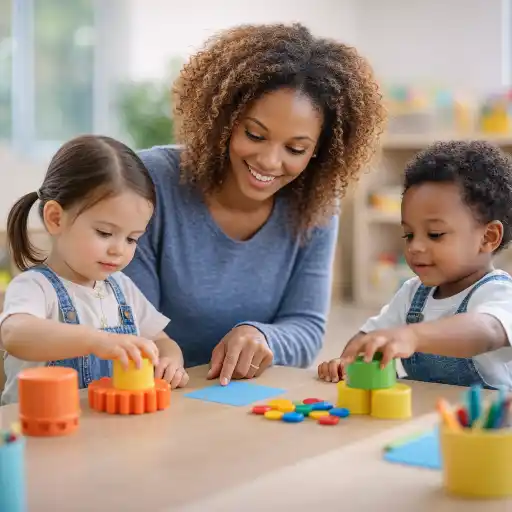
Small adjustments can make a significant difference. Change the space by reducing distractions or offering a quieter area. Change materials by using larger manipulatives, thicker tools, picture cues, or fewer pieces. Adjust the steps by modeling the first action, simplifying directions, allowing wait time, or breaking a task into manageable parts. If a child has an IEP, coordinate with families and relevant specialists, and incorporate applicable goals and supports into natural classroom routines.
- For a pattern activity, offer large blocks, smaller counters, or a chance to point to a pattern made by a peer.
- For a story discussion, welcome spoken responses, home-language words, picture choices, gestures, or puppet retelling.
- For a movement game, provide seated and standing ways to participate and clear visual demonstrations.
- For sensory exploration, offer a choice of tools and an alternative way to observe without touching.
How can you balance play, guidance, and a usable plan?
A developmentally appropriate plan is a guide, not a script. Prepare a purposeful invitation, then allow children time to explore, repeat, change direction, and collaborate. The educator’s role is to observe, ensure safety, and offer support that extends children’s thinking without taking over. Open-ended prompts such as “What do you notice?” or “What else could you try?” encourage children to explain and test ideas.
Think across the day, not just the teacher-led activity. Centers, outdoor play, transitions, meals, and small-group experiences can all provide authentic opportunities for learning. A child practicing turn-taking at snack or using descriptive language while dressing for outdoors is still developing important skills. Planning across routines helps make learning coherent and reduces pressure to fit every objective into a formal lesson.
Keep documentation brief and useful. After an activity, record what children did or said, whether the experience seemed too challenging or too familiar, and what you might change next time. A photo, work sample, or short factual note can help staff reflect together and share meaningful observations with families. Use reflection to decide whether to repeat the activity, add a new material, change group size, or follow an unexpected interest into a longer project.
Common pitfalls are avoidable: planning too many goals, expecting identical products, relying on worksheets instead of active exploration, or directing every step. Keep the purpose clear and the process flexible. State requirements vary - check your state licensing agency.
What practical steps can you use to plan this week?
Use a simple planning cycle to move from noticing children’s interests to shaping the next experience. You do not need an elaborate document for every activity; a concise plan that staff can use and adapt is more valuable than a lengthy plan that does not reflect the children in the room.
- 🔍 Observe children during play and routines; note a repeated interest, question, or emerging skill.
- Choose one or two observable goals that connect to the interest and a relevant developmental domain.
- Prepare safe, flexible materials and consider different ways children can participate.
- Introduce the invitation briefly, then follow children’s ideas and offer open-ended prompts.
- Document a small piece of evidence and reflect on what to repeat, adapt, or explore next.
For example, if children are building “bridges” for toy animals, offer blocks, cardboard, and figures of different sizes. A goal could be to test how structures support weight and to describe a design choice. Children might build independently or together, draw a plan, or explain their structure with gestures. Observe their strategies and use their questions to plan a follow-up investigation.
This cycle supports responsive practice: observe, plan, implement, document, reflect, and revise. It aligns with the NAEYC emphasis on observing, assessing, teaching, and implementing engaging curriculum as connected professional responsibilities. Most importantly, it respects the knowledge preschoolers demonstrate through curiosity, relationships, and play.
Conclusion: What makes an activity developmentally appropriate?
Planning developmentally appropriate activities for preschoolers means combining knowledge of child development with close attention to individual strengths, interests, and contexts. Start with observation, choose a small number of meaningful goals, provide flexible and inclusive ways to participate, and use play as a central learning pathway. Then document what children show you and adapt the next step accordingly.
When educators treat plans as responsive guides rather than fixed scripts, children have room to make choices, persist through manageable challenges, and learn with peers. Families and colleagues add valuable insight to this process. Consistent, thoughtful planning can make the classroom more engaging and help every child experience belonging and growth.
For a more structured exploration of preschool lesson-plan components and developmentally appropriate teaching, consider ChildCareEd’s Lesson Planning for Preschoolers Buy Now $24.00 course. Check state and program requirements when determining whether training hours meet your needs.
Further ChildCareEd courses
- Lesson Planning for Preschoolers
- Balancing Physically Active Play in Child Care
- 45 Hour Preschool Methods and Materials
- CDA Infants/Toddlers: Lesson Planning Made Easy
- Pediatric RSV First Aid & CPR/AED
- Inclusive Lessons for Preschoolers
- CDA Bridge Bundle: Preschool without Portfolio Review
- 45-Hour Infant and Toddler Curriculum
- Texas Director Credential
- Balancing Active Play in Child Care
- Labor Day Activities
- Juneteenth History and Activities
- 🎉STEM-sational Fun: How Can You Spark Preschoolers’ Curiosity with Engaging STEM Activities? 🔬🧪🔢
- How to Write an Early Childhood Lesson Plan Step by Step
- Early Childhood Lesson Plan Examples for Toddlers and Preschoolers
- What are age-appropriate learning activities for infants, toddlers & preschoolers in Michigan?
- What age-appropriate learning activities should we use for infants, toddlers & preschoolers in New York?
- Celebrando la amistad en el cuidado infantil durante el Día de los Mejores Amigos
- Weekly Lesson Plans for Infants, Toddlers, and Preschoolers
- How can we teach community and country to young children in simple, respectful ways?
- Hello, Fall! Cozy Activities to Help Babies Explore the Season
- Can You Build a Leaf Bridge? Fall STEM Challenges for Pre-K
- How Can Child Care Providers Strengthen Fine Motor Development Through Play and Daily Routines?
- How Much Structured Learning Do Preschoolers Really Need?
- How Can Themed Activity Bundles Simplify Weekly Planning?
- How Do Mazes Strengthen Pencil Control and Problem-Solving in Preschool?
- What Should a Useful Early Childhood Lesson Plan Include?
- How Can Spring-Themed Pencil-Control Activities Support Preschoolers’ Pre-Writing Skills?
- How Can You Plan Developmentally Appropriate Activities for Preschoolers?
- How Do You Create Effective Lesson Plans for Preschoolers?
