Young children can practice setting goals without turning childhood into a performance contest. By connecting goals to play, personal interests, and everyday routines, providers can nurture agency and persistence while respecting each child’s pace; Observations and Goal Setting in Childcare  Buy Now $24.00 offers a focused next step for strengthening the observation and planning skills behind this work. The strategies below show how to make goal setting simple, inclusive, and encouraging.
Why introduce goals through everyday experiences?
For young children, a goal is most meaningful when it grows from something they want to try: building a taller tower, learning a new song, putting on a coat, or joining a game. These small aims give children a reason to plan, act, and notice what happens. The point is not to demand adult-like discipline; it is to give children supported opportunities to make choices, test ideas, and experience progress.
That distinction matters. If educators focus only on whether a child “succeeds,” goal setting can become pressure or a comparison between peers. A developmentally appropriate approach values effort, curiosity, flexibility, and the relationships that help children learn. NAEYC’s developmentally appropriate teaching guidance emphasizes agency, play, individual differences, and meaningful goals within responsive learning experiences.
Simple goals can support emerging confidence, communication, problem-solving, and persistence. They also help providers notice children’s strengths and interests. As ChildCareEd’s guidance on goal-setting with preschoolers suggests, visuals, small steps, modeling, and celebration can make the process concrete and enjoyable. A child who does not reach a goal on the first attempt has not failed; the goal or support may simply need adjustment.
What makes a goal appropriate for a young child?
Appropriate goals are concrete, personally meaningful, achievable with support, and close enough in time for children to see what they are working toward. A broad adult target such as “be more responsible” is hard for a preschooler to understand. Translate it into an action children can see and practice, such as “I will put my cup in the bin after snack.” When possible, start with the child’s own idea rather than selecting a goal solely because it suits the adult’s schedule.
Match the goal to the child’s developmental profile, interests, language, culture, and current abilities—not only their age. A child might communicate a goal through words, a drawing, a gesture, a picture choice, or an assistive communication device. NAEYC’s DAP framework calls on educators to build on children’s assets and provide varied ways to participate and express learning. Penn State Better Kid Care similarly notes that effective DAP combines knowledge of child development, individual children, and their social and cultural context.
- Keep the scope modest: a daily or weekly practice is often more understandable than a distant outcome.
- Use observable actions: “try asking a friend for a turn” is clearer than “be better at sharing.”
- Offer choice: “Would you like to practice zipping your coat or putting on your boots?”
- Accept revisions: interests and circumstances change, and changing a goal can be thoughtful problem-solving.
For infants and very young toddlers, the adult’s role is primarily to notice interests, offer safe opportunities to explore, and narrate actions. Goal-setting language is more suitable when children can participate in simple choices and understand a short, familiar plan.
How can providers help children choose and plan a goal?
Start by observing before proposing a target. Notice what a child returns to, what captures their attention, and what they say or show they want to do. Ask open-ended questions such as, “What would you like to try?” or “What do you want to make next?” If a child is unsure, offer two or three meaningful options. Keep the child’s ownership central: the educator supports the process but does not turn the child’s wish into an adult assignment.
Next, help the child shape the idea into a short plan. For example, “I want to make a really tall block tower” could become “First, I’ll use the wide blocks at the bottom. Then I’ll add smaller blocks.” The plan need not use formal SMART terminology. Young children benefit more from a clear, visible next step than from an abstract lecture about goals.
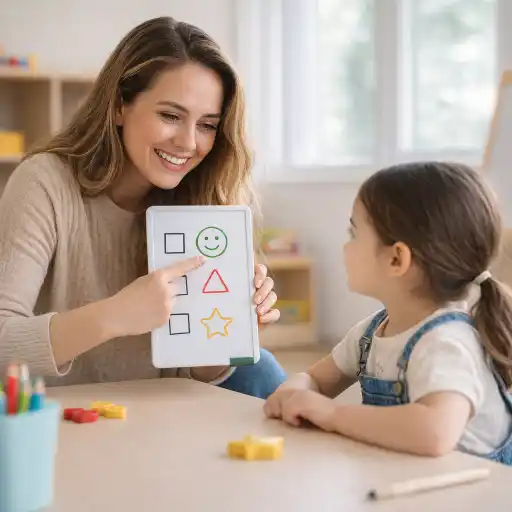
Visual tools can make plans accessible and engaging. A child may draw the goal, choose a photograph, place a symbol on a board, or add a mark to a simple progress chart. Keep tracking low-pressure: visuals should help children remember and reflect, not publicly rank them or determine who earns approval.
- Invite the child to name or show what they hope to do.
- Agree on one small action to try and when to try it.
- Gather materials or arrange the space so the child can begin.
- Check in with a simple prompt: “What did you try? What might you do next?”
- Adjust the steps or supports if the plan proves too easy, too difficult, or no longer interesting.
Play is an especially natural setting for this process. Planning a pretend picnic, building a bridge, or learning a movement game lets children practice goal-directed thinking while remaining active, social, and joyful.
How can play and routines make goal setting practical?
Goal setting does not need a separate lesson or worksheet. It can be woven into play and familiar classroom routines, where children can see the purpose and practice repeatedly. A goal to “help care for our classroom” might involve returning one set of materials to its labeled shelf. A child interested in gardening might aim to water the class plant with support. Small goals linked to real activities help connect intention with action.
Use brief conversations before, during, and after the experience. Before play, ask, “What are you hoping to build?” During the activity, notice strategies: “You tried a wider block when the tower wobbled.” Afterwards, invite reflection: “What helped your tower stay up?” Avoid taking over the task; offer just enough guidance for the child to keep thinking and acting.
Stories and dramatic play can make the process memorable. Read a book about a character learning or persisting, then wonder together about the character’s plan and what changed along the way. Puppets can act out a small challenge and brainstorm possible next steps. Group goals can also build belonging—for example, working together to create a pretend market—but ensure each child has a genuine role and that no child is held responsible for the group’s outcome.
- Use predictable check-ins at arrival, transitions, or closing circle.
- Make simple picture cards for “my idea,” “my next step,” and “I tried.”
- Celebrate process: “You asked for help and tried another way.”
- Let children revisit the same project across days instead of rushing to a finished product.
- 🌱 Treat a pause, change of plan, or request for help as useful information—not a reason for shame.
This approach reflects the value of #play and flexible, child-led learning described in NAEYC’s guidance. It also makes goal practice easier to adapt across ages, abilities, and interests.
How can educators support inclusion and partner with families?
Children should be able to pursue and demonstrate progress in different ways. Some may say a goal aloud; others may point to a symbol, use home-language words, draw, demonstrate, or communicate with a device. Offer materials and choices that remove barriers, and provide additional time, modeling, or a quieter space when useful. A shared goal does not require identical participation or a single “right” route to success.
Pay attention to whose goals are being heard. Children’s interests and ideas may reflect their family experiences, languages, and cultures. Invite family insight with respectful, optional questions such as, “What has your child been excited to practice lately?” Avoid assuming that every family has access to the same activities, resources, or schedule. The goal should be meaningful within the child’s context, not dependent on purchases or experiences outside the program.
Family partnership can help connect practice across settings, but it should remain collaborative rather than prescriptive. Share a brief update about what the child chose and what support helped. Ask whether the family would like to continue the idea at home; do not make participation a requirement. ChildCareEd’s article on supporting children’s goals and shared interests offers further examples of choice, self-expression, and family connection.
- Keep progress records private, factual, and focused on learning—not labels.
- Never require public sharing of personal wishes or family plans.
- Offer multiple communication modes and recognize home languages as strengths.
- Coordinate with families and relevant specialists when a child has an individualized support plan.
When a goal relates to documentation, photographs, or individualized planning, follow program policies and applicable requirements; state requirements vary - check your state licensing agency.
How can providers encourage progress without creating pressure?
Children need encouragement that directs attention to what they did, not just whether they finished. Specific feedback helps them notice strategies and effort: “You held the zipper at the bottom and tried again,” or “You waited, then asked your friend for a turn.” This is more informative than broad praise alone and supports a view of learning as something that develops through practice.
Keep celebration proportionate and inclusive. A smile, a brief acknowledgment, a child’s own reflection, or a chance to share a work sample can be enough. Avoid turning every goal into a sticker contest or offering rewards that make children dependent on external approval. Recognition should communicate that the child’s effort and ideas matter—not that adult praise is the purpose of learning.
When progress stalls, respond with curiosity. Is the goal too broad? Does the child need more time, different materials, a smaller step, a peer partner, or a different way to communicate? Perhaps the child’s interest has shifted. These are opportunities to adapt, not evidence that a child lacks motivation. Educators can model this flexibility by sharing their own small plans and explaining how they revise them when something does not work.
Use brief, objective observations to guide next steps. For example, note what the child tried, what support was offered, and what happened. Avoid judging character (“lazy” or “not trying”); describe actions and context. The course Tracking Progress, Shaping Futures: Observation & Assessment Skills Buy Now $55.00 offers additional professional learning on observing children and using information to inform individualized goals.
Conclusion: What should goal setting look like for young children?
Developmentally appropriate goal setting is a gentle, practical process grounded in children’s interests, play, relationships, and individual strengths. Goals should be small enough to understand, flexible enough to revise, and supported by adults who help children notice effort and progress. The purpose is not early performance management; it is to nurture agency, persistence, communication, and confidence through authentic experiences.
Providers can begin simply: observe what a child cares about, invite them to choose one achievable next step, make that step visible, and reflect together without judgment. Adapt materials and communication so each child can participate, and invite families into the conversation when it is helpful and welcome. A goal that changes or takes longer can still offer valuable learning.
When educators keep choice and well-being at the center, goal setting becomes part of a supportive classroom culture rather than another demand. Small attempts—asking for help, trying a new strategy, or returning to a project tomorrow—are meaningful signs of growth. The key question is not whether every child reaches the same endpoint, but whether each child has a responsive opportunity to explore, try, and develop at their own pace.
Additional English-language courses to explore:
- DAP for Preschool Buy Now $35.00 — connects preschool development with developmentally appropriate classroom practice.
- Inclusive Lessons for Preschoolers Buy Now $16.00 — focuses on adapting activities so all children can participate.
- From Tantrums to Triumphs: Equipping Preschoolers with Self-Regulation Skills Buy Now $25.00 — explores classroom strategies for supporting self-regulation and confidence.
- Recognize, Respond, Respect: Supporting Diverse Learners
- CDA Home Visitor Subject Area 3 Part 3 Birth to 5
- CDA Home Visitor Subject Area 2 Part 3 Birth to 5
- Tracking Progress, Shaping Futures: Observation & Assessment Skills
- Children at the Wheel: Emergent Curriculum
- Pediatric RSV First Aid & CPR/AED
- CDA Bridge Bundle: Family Child Care without Portfolio Review
- CDA Bridge Bundle: Infant/Toddler without Portfolio Review
- CDA Bridge Bundle: Preschool without Portfolio Review
- Creating Engaging and Meaningful Learning Experiences
- CDA Certification en Español: Recursos y Consejos para Educadores Bilingües
- 🔍 ¿Qué ves cuando observas a un niño aprender?
- 😅❌ ¿Cómo Puedo Manejar a un Niño que Dice “¡NO!” a Todo en el Aula?
- ❄️ ¿Qué actividades al aire libre funcionan bien para los niños de Illinois en cada estación? 🌷🍂
- Regulaciones de Licenciamiento de Cuidado Infantil en California para Centros y Hogares de Cuidado Infantil Familiar
- Cómo Celebrar el Día Nacional del Kindergarten
- Lista para Guardería en Casa en Illinois: Cómo Iniciar una Guardería en el Hogar
- Consejos de Supervisión Activa para Salones de Preescolar y el Juego al Aire Libre
- Las Mejores Ideas de Excursiones para Guarderías en Texas
- Canciones, juegos y preguntas de círculo para niños
- Building a Better Head Start Lesson Plan: 7 Things Every Teacher Should Include
- Social Studies Activities for Toddlers: Start With Home, Helpers, and Their Little World
- How Can Child Care Providers Set Clear Classroom Rules and Expectations?
- How Can Meaningful Juneteenth Vocabulary Support Early Writers?
- How Can You Turn a Classroom Observation into Tomorrow’s Lesson Plan?
- What Should Child Care Providers Prioritize When Preschool Readiness Goals Compete for Time?
- How Can You Check Whether an AI-Written Learning Objective Is Measurable?
- Teaching Syllables Through Play: What Should Preschoolers Notice?
- What Should Teachers Consider When a Classroom Activity Is Too Easy or Too Difficult?
- What Are Developmentally Appropriate Ways to Introduce Goal Setting to Young Children?
