A strong lesson plan gives educators direction without turning the classroom into a script. If you want a practical foundation for connecting goals, materials, activities, and reflection, explore Curriculum Planning  Buy Now $24.00; the course can strengthen your understanding of developmentally appropriate lesson planning and support relevant professional learning.
For an immediately usable tool, pair that training with the Simple Daily Lesson Plan Template for Early Childhood Educators Buy Now $0.00. Together, they can help your team plan more consistently, prepare materials efficiently, and document children’s learning with greater confidence.
Why does a useful lesson plan matter?
Lesson planning is not paperwork for its own sake. A thoughtful plan helps educators translate knowledge of child development into intentional experiences that are playful, responsive, and connected to meaningful goals. It also gives a teaching team a shared language for discussing what children are learning and what support they may need next.
Good planning benefits children and adults simultaneously. Children experience predictable rhythms, purposeful invitations, and opportunities to make choices. Educators gain a framework that reduces last-minute decisions while preserving the flexibility essential in early childhood settings. Directors can also review plans to identify strengths, provide coaching, and support consistency across classrooms.
Research-informed guidance emphasizes that curriculum should align with learning outcomes, respond to children’s interests and families, and remain developmentally appropriate. The ChildCareEd resource How to Write an Early Childhood Lesson Plan Step by Step similarly recommends short, clear plans with goals, materials, steps, questions, and observation notes.
What essential information belongs at the top?
Begin with context that allows another educator to understand the plan quickly. Include the date, age group, classroom or group, theme or focus, and any relevant routines. A theme can provide cohesion, but it should support learning rather than dictate every experience.
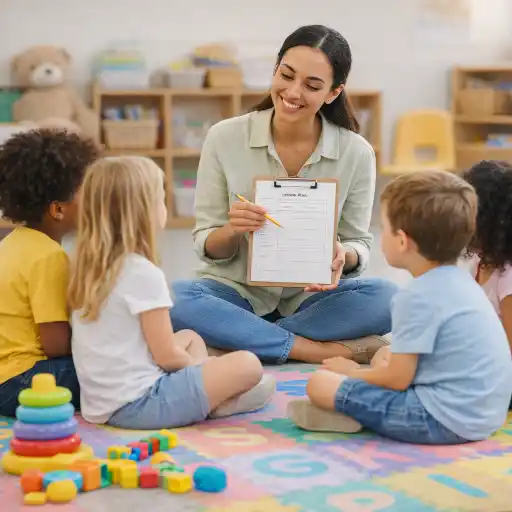 The most important element is the learning objective. Select one or two observable goals instead of listing every possible developmental benefit. “Children will explore colors” is broad; “Children will name or match two colors during open-ended painting” gives educators something specific to notice.
- Theme or focus: A concise phrase such as “Seeds,” “Friendship,” or “Weather.”
- Learning goal: One or two measurable, age-appropriate skills.
- Developmental domains: Language, cognition, social-emotional development, physical development, or creative expression.
- Connections: Relevant early learning standards, curriculum goals, or previous observations.
- Time and grouping: Estimated duration and whether the experience is individual, small-group, or whole-group.
Starting with the skill—not the craft—keeps the plan purposeful. A collage, song, sensory activity, or story is a method; the objective explains why that method is useful.
How should materials and procedures be described?
Materials should be specific enough for efficient preparation but open-ended enough to support children’s ideas. List quantities when necessary, note where items are stored, and identify safety or accessibility considerations. A prepared materials basket can save time and help substitute staff implement the experience confidently.
The procedure should describe a flexible sequence rather than a rigid script. A simple structure works well:
- Invitation: Introduce an object, question, book, song, or demonstration that sparks curiosity.
- Exploration: Give children time to manipulate materials, talk, move, create, and test ideas.
- Teaching interactions: Model vocabulary, offer prompts, and scaffold without taking over.
- Closure: Invite children to share, revisit the goal, and transition smoothly.
Include estimated timing, but treat it as a guide. Toddlers may need ten to fifteen minutes for a focused activity, while preschoolers may sustain engagement longer when the experience is genuinely interesting. Repetition is valuable; children often deepen learning when a favorite activity returns with a small variation.
Use the template to record open-ended prompts such as “What do you notice?” “How could we try another way?” or “What makes these objects alike?” Avoid planning so many steps that children have little room for agency.
How can a plan remain developmentally appropriate and inclusive?
Developmentally appropriate planning begins with observation. Notice what children already do, what they attempt repeatedly, how they communicate, and what interests them. Then design a next step that is challenging but attainable. Age is relevant, but individual development, culture, language, sensory preferences, and access needs matter just as much.
One experience can be layered for different learners. For example, a seed investigation might include a sealed sensory bag for infants, scooping and counting for toddlers, and planting, predicting, and documenting growth for preschoolers.
- Offer materials in different sizes, textures, and levels of complexity.
- Use photographs, gestures, objects, songs, and home-language vocabulary.
- Provide visual schedules, quieter participation areas, or adapted tools when helpful.
- Allow children to participate through talking, pointing, moving, creating, or observing.
- Plan extensions for children ready to compare, explain, predict, or lead.
🤝 Partner with families and specialists when individualized supports are needed. Describe children’s strengths and the conditions that help them participate rather than framing differences as deficits. State requirements vary - check your state licensing agency when documentation, standards, or individualized planning are part of compliance.
Educators seeking additional support may explore Inclusive Lessons for Preschoolers Buy Now $16.00, which focuses on adapting lesson materials, equipment, and experiences for diverse learners.
What should assessment and reflection look like?
Assessment in early childhood is an ongoing process of observing, documenting, interpreting, and responding. It should be closely connected to the objective. If the goal is turn-taking, watch how children request materials, wait, respond to peers, and accept support. If the goal is counting, notice whether children coordinate number words with objects.
Keep documentation manageable. A short note, photograph, work sample, or checklist can provide useful evidence when it is specific. Record what the child did, what support was offered, and what might come next.
- Observation: What did children say, do, repeat, or avoid?
- Evidence: What demonstrates progress toward the goal?
- Response: What should be repeated, simplified, extended, or changed?
- Communication: What brief, strengths-based insight could be shared with families?
Reflection should happen soon after the experience, while details are fresh. Ask: Did the materials invite the intended learning? Were children actively engaged? Did the timing and grouping work? Which children need another entry point? What unexpected interest could shape tomorrow’s plan?
Common mistakes include overplanning, choosing too many objectives, using one teaching style, and skipping observation. A one-page plan with clear priorities is usually more useful than a long document that staff cannot realistically consult during a busy day.
How can directors make lesson planning sustainable for teams?
Consistency improves when directors create systems rather than simply asking educators to “plan better.” Provide a shared template, protected planning time, accessible materials, and examples of strong objectives and observations. Review plans as coaching documents, not merely compliance paperwork.
A practical weekly system might include:
- Choose one or two priority goals based on observations and curriculum expectations.
- Prepare a materials basket and confirm safety or accessibility needs.
- Offer the experience repeatedly with small adjustments.
- Invite staff to record one concise observation per day.
- Use a brief team reflection to identify next steps.
Professional learning can deepen this process. Lesson Planning for Preschoolers Buy Now $24.00 focuses on identifying lesson-plan components and applying developmentally appropriate practices. For infant and toddler teams, Meaningful Lesson Planning for Infants/Toddlers Buy Now $24.00 addresses individualized planning and age-appropriate activity ideas. Teams interested in child-led inquiry can consider Children at the Wheel ONLINE Buy Now $24.00.
Conclusion: What makes a lesson plan genuinely useful?
A useful early childhood lesson plan is concise, intentional, flexible, and grounded in observation. It identifies a clear goal, names the materials and sequence, anticipates different ways children may participate, and includes practical assessment and reflection.
Remember the essentials:
- Observe before planning.
- Choose one or two clear, observable goals.
- Connect activities to children’s interests and developmental needs.
- Prepare accessible materials and flexible steps.
- Document brief evidence and use it to plan the next experience.
The goal is not a perfect performance or an identical finished product. The goal is a responsive learning environment in which educators can notice, support, and extend children’s thinking. A simple template, strengthened by thoughtful curriculum knowledge and ongoing reflection, can make that work more manageable and meaningful.
- Lesson Planning for Preschoolers
- 45 Hour Preschool Methods and Materials
- CDA Infants/Toddlers: Lesson Planning Made Easy
- Bienvenido! Welcoming All Families
- Children at the Wheel: Emergent Curriculum
- Inclusive Lessons for Preschoolers
- 45 Hour School Age Methods and Materials
- 45-Hour Preschool Curriculum
- 45-Hour Infant and Toddler Curriculum
- Meaningful Lesson Planning for Infants/Toddlers
- Labor Day Activities
- Empowering Early Childhood Education: NYAEYC
- CDA Certification en Español: Recursos y Consejos para Educadores Bilingües
- 😫🧸 ¿Qué hacer cuando un bebé no quiere dormir la siesta en el aula?
- Recursos en Español sobre el Sueño Seguro del Bebé
- Lista para Guardería en Casa en California: Cómo Iniciar una Guardería en el Hogar
- Lista para Guardería en Casa en Texas: Cómo Iniciar una Guardería en el Hogar
- Retraso del Habla en la Guardería: Cómo Pueden Ayudar los Proveedores
- Cómo Trabajar en el Cuidado Infantil en Carolina del Norte: Requisitos y Pasos
- Cómo Ser Maestra de Preescolar en Illinois
- How can music and movement strengthen early childhood programs in North Dakota?
- Horas de capacitación para daycare en Carolina del Norte: ¿cuántas necesita?
- Weekly Lesson Plans for Infants, Toddlers, and Preschoolers
- Daycare Lesson Plans for Toddlers: Easy Activities for Every Day
- Early Childhood Policy Training: How Policy Shapes Practice in ECE
- What Counts as Professional Development for Early Childhood Educators?
- How to Write a Lesson Plan for Early Childhood Education: Start With the Skill, Not the Craft
- After School Activities for Elementary Kids Who Finish Homework Early
- What Should a Useful Early Childhood Lesson Plan Include?
- What Should Preschool Educators Do When an Activity Finishes Early?
