Preschoolers learn responsibility through small, meaningful chances to make choices, care for themselves, and contribute to a group—not through lectures or expectations beyond their development. Explore practical ways to scaffold these skills, and consider Supporting Children’s Independence  Buy Now $24.00 for a focused three-hour learning experience on independence, self-regulation, and conflict resolution that can strengthen your classroom practice.
Why does personal responsibility matter in preschool?
For a preschooler, responsibility is not adult-like accountability. It is an emerging capacity to notice a need, make a manageable choice, take action, and begin to understand how that action affects oneself and others. Returning a book, putting on a coat, or helping a peer find a missing puzzle piece can offer practice in planning, persistence, self-regulation, and membership in a community.
Children develop these abilities gradually. Their attention, impulse control, language, coordination, and perspective-taking are still growing, so a child may understand a routine one day and need reminders the next. That variability is not necessarily defiance or lack of care; it is a reason to keep teaching with patience and appropriate support. Developmentally appropriate practice recognizes both common developmental patterns and each child’s individual strengths and experiences, as described in NAEYC’s DAP position statement.
Responsibility is also different from simple compliance. A child who follows a command only when an adult is watching may not yet know how to plan or act independently. Educators can build those skills by offering real choices, inviting children to think through next steps, and supporting them as they follow through. These practices nurture #confidence and #belonging while helping a child see, “I can contribute here.”
For providers and directors, this perspective can reframe everyday routines. The goal is not to make children responsible for adult workloads; it is to create safe, worthwhile opportunities for participation, learning, and care for a shared community.
Which responsibilities fit preschoolers’ development?
Start with tasks that are concrete, brief, safe, and connected to something children can understand. “Be responsible” is too abstract; “put your cup in the dish tub” gives a clear action. Consider each child’s current communication, motor, sensory, attention, and problem-solving skills rather than relying on age alone. A task may be manageable with a picture cue, a peer model, or one adult prompt.
Everyday classroom life offers natural practice. Examples include:
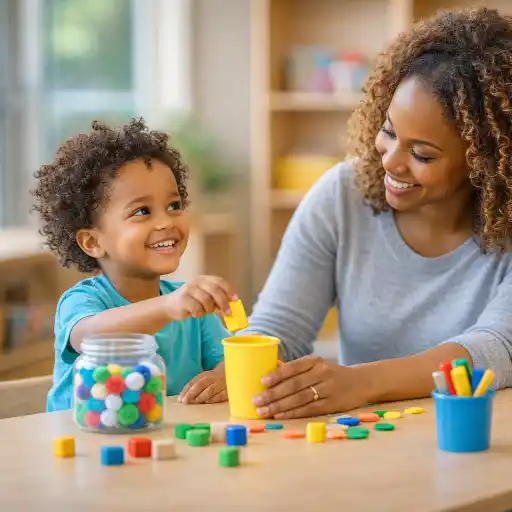
- 🧺 Care for shared materials: return a few blocks to a picture-labeled basket or place a book on an accessible shelf.
- Participate in self-care: hang up a coat, attempt handwashing steps, or put belongings in a designated place with help as needed.
- Help with classroom routines: place napkins on the table, carry a lightweight item, or move a visual schedule marker.
- Care for the environment: water a plant with an adult controlling the amount, or wipe a defined area with an appropriate cloth.
- Practice social responsibility: wait for a turn, help restore a shared play area, or suggest a fair plan when two children want the same material.
Keep hazardous or regulated work in adult hands. Children should not handle cleaning chemicals, sharp tools, hot liquids, heavy objects, or tasks that compromise supervision, food safety, or sanitation. CDC guidance for preschoolers also supports letting children help with simple chores while maintaining clear, consistent expectations and attention to safety. State requirements vary - check your state licensing agency.
How can educators teach responsibility without relying on commands?
Teach a responsibility as a skill: explain the purpose, model the steps, invite the child to try, and provide just enough help. Keep directions short and concrete. “First, put the puzzle pieces in the tray; then place the tray on the shelf” gives more useful information than “Clean up properly.” A photograph or two-step visual can make the sequence easier to remember.
Questions can invite children to think and act rather than wait for an adult to manage every detail. Try, “Where does the puzzle go?” or “What do we need before snack?” Pause for the child to process. If the child is unsure, point to a picture, model one step, or offer two reasonable choices. NAEYC’s discussion of fostering competence and responsibility emphasizes the value of helping children plan and solve problems, rather than confusing cooperation with mere compliance.
Use specific, descriptive feedback to make effort and impact visible: “You checked the picture and returned the books,” or “You waited while your friend finished.” Avoid praise that turns a task into a test of character, such as “You’re a good child because you cleaned up.” A child’s worth is never conditional on task performance.
When a child resists, first consider whether the task is too long, unclear, difficult, or poorly timed. Acknowledge feelings, reduce the task to a doable step, and offer support. Calm, logical responses connected to the situation teach more than threats or unrelated punishments; the CSEFEL brief on logical consequences describes how respectful, related consequences can guide children to understand the connection between choices and outcomes.
How can routines and the classroom environment support responsibility?
Children are more able to follow through when the environment makes expectations understandable and physically possible. Place everyday materials within reach, keep storage locations consistent, and label shelves or baskets with photographs and words. If children cannot reach a hook or tell where items belong, the setup may unintentionally create dependence.
Teach routines deliberately rather than assuming children already know them. Practice cleanup during a calm moment; use the same simple cue before transitions; and allow enough time for children to act. Predictable sequences help preschoolers anticipate what happens next and build autonomy over repeated experiences. NAEYC notes that daily routines and transitions are important elements of a supportive early learning environment.
- Use picture cues, objects, or brief visual sequences at children’s eye level.
- Break multistep routines into smaller actions and teach one step at a time.
- Rotate helper opportunities fairly, while allowing enough repetition for children to learn.
- Offer complementary roles when several children want to help at once.
- Align staff language so children receive consistent, calm prompts.
Responsibility also includes emotional and social learning. Children may need adult support to pause, manage frustration, ask for help, or repair a problem with a peer. Co-regulation—an adult’s warm, steady support during strong feelings—helps children gradually develop their own self-regulation skills. The Administration for Children and Families’ preschool practitioner guidance highlights responsive relationships, calm structure, and supported problem-solving as important strategies.
How can responsibility teaching be inclusive and equitable?
Equity means each child has a genuine opportunity to contribute, not that every child must complete the same task in the same way. Review who gets invited to be a helper. If opportunities consistently go to children who speak quickly, move easily, or appear compliant, other children may be excluded from meaningful participation.
Adapt tasks to children’s communication, mobility, sensory, and developmental needs. A child can point to a picture showing where an item belongs, carry one object, sort materials while seated, or complete one step alongside an adult. Pair spoken directions with gestures, photographs, home-language words, or communication tools where helpful. These adjustments preserve the purpose of the responsibility while making participation accessible.
Family partnership helps educators understand what independence and helping look like in each child’s context. Ask caregivers what tasks the child enjoys at home and what language or routines are familiar. Families may have different cultural expectations about children’s contributions, self-care, and adult support; listening prevents one approach from being treated as universal.
Keep safety and adult accountability clear. Children may participate in appropriate classroom routines, but adults remain responsible for supervision, hygiene, safe materials, and decisions about whether a task is suitable. If a responsibility causes repeated distress or conflict, adjust the setup or role rather than labeling the child as unwilling. An inclusive approach communicates that every child is a valued member of the #community and has meaningful ways to take part.
How can teams notice progress and avoid common mistakes?
Observe children across multiple opportunities and describe what happened without turning responsibility into a score or personality label. Instead of writing “not responsible,” note: “After seeing the cleanup picture, Sam returned two blocks and asked for help with the shelf.” This records the child’s initiative, the support that helped, and the next step to consider.
Progress may look like starting after a cue, completing one additional step, asking for help, waiting for a peer, or returning to a task after frustration. Performance can vary with fatigue, a busy room, changes in routine, or a child’s feelings. Use observations to refine the environment and adult support—not to compare children.
Common pitfalls are preventable:
- Expecting too much at once: reduce the number of steps and teach them explicitly.
- Taking over too quickly: offer one cue, pause, and allow processing time.
- Using jobs as rewards or punishments: make helpful participation a normal part of community life.
- Expecting identical performance: adapt tools and participation while keeping the purpose meaningful.
- Prioritizing speed over learning: build a little time into routines so children can practice.
Directors can help staff establish shared prompts, review who receives opportunities, and discuss observations together. If children repeatedly struggle, ask whether the task, timing, materials, or adult expectations need to change. The goal is supported growth—not perfect, immediate independence.
Conclusion: What is the goal of teaching preschoolers personal responsibility?
Developmentally appropriate responsibility grows through repeated, supported experiences in which preschoolers make manageable choices, care for themselves and shared materials, and contribute to the group. It is taught in everyday moments: cleanup, meals, transitions, self-care, play, and peer problem-solving. Clear demonstrations, accessible environments, predictable routines, and warm, specific feedback help children understand what to do and why it matters.
Remember that responsibility is a developing skill, not a measure of a child’s character. Match expectations to each child, include meaningful ways to participate, and support emotions and safety while children practice. For a deeper, structured exploration of how to nurture independence and self-regulation, consider Supporting Children’s Independence Buy Now $24.00. Small, consistent opportunities can help preschoolers experience themselves as capable contributors to their classroom community.
Additional ChildCareEd courses for continued professional learning:
- Student Success: Expectations & Independence Buy Now $16.00 — explore realistic expectations and ways to support children’s independent practice.
- DAP for Preschool Buy Now $35.00 — build understanding of developmentally appropriate practice in preschool settings.
- Staying Positive: Guidance for Preschoolers Buy Now $24.00 — consider positive guidance approaches that support social-emotional development.
- From Tantrums to Triumphs: Equipping Preschoolers with Self-Regulation Skills Buy Now $25.00 — explore strategies for supporting self-regulation in preschool classrooms.
- 45 Hour Child Growth and Development
- You're Not My Friend Anymore: Learning Conflict Resolution
- CDA Home Visitor Subject Area 3 Part 3 Birth to 5
- CDA Home Visitor Subject Area 2 Part 3 Birth to 5
- 45 Hour Preschool Methods and Materials
- Birth to Five CDA Credential with Portfolio Review
- Art from the Heart for Preschoolers: Open Ended Art Projects that Build Self-Esteem
- Play, Learn, Grow
- Every Moment Matters: Schedules and Transitions
- CDA Certification en Español: Recursos y Consejos para Educadores Bilingües
- 😅❌ ¿Cómo Puedo Manejar a un Niño que Dice “¡NO!” a Todo en el Aula?
- ❄️ ¿Qué actividades al aire libre funcionan bien para los niños de Illinois en cada estación? 🌷🍂
- Normas de Licenciamiento de Cuidado Infantil en Virginia para Centros Diurnos Infantiles y Hogares Diurnos Familiares
- Proporciones de Cuidado Infantil y Tamaños de Grupo por Edad en Maryland (Guía Rápida para Centros y Hogares)
- Cómo Trabajar en el Cuidado Infantil en California: Requisitos y Pasos
- Cómo Ser Maestra de Preescolar en Wisconsin
- Las Mejores Ideas de Excursiones para Guarderías en Texas
- Cómo Ser Maestra de Preescolar en Virginia
- Celebrando la amistad en el cuidado infantil durante el Día de los Mejores Amigos
- How can we teach community and country to young children in simple, respectful ways?
- What Makes a Great Home Daycare? 10 Things Parents Notice First
- Attention Signals: Which Ones Work Best for Toddlers, Preschoolers, and School-Age Kids?
- Active Supervision Examples: 10 Real Classroom Scenarios—Safe or Unsafe?
- Why Is My Preschool Classroom So Chaotic? 7 Classroom Management Fixes to Try
- How Can Child Care Providers Set Clear Classroom Rules and Expectations?
- What Are Developmentally Appropriate Ways to Teach Classroom Responsibilities?
- How Can Teachers Use AI to Create Better Circle-Time Questions?
- What Are Developmentally Appropriate Ways to Introduce Goal Setting to Young Children?
- What Are Developmentally Appropriate Ways to Teach Preschoolers About Personal Responsibility?
