How can a busy child care team create a week that feels playful, intentional, and manageable? A thoughtful weekly framework connects children’s interests with developmental goals while protecting time for exploration. For deeper guidance on planning and assessing meaningful experiences, explore Creating Engaging and Meaningful Learning Experiences  Buy Now $55.00, which can strengthen classroom practices and support professional learning hours where applicable.
Why does purposeful weekly planning matter?
Purposeful play is not a contradiction. Research and professional guidance describe play as a context for language, problem solving, physical development, self-regulation, creativity, and relationships. The goal is not to turn every playful moment into a lesson, but to design environments and interactions that make rich learning possible.
Weekly planning helps providers move beyond a collection of disconnected activities. It offers a flexible structure for observing children, preparing materials, balancing developmental domains, and responding to emerging interests. NAEYC describes teachers during play as observers, guides, participants, and mediators who use what they notice to extend learning. This approach keeps children’s agency at the center while giving adults a clear professional purpose.
- Connect observations to learning goals.
- Protect uninterrupted play and repetition.
- Prepare open-ended materials that invite choice.
- Document children’s strengths and next steps.
How do you begin with children’s interests?
Start before writing the plan. During the previous week, record brief, objective notes about what children repeatedly do, say, build, pretend, investigate, or avoid. A child transporting blocks, another repeatedly pouring water, or a group designing a pretend restaurant may be communicating important interests and developmental questions.
Look for patterns rather than isolated moments. Ask: What skills are emerging? Which children are deeply engaged? What social challenges appear? What family or community experiences could enrich the topic? The answers can become the foundation for a weekly inquiry such as “How do things move?” or “How can we make our classroom restaurant work?”
Choose one broad interest and two or three related learning priorities. For example, a transportation interest might support vocabulary, counting, spatial reasoning, collaboration, and gross-motor movement. Avoid allowing the theme to dictate every activity; the children’s engagement and needs should guide the direction.
What should a purposeful weekly plan include?
A useful plan is detailed enough to guide the team but flexible enough to honor children’s ideas. Include a weekly focus, observable objectives, materials, learning-center invitations, group experiences, outdoor possibilities, family connections, observation targets, and reflection notes.
- Focus: the children’s interest or meaningful question.
- Goals: one or two observable skills per day.
- Materials: accessible, open-ended, culturally responsive resources.
- Teacher role: when to model, question, scaffold, participate, or step back.
- Evidence: language, actions, problem solving, social interaction, or work samples to observe.
- Adaptations: visual supports, sensory options, varied tools, and multiple ways to participate.
A template reduces cognitive load and makes planning visible to colleagues and families. It should function as a working document, not a script. If children need more time with a meaningful investigation, carry it into the next day. Repetition often deepens learning more effectively than constant novelty.
How can you organize purposeful play across five days?
Use a gradual sequence: invite curiosity, provide time to explore, add a carefully chosen challenge, connect ideas across centers, and reflect on what children discovered. Consider this example for a preschool group interested in building.
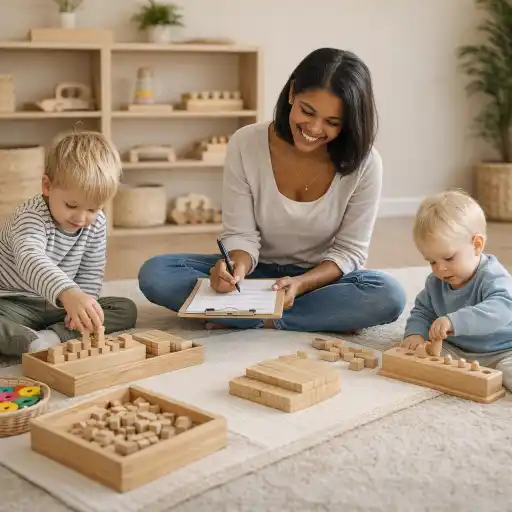
- Monday—Notice and invite: Offer blocks, photographs of structures, cardboard tubes, and clipboards. Introduce vocabulary such as balance, tall, wide, strong, and design. Observe how children begin.
- Tuesday—Investigate: Add ramps, vehicles, measuring tools, and books about construction. Ask, “What might make the bridge stronger?” Record children’s predictions.
- 🌟 Wednesday—Collaborate: Invite small groups to design a structure for toy animals or people. Support turn-taking, planning, and negotiation without taking over.
- Thursday—Represent: Provide drawing materials, signs, labels, and dramatic-play props. Children can map, describe, dictate, or act out their structures.
- Friday—Share and extend: Photograph designs, invite children to explain changes, and consider what materials or questions should be added next week.
This sequence integrates literacy, mathematics, science, motor development, social-emotional learning, and creative expression without requiring a separate worksheet for each domain.
How do you individualize play for infants, toddlers, and preschoolers?
Purposeful planning must reflect age, temperament, ability, language, culture, and current development. Infants benefit from responsive caregiving, sensory exploration, movement, and repeated interactions. A plan may identify individual goals such as reaching, tracking, crawling, vocalizing, or participating in back-and-forth exchanges.
Toddlers need short invitations, predictable routines, repetition, and freedom to move between exploration and caregiving moments. Offer large, safe materials and simple language: “You poured the water into the cup.” Preschoolers can sustain longer investigations, collaborate with peers, represent ideas, and take on increasingly complex roles.
- Offer more than one way to enter an activity: touching, moving, talking, drawing, building, or observing.
- Use picture cues, gestures, home-language vocabulary, and demonstrations.
- Adjust the size, texture, weight, or complexity of materials.
- Provide extensions for children seeking challenge and simpler pathways for children who need support.
Inclusive planning begins with strengths rather than deficits. Coordinate with families and specialists when individualized supports are documented, and avoid assuming that one strategy will work for every child.
How do observation, families, and reflection complete the cycle?
Observation turns purposeful planning into an ongoing cycle: notice, plan, offer, observe, reflect, and revise. Select a small number of children or skills to watch each day. Capture short notes, children’s words, photographs when permitted, and work samples. Documentation should help you decide what to repeat, remove, adapt, or extend.
Invite families to contribute knowledge about children’s interests, languages, routines, and experiences. A family photograph, familiar song, home-language word, or suggestion for a dramatic-play prop can make the curriculum more relevant. Share the week’s focus and ask what children are exploring at home.
At the end of the week, ask the team:
- Where did children show sustained engagement?
- Which materials encouraged collaboration or independence?
- Who participated easily, and who needed a different entry point?
- What unexpected questions emerged?
- What should remain available next week?
Common mistakes include overscheduling, interrupting play too quickly, directing children toward identical products, and documenting only completed crafts. A flexible plan protects time for discovery and values process. State requirements vary - check your state licensing agency when aligning schedules, documentation, and required learning experiences.
Conclusion: What makes a week of purposeful play successful?
A successful week of purposeful play begins with careful observation, uses a few meaningful goals, prepares inviting materials, and leaves room for children to lead. Plan a flexible sequence rather than five isolated activities. Balance child-directed play, guided play, routines, movement, small-group experiences, and outdoor exploration.
The central question is not, “Did we complete everything on the plan?” It is, “Did our planning help children investigate, connect, communicate, persist, and grow?” When providers observe closely and reflect honestly, the weekly plan becomes a supportive tool for better care—not another burden. For continued professional development, consider The Best Promotion is Play Buy Now $35.00, Lesson Planning for Preschoolers Buy Now $24.00, Planning for Every Child Buy Now $55.00, and Role of Play in Learning Buy Now $16.00.
- 45-Hour School Age Curriculum
- Beyond the Classroom: Connecting Families to Essential Services
- 45 Hours Director-Administration ONLINE
- 45 Hour Preschool Methods and Materials
- From Play to Planning: Building Culturally Competent, Child-Centered Curriculum
- Tracking Progress, Shaping Futures: Observation & Assessment Skills
- Children at the Wheel: Emergent Curriculum
- 45 Hour School Age Methods and Materials
- Creating Engaging and Meaningful Learning Experiences
- Texas Director Credential
- 10 Ejemplos de Cómo la Cultura Influye en el Desarrollo Infantil
- Proporciones de Cuidado Infantil y Tamaños de Grupo por Edad en Virginia (Guía Rápida para Centros y Hogares)
- Learning Through Creative Daycare Activities
- How can we teach children through play?
- Celebrando la amistad en el cuidado infantil durante el Día de los Mejores Amigos
- Canciones, juegos y preguntas de círculo para niños
- Do Toys Come Alive: How Can Pretend Play Spark Creativity in Your Daycare?
- How Can We Teach Young Children About Community Helpers and Work?
- How can small playgrounds be transformed into engaging learning environments using natural materials?
- What Can Child Care Providers Learn from Children's Favorite Games?
- How Can I Create Engaging Learning Centers for Preschoolers?
- Can Counting Activities Really Feel Like Play?
- How can dramatic play ideas intentionally encourage children's imagination?
- How Can You Turn a Superhero Theme Into a Full Week of Preschool Learning Centers?
- First Week of Pre-K Lesson Plans: What Can You Learn About Your New Class?
- How Can You Plan a Week of Purposeful Play?
- What Is Purposeful Play—and Why Is It Replacing Worksheets?
- What Is Purposeful Play—and Why Is It Replacing Worksheets?
- How Can You Choose Recycled Classroom Materials With a Real Purpose for Play?
- Is Your Preschool Lesson-Planning Routine Taking Too Much Time?
