Want to transform children’s enthusiasm for capes and missions into purposeful learning without creating five unrelated lesson plans? A superhero week can integrate literacy, math, science, art, movement, and social-emotional learning when each center has a clear goal and playful invitation. For a deeper foundation in planning intentional, child-centered experiences, explore Spicing Up the Classroom: Learning Centers  Buy Now $16.00, a practical course that can strengthen your center design and lesson-planning skills.
Why does a superhero theme work so well for preschool learning?
Young children often arrive with strong interests, and those interests can become meaningful curriculum entry points. Superhero play invites children to imagine, negotiate roles, move their bodies, tell stories, solve problems, and practice helping. The CDC notes that pretending to be a superhero can reflect both social-emotional and cognitive development, especially when children play with others and use symbolic thinking.
Dramatic play is not “just pretend.” It requires planning, language, perspective-taking, flexibility, and impulse control. As children decide who will be the rescuer, dispatcher, scientist, or reporter, they practice cooperation and communication. Research on project-based learning also suggests that children’s participation and motivation can increase when they help shape investigations and work with meaningful materials.
The theme becomes most effective when educators focus on real-life heroic qualities rather than fighting: kindness, courage, persistence, problem-solving, and knowing when to ask a trusted adult for help.
If the theme falls near Memorial Day, age-appropriate Memorial Day activities can extend children’s conversations about community and appreciation for those who served.
- 🦸 Build identity through strengths-based language: “You used careful hands,” or “You kept trying.”
- Connect pretend missions to everyday helpers such as nurses, firefighters, teachers, families, and neighbors.
- Use the children’s questions to extend the week rather than forcing every activity into a predetermined script.
For additional practical examples, see ChildCareEd’s superhero activities for preschoolers.
How should you prepare the room and learning goals?
Begin with three or four broad goals instead of a long list of disconnected objectives. For example, you might target cooperative language, counting and one-to-one correspondence, observation and prediction, and fine-motor control. Then assign each goal to a center while allowing children to use materials in open-ended ways.
Arrange centers so active areas do not interfere with quiet work. A movement center should have clear boundaries and a visible landing space. Dramatic play can sit near blocks or writing materials so children can build a city and document their missions. A quiet planning area can include books, visual schedules, and emotion cards.
- Mission board: Display picture cards showing the day’s choices.
- Prop bins: Label containers “capes,” “tools,” “books,” and “mission reports.”
- Role cards: Offer rescuer, planner, medic, reporter, designer, and helper roles.
- Documentation: Keep a clipboard for brief notes about language, cooperation, problem-solving, and motor skills.
Limit each rotation to approximately 12–20 minutes, depending on the group. Children may need longer for dramatic play and shorter intervals for teacher-guided tasks. Give a brief demonstration, ask one inviting question, and then step back so children retain ownership. The ChildCareEd course Creating Environments that Nurture Growth and Community Buy Now $55.00 offers additional guidance on arranging spaces that support belonging, exploration, and development.
What can children explore on Monday and Tuesday?
Monday: Hero Headquarters and Identity. Introduce the theme with a conversation about what makes someone helpful. Invite children to design an original hero, not necessarily a licensed character. At the art center, they can create a badge showing a personal strength such as patience, curiosity, bravery, or kindness. This supports self-expression, vocabulary, and fine-motor development.
At the dramatic-play center, provide capes, clipboards, stuffed animals, cardboard boxes, telephones, and simple role cards. Children can establish a headquarters, assign jobs, and create a mission. Adults can model language such as, “What does your team need?” and “How can we make a plan together?”
Tuesday: Super Senses and Safe Movement. Begin with a body-awareness check: What do you notice in your hands, feet, eyes, and breathing? At the movement center, create a low-risk training course with tape lines, tunnels, stepping spots, beanbag targets, and a soft-toy rescue. Emphasize control, balance, and awareness rather than speed.
At a sensory station, children can sort textured “power crystals” made from large, safe objects by color, size, or texture. Always review materials for choking hazards, allergies, and developmental appropriateness. ChildCareEd’s body-awareness and safety lessons provide useful prompts for discussing limits, consent, and safe choices.
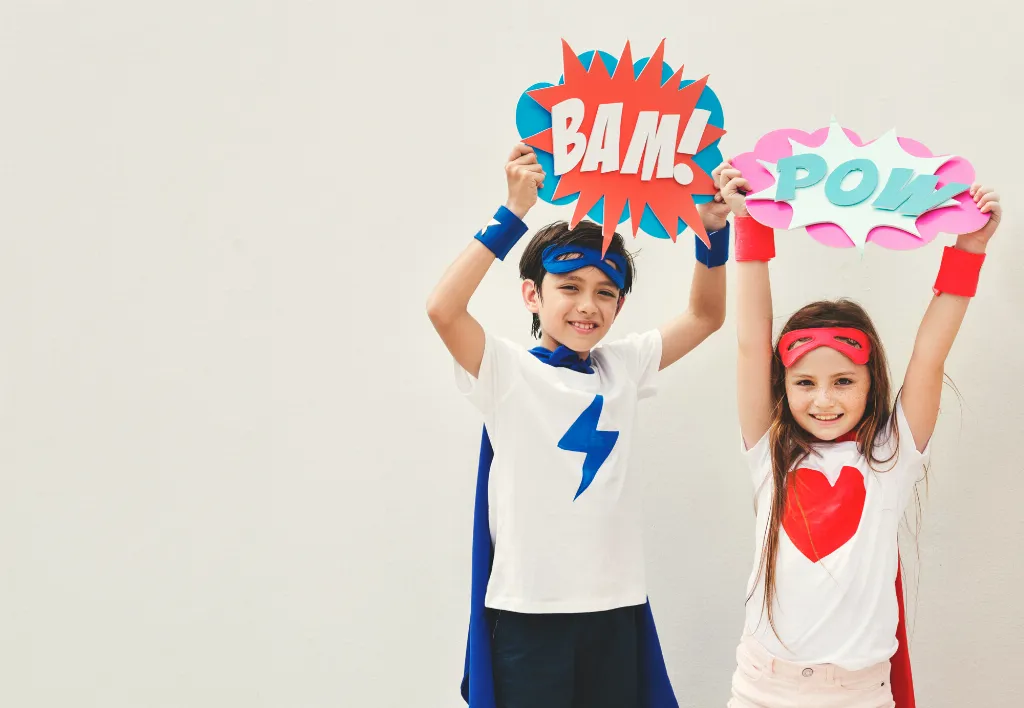
How can Wednesday and Thursday connect superheroes to literacy, math, and science?
Wednesday: Mission Reports and Rescue Math. Create a writing center with paper, pencils, stamps, stickers, envelopes, and picture prompts. Children may dictate or draw a report explaining who needed help, what happened, and what the team did next. Emergent writers can copy names or labels; more experienced writers can sequence three events.
For math, use numbered shields or “power stations.” Children can match quantities of counters to numerals, count supplies into rescue bags, compare which tower is taller, or create repeating patterns with colored symbols. The goal is mathematical reasoning through play, not a worksheet-heavy exercise. KidSparkz’s superhero resources similarly connect the theme to counting, number recognition, patterning, matching, and beginning sounds.
Thursday: The Superhero Science Lab. Invite children to investigate a practical problem: Which material makes the best cape for blocking wind? Which objects roll, slide, or stay still? How can a cardboard bridge help a toy cross the “city”? Encourage children to predict, test, observe, and describe results.
- Compare paper, fabric, foil, and cardboard as “shield” materials.
- Use ramps to explore speed, distance, and surface texture.
- Build a rescue vehicle from boxes and recyclable materials.
- Record findings with drawings, marks, photographs, or dictated sentences.
For professional development focused on inquiry and exploration, consider Building Early Science Foundations Buy Now $16.00. It can help providers turn children’s natural curiosity into developmentally appropriate investigations.
How can Friday bring the week together through collaboration and reflection?
Use Friday as a collaborative “community mission.” Children can work in small groups to design a safe, welcoming neighborhood for everyone. One group might build with blocks, another might create signs and maps, while another prepares a helper station for stuffed animals. This project integrates spatial reasoning, art, language, cooperation, and social-emotional learning.
Invite children to rotate leadership roles. A child who dislikes running can become the mapmaker, reporter, prop manager, or safety checker. A child who uses limited spoken language can participate with picture cards, gestures, communication devices, or a clearly modeled script. Inclusion is not an extra center; it is a design principle applied throughout the week.
Close with a short reflection circle. Ask:
- What problem did your team solve?
- How did you ask for help or offer help?
- What safe choice did you make?
- What would you change next time?
Document one or two observations per child, such as initiating peer interaction, using a consent phrase, persisting with a design, counting accurately, or explaining a prediction. The CDC emphasizes that observing developmental milestones across language, cognitive, physical, and social-emotional domains helps educators notice progress and identify concerns that may require family follow-up.
Send families a brief “mission report” describing a strength the child practiced. Invite families to share examples of everyday heroes in their homes and communities.
How do you keep the week safe, inclusive, and developmentally appropriate?
Superhero play can become overly physical quickly, especially when children imitate television or movie stunts. Establish rules before play begins: no jumping from furniture, no hitting, no taking another child’s cape, and stop immediately when someone says “stop.” Teach alternatives such as superhero poses, sound effects, gentle rescues, and obstacle courses at floor level.
Active supervision requires more than standing nearby. Position adults so movement areas remain visible, scan continuously, listen for changes in tone, and intervene early when play becomes unsafe. A consistent bell, clap, or verbal cue can pause the group.
Offer adaptations without labeling children as “less capable.” Use soft capes, loose masks, larger tools, visual directions, quieter roles, and alternate challenge levels. Some children may prefer observing before joining; observation can be a legitimate entry point into cooperative play.
- Common mistake: Treating the theme as a single craft. Better approach: Use the theme across multiple domains.
- Common mistake: Rewarding speed or physical boldness only. Better approach: Celebrate planning, kindness, persistence, and careful movement.
- Common mistake: Using calm spaces as punishment. Better approach: Teach children that a planning or recharge area is available to everyone.
- Common mistake: Assuming one superhero image represents every child. Better approach: Include diverse helpers, family traditions, languages, abilities, and original characters.
State requirements vary - check your state licensing agency for supervision, ratios, materials, documentation, and training expectations. For additional guidance on inclusive curriculum and individualized planning, explore Planning for Every Child: Responsive Strategies in Action Buy Now $55.00.
Conclusion: What makes a superhero learning-center week successful?
A successful superhero week is not defined by elaborate costumes or expensive materials. It is defined by intentional connections: dramatic play supports language and cooperation; movement develops body awareness and planning; art builds fine-motor control and identity; math and science emerge through meaningful missions; and reflection helps children connect pretend actions to real-life kindness and safety.
Start with a few open-ended props, three or four learning goals, and a predictable rotation schedule. Observe what children pursue, adapt the centers, and let their questions guide the next mission. When educators protect safety while preserving imagination, children experience themselves as capable contributors—the kind of everyday heroes every classroom needs.
Which ChildCareEd courses can support this plan?
- Spicing Up the Classroom: Learning Centers Buy Now $16.00 — strengthens intentional center planning.
- From Play to Planning Buy Now $55.00 — supports child-centered, culturally responsive curriculum.
- Building Early Science Foundations Buy Now $16.00 — develops inquiry-based science experiences.
- Active Supervision: A Strategy That Works Buy Now $35.00 — supports safer active-play environments.
- Building Equity: Inclusionary Practices in Preschool Buy Now $10.00 — helps educators make participation more accessible and affirming.
- 45 Hour Child Growth and Development
- CDA Home Visitor Subject Area 3 Part 3 Birth to 5
- CDA Bridge Bundle: Preschool
- Art from the Heart for Preschoolers: Open Ended Art Projects that Build Self-Esteem
- CDA Bridge Bundle: Preschool without Portfolio Review
- Texas Director Credential
- CDA Infants/Toddlers: Brain Development and Gene Expression
- CDA Infants/Toddlers: Stages of Development
- 45 hour Growth and Development Birth-age 12 ONLINE
- Tiny Tastemakers to Make Vegetables Cool for Kids
- CDA Certification en Español: Recursos y Consejos para Educadores Bilingües
- 💛🧩 ¿Cómo puedo hacer que mi enseñanza sea inclusiva para los niños con autismo?
- 🤯 ¿Por qué este niño está teniendo un comportamiento difícil de repente?
- Recursos en Español sobre el Sueño Seguro del Bebé
- Proporciones de Cuidado Infantil y Tamaños de Grupo por Edad en Nueva Jersey (Guía Rápida para Centros y Hogares)
- Proporciones de Cuidado Infantil y Tamaños de Grupo por Edad en Virginia (Guía Rápida para Centros y Hogares)
- Cómo Celebrar el Día Nacional del Kindergarten
- Celebrando la amistad en el cuidado infantil durante el Día de los Mejores Amigos
- Canciones, juegos y preguntas de círculo para niños
- Superhero Activities for Preschoolers: Play, Create, and Learn
- Superhero Examples for Kids: Learning About Helpers, Safety, and Kindness
- Superhero Theme Activities for Preschool and Child Care
- Cómo simplificar la capacitación para sus empleados de daycare
- How can superhero-themed play help build confidence in young children?
- What Do Superheroes Teach Kids About Kindness and Courage?
- Can Superhero Day Capes and Pretend Play Teach Children to Help Others?
- How can we host a Costume & Character Day that truly builds imagination and learning?
- Can a Superhero Week Help Preschoolers Learn to Name and Manage Emotions?
- How Can You Turn a Superhero Theme Into a Full Week of Preschool Learning Centers?
