When a worksheet measures completion more than understanding, purposeful play offers a richer path to observe children thinking, communicating, and solving problems. Strengthen your classroom practice with The Best Promotion is Play  Buy Now $24.00, a relevant professional-development course that explores play’s role across developmental domains and provides strategies for creating engaging learning experiences.
Why does purposeful play matter in early childhood?
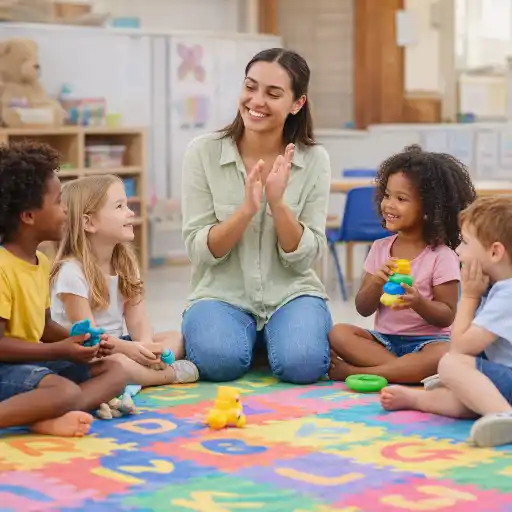
Purposeful play is play designed with intention but not controlled so tightly that children lose agency. Educators establish meaningful goals, prepare environments and materials, and then allow children to make choices, test ideas, collaborate, and revise their plans. The result is learning that is active, social, emotional, physical, and intellectually demanding.
This approach matters because early learning is not simply the accumulation of isolated skills. Children need opportunities to develop language, executive function, self-regulation, motor coordination, curiosity, and confidence alongside early literacy, mathematics, science, and social understanding. NAEYC describes play as a context for joyful learning that supports self-regulation, language, cognition, social competence, and content knowledge across disciplines (NAEYC’s overview of play).
Purposeful play also responds to a practical concern familiar to directors and teachers: a completed page may be easy to file, but it does not necessarily show whether a child understands an idea or can use it in a new situation. During play, educators can observe the strategies children choose, the language they use, their persistence, and the support that helps them progress.
What makes play purposeful rather than merely entertaining?
Purposeful play combines child agency with adult intentionality. It can range from self-directed exploration to guided play and structured games. The adult’s role changes according to the children’s needs: planner, observer, co-player, questioner, model, mediator, and reflective assessor.
A purposeful experience generally includes four elements:
- A meaningful learning intention: for example, comparing quantities, using descriptive vocabulary, or negotiating roles.
- Choice and agency: children decide how to enter, modify, or represent the experience.
- Open-ended materials: blocks, fabric, cardboard, loose parts, art tools, books, natural objects, and dramatic-play props.
- Responsive adult support: teachers observe, ask questions, introduce vocabulary, model strategies, and step back when children are productively engaged.
The Singapore Ministry of Education’s guidance on purposeful play emphasizes wonder, choice, and delight. These qualities protect play from becoming a disguised worksheet. A child may be working toward a learning goal, but the experience should still invite curiosity, decision-making, and experimentation.
For example, a teacher who wants to support spatial reasoning might provide photographs of bridges, blocks, ramps, and measuring tools. Children can choose what to build and how to test it. The teacher may ask, “What could make the bridge stronger?” without prescribing one correct design.
Why are worksheets less effective as the primary learning method?
Worksheets are not inherently harmful, and there may be limited situations in which a short page is useful. However, worksheets often narrow learning to tracing, matching, circling, or producing an identical product. They can provide practice, but they rarely offer the sustained conversation, movement, collaboration, sensory feedback, or flexible problem solving that young children need.
NAEYC’s discussion of playful learning challenges the false opposition between play and learning. The stronger question is not “play or academics?” but “Which learning context allows this child to understand and apply the concept?” Playful learning can be active, engaging, meaningful, socially interactive, and iterative—conditions that support durable learning.
A worksheet asking children to count pictures may assess one narrow response. A pretend grocery store can invite children to count items, compare quantities, read labels, negotiate roles, use money, write signs, and explain their decisions. The second experience provides more opportunities for transfer and differentiation.
Research also calls for professional balance. Evidence does not justify claiming that every worksheet is ineffective or that play automatically produces better outcomes. Guided play appears especially promising for areas such as early mathematics, shape knowledge, spatial vocabulary, and task switching, but the quality and implementation of the experience matter.
- Use worksheets briefly for targeted practice when they have a clear purpose.
- Pair paper-based work with hands-on exploration and conversation.
- Never allow worksheets to displace substantial blocks of free, guided, outdoor, and social play.
- Evaluate whether the task is developmentally appropriate and accessible to the individual child.
How can teachers design purposeful play around curriculum goals?
Begin with observation rather than a predetermined craft. Notice what children repeatedly build, pretend, discuss, collect, avoid, or attempt. These observations reveal interests and emerging skills that can guide planning.
- Choose one or two observable goals. Examples include using positional words, creating an AB pattern, retelling a sequence, or taking turns with a peer.
- Prepare an inviting environment. Add materials that encourage multiple solutions and ensure children can access them independently.
- Connect experiences across domains. A construction project can involve measurement, vocabulary, drawing, negotiation, science, and motor development.
- Use brief, open-ended prompts. Ask, “What is your plan?” “What do you notice?” or “What might happen if…?”
- Document evidence. Record children’s words, strategies, interactions, and next steps rather than only collecting finished products.
Consider a classroom investigation about transportation. Children might build roads with blocks, sort vehicles by attributes, create maps, dictate travel stories, measure ramps, and act out roles as drivers or mechanics. The teacher can introduce vocabulary such as route, distance, heavy, light, fast, and slow while preserving children’s control over the investigation.
Purposeful planning should remain flexible. If children need more time to solve a problem, repeating and extending the experience may be more valuable than moving to a new activity. State requirements vary - check your state licensing agency when aligning schedules, documentation, curriculum, and staff training.
How can directors support a transition from worksheets to play?
A program-wide shift requires shared expectations, staff reflection, and visible evidence of learning. Directors can reassure educators that replacing worksheets does not mean abandoning structure or accountability. Instead, the program is changing how learning is designed, observed, and communicated.
Provide a planning template with the following fields:
- Children’s observed interests and strengths
- Developmental or curriculum goal
- Materials and environmental arrangement
- Possible teacher language and prompts
- Adaptations for multilingual learners and children with disabilities
- Observable evidence of learning
- Possible extensions and next steps
Professional learning is valuable because purposeful play requires skilled observation and responsive interaction. The ChildCareEd course From Play to Planning: Building Culturally Competent, Child-Centered Curriculum Buy Now $55.00 can help providers connect children’s interests with curriculum, scaffolding, inclusion, and culturally responsive planning.
Begin with one center rather than changing everything at once. Replace a letter-tracing sheet with a message center, name puzzles, magnetic-letter hunts, clay formation, and environmental print. Replace a counting sheet with snack sorting, block inventories, movement games, or a pretend store. Then ask staff what children demonstrated and what support they needed.
How can educators document and explain purposeful play?
Documentation makes complex learning visible to families, colleagues, and administrators. A useful observation includes context, evidence, interpretation, and a next step.
For example: “During block construction, Maya counted eight units, compared two towers, and explained that the taller tower needed a wider base. Next, we will offer bridge photographs and invite children to test different designs.” This note communicates mathematical reasoning, language, persistence, and planning more clearly than “completed a worksheet.”
Families may initially equate paper with academic progress. Respond with respect rather than dismissal. Share photographs, children’s words, project samples, and concise explanations of the skills being developed. Invite families to contribute home-language words, cultural experiences, stories, or materials that can enrich classroom play.
Observation should also guide inclusion. Offer multiple ways to participate—touching, moving, speaking, drawing, building, pointing, signing, or using AAC. Adjust the size, texture, complexity, or sensory qualities of materials. Purposeful play is strongest when every child has a meaningful entry point.
Common mistakes include overscheduling, interrupting play too quickly, directing children toward identical products, and treating every activity as a hidden test. Avoid these pitfalls by protecting uninterrupted play, accepting varied outcomes, and using documentation to understand learning rather than to rank children.
Conclusion: Is purposeful play a better replacement for worksheets?
Purposeful play is not a rejection of all paper-based practice. It is a more developmentally responsive way to connect learning goals with children’s agency, relationships, movement, imagination, and problem solving. Worksheets may occasionally support a narrow objective, but they should not replace rich play, teacher interaction, outdoor experiences, or hands-on exploration.
The practical answer is to observe first, plan a clear intention, prepare flexible materials, guide without taking over, and document what children actually do and say. When programs make learning visible through play, they preserve childhood while strengthening the foundations children need for later academic success.
For additional professional development, explore Role of Play in Learning Buy Now $16.00, which examines how play supports child development and learning, or Creating Engaging and Meaningful Learning Experiences Buy Now $55.00, which focuses on planning, implementing, assessing, and adapting developmentally appropriate experiences.
- Easy Steps to Resume and Interview Success
- Montessori Foundations
- CDA Bridge Bundle: Family Child Care without Portfolio Review
- CDA Bridge Bundle: Infant/Toddler without Portfolio Review
- The Best Promotion is Play
- CDA Bridge Bundle: Preschool without Portfolio Review
- Play with Purpose: Supporting Children with Autism
- Texas Director Credential
- Mastering Observation Techniques in the Montessori Classroom
- CDA Certification en Español: Recursos y Consejos para Educadores Bilingües
- Qué capacitación se requiere para ser director de cuidado infantil en Texas?
- Que es Título 22 en California?
- ¿Cómo solicito la licencia para una guardería en California?
- Regulaciones de Licenciamiento de Cuidado Infantil en California para Centros y Hogares de Cuidado Infantil Familiar
- Cómo Trabajar en el Cuidado Infantil en California: Requisitos y Pasos
- How does play shape brain development in children under 5 — what do Minnesota educators need to know?
- How Can Printable Activities Save Teachers Hours of Prep Time?
- How Can Child Care Providers Support Healthy Child Growth and Development?
- How Can Clip Cards Prepare Little Hands for Writing?
- How Can Child Care Providers Support Early Writing Without Using Worksheets?
- What Is Purposeful Play—and Why Is It Replacing Worksheets?
- What Is Purposeful Play—and Why Is It Replacing Worksheets?
- How Can Teachers Build Early Literacy Without Screens or Worksheets?
- How Can Printables Save Teachers Time Without Cutting Corners?
- What Makes Task Cards a Teacher’s Time-Saving Favorite?
- Which Printable Activities Belong in Every Preschool Classroom?
- What Is Developmentally Appropriate Practice? Examples by Age
- How Can Child Care Providers Teach Less-Frequent Letters Without Relying on Worksheets Alone?
- What Should Child Care Providers Prioritize When Preschool Readiness Goals Compete for Time?
