When a worksheet measures completion but not understanding, purposeful play offers children a richer route to language, problem-solving, self-regulation, and content knowledge. Providers who want practical strategies for designing engaging, developmentally appropriate experiences can explore The Best Promotion is Play  Buy Now $24.00, a course focused on using play intentionally to support children’s development and classroom learning.
What does purposeful play actually mean?
Purposeful play is play that preserves children’s agency while connecting their interests and actions to meaningful learning goals. It is neither unstructured free time nor a disguised worksheet. Instead, educators prepare environments, materials, questions, and interactions that invite children to investigate, represent ideas, collaborate, and revise their thinking.
NAEYC describes playful learning as active, engaging, meaningful, socially interactive, and iterative. This framework challenges the assumption that play and academic learning are opposites. Children can explore freely, participate in guided play, or engage in structured games while developing vocabulary, early mathematics, scientific reasoning, motor skills, and social competence.
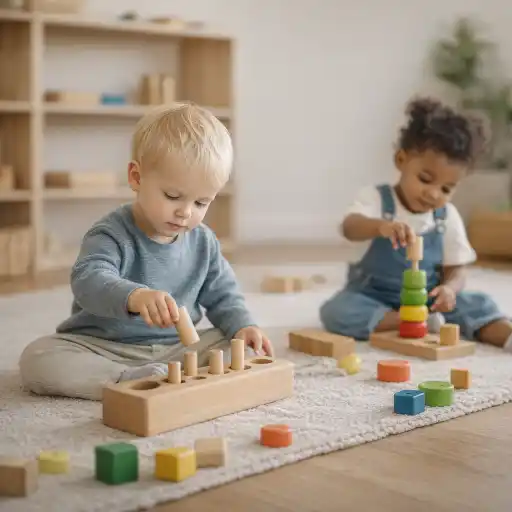
For example, a pretend restaurant may involve counting, sorting, writing, negotiation, sequencing, and storytelling. A block investigation may involve balance, measurement, spatial reasoning, planning, and persistence. The educator’s responsibility is to notice those possibilities and offer just enough support to extend them.
Purposeful play therefore begins with intentional teaching, but it does not end with adult control. The child’s choices, questions, culture, communication style, and prior experiences remain central to the learning process.
Why are worksheets being reconsidered in early childhood settings?
Worksheets can appear efficient because they produce a visible product. A completed page may reassure adults that a child practiced a letter, number, or shape. Yet the page often provides limited evidence of whether the child understands the concept, can apply it in a new context, or was meaningfully engaged.
Many worksheets require children to sit still, follow a predetermined sequence, use fine-motor skills that may still be emerging, and identify one expected answer. Those demands can disadvantage children who learn through movement, conversation, sensory exploration, home-language interaction, or collaborative problem solving.
NAEYC’s developmentally appropriate practice guidance emphasizes a planned environment that combines self-directed play, guided play, and direct instruction. It also stresses children’s choice, agency, culturally responsive materials, extended time, and multiple ways to participate. A paper task may occasionally support a specific goal, but it should not displace richer experiences across the day.
- Worksheets often isolate skills; play integrates several domains at once.
- Worksheets usually offer one pathway; play allows multiple entry points.
- Worksheets emphasize products; play reveals processes, strategies, and thinking.
- Worksheets limit dialogue; play generates sustained conversation and feedback.
The shift is not about declaring every worksheet harmful. It is about asking which method best supports a particular child, goal, and developmental context.
What does research say about play compared with worksheets?
The strongest conclusion is not that worksheets never work, but that high-quality playful learning offers broader developmental opportunities and can be especially effective when adults guide it thoughtfully. Research summarized by NAEYC indicates that guided play can support vocabulary, spatial skills, early mathematics, task switching, and other outcomes while preserving children’s choice.
Evidence should nevertheless be interpreted carefully. Research findings vary by age, learning goal, instructional quality, and implementation. It is therefore more accurate to say that worksheets are limited tools, while purposeful play can create a more complete learning context. The educational value comes from the interaction among children, materials, peers, and responsive adults.
Play also supports learning characteristics identified by the science of learning: active thinking, meaningful engagement, social interaction, iteration, and emotional investment. Children test ideas, receive immediate feedback, experience manageable challenges, and revise their strategies. These processes can make learning more transferable than isolated repetition.
Direct instruction remains valuable when it is brief, responsive, and connected to children’s experiences. A teacher may introduce the word “balance,” demonstrate how to compare quantities, model a sound, or explain a safety procedure. Children then need opportunities to use that knowledge in games, projects, conversation, construction, movement, and dramatic play.
For directors, the practical implication is clear: evaluate learning by looking for children’s explanations, applications, questions, persistence, and relationships—not only completed paper.
How can educators turn play into intentional curriculum?
Intentionality begins with observation. Before adding materials or directing an activity, notice what children repeatedly do, say, build, pretend, investigate, or avoid. These observations reveal interests, emerging skills, social questions, and useful next steps.
- Choose a meaningful goal. Select one or two observable priorities, such as comparing quantities, using descriptive vocabulary, negotiating roles, or testing a prediction.
- Prepare an inviting environment. Add open-ended materials, books, props, visual supports, tools, and enough time for sustained exploration.
- Join strategically. Ask questions such as “What is your plan?” “What do you notice?” or “How might you make it stronger?”
- Extend without taking over. Introduce vocabulary, a new material, a representation, or a manageable challenge when children are ready.
- Document evidence. Record children’s words, actions, strategies, social interactions, and revisions.
Consider a group designing a neighborhood. Children can build structures, create signs, dictate or write messages, count materials, map routes, role-play community roles, and solve disagreements. One investigation can address literacy, mathematics, science, social studies, language, motor development, and social-emotional learning.
Purposeful play is strongest when the goal is clear to adults, but the pathway remains flexible for children. Planning should guide professional decisions, not prescribe identical outcomes.
How can directors replace worksheets without losing structure or accountability?
Moving away from worksheets does not mean removing expectations, routines, assessment, or curriculum. It means making those elements visible through developmentally appropriate experiences. Directors can help staff connect goals to centers, projects, routines, outdoor play, small groups, and conversations.
A practical planning template can include:
- the learning or developmental goal;
- children’s observed interests and strengths;
- materials and environmental arrangements;
- possible teacher prompts and vocabulary;
- adaptations for disabilities, multilingual learners, and varied abilities;
- observable evidence of learning; and
- a possible next step.
Replace common worksheet objectives with authentic experiences:
- Letter recognition: name puzzles, message centers, magnetic-letter hunts, menus, and sensory writing.
- Counting: snack sorting, block inventories, movement games, and pretend-store purchases.
- Patterns: bead designs, rhythm sequences, nature collections, and repeated movements.
- Story comprehension: puppets, story stones, dramatic retelling, and child-created endings.
- Fine-motor development: play dough, tongs, lacing, construction materials, and process art.
Use observation-based documentation to show families and administrators what children are learning. A note such as “Maya compared two towers, counted eight blocks, and explained that the taller structure needed a wider base” communicates more about thinking than a page marked complete.
Common mistakes include overscheduling, interrupting play too quickly, directing identical products, and confusing compliance with learning. Start with one center, one goal, and one observation routine. State requirements vary - check your state licensing agency.
How can providers make purposeful play inclusive and meaningful for every child?
Purposeful play must be accessible across language, culture, ability, temperament, and developmental level. Inclusion is not achieved by giving every child the same materials or expecting the same response. It is achieved by providing multiple ways to enter, communicate, participate, and demonstrate understanding.
Educators can use pictures, gestures, objects, home-language vocabulary, communication boards, AAC, adapted tools, sensory options, and varied group sizes. One child may sort objects, another may explain a classification rule, and another may represent the idea through movement or drawing. Each pathway can reflect legitimate learning.
Culturally responsive play materials should reflect children’s families, languages, communities, and lived experiences without reducing culture to occasional themed activities. Invite families to contribute songs, words, photographs, stories, recipes, or ideas for dramatic-play settings.
Adult support should be responsive rather than intrusive. Observe first, interpret the child’s intention, offer a prompt or model when needed, and then step back. Protect the child’s ownership of the play.
- 🧩 Provide materials with different sizes, textures, weights, and levels of complexity.
- Offer quiet and active participation options.
- Pair visual directions with spoken language, gestures, or object cues.
- Plan partner roles so collaboration does not depend only on verbal communication.
- Use strengths-based documentation to guide individualized next steps.
When play is accessible and culturally meaningful, children are more likely to take risks, persist, communicate, and see themselves as capable learners.
Conclusion: Why is purposeful play replacing worksheets?
Purposeful play is replacing worksheets as the central learning experience because it better reflects how young children develop understanding: through action, relationships, language, movement, imagination, choice, and repeated experimentation. It allows educators to address academic goals while also supporting self-regulation, creativity, collaboration, physical development, and confidence.
Worksheets may have limited uses, but they cannot provide the range of social, cognitive, linguistic, and physical experiences available through well-designed play. The goal is not simply to remove paper; it is to replace passive task completion with meaningful evidence of children’s thinking and growth.
For providers and directors, begin small: observe children, select a clear goal, prepare open-ended materials, protect uninterrupted play, scaffold thoughtfully, and document what children actually do. Purposeful play is not less rigorous than worksheets. When carefully planned and responsively supported, it is a more integrated and developmentally appropriate way to make learning visible.
Additional ChildCareEd courses to explore:
- From Play to Planning: Building Culturally Competent, Child-Centered Curriculum Buy Now $55.00
- Early Mathematics Through Play Buy Now $24.00
- Play Safe, Think Big: Literacy Through Play
- Preschool Assessments & Observations Buy Now $24.00
References:
- Early Mathematics Through Play
- Bienvenido! Welcoming All Families
- 24 Hour Texas Pre-Service
- CDA Bridge Bundle: Family Child Care without Portfolio Review
- CDA Bridge Bundle: Infant/Toddler without Portfolio Review
- CDA Bridge Bundle: Preschool without Portfolio Review
- Creating Engaging and Meaningful Learning Experiences
- Texas Director Credential
- Access for All: Inclusion and the ADA
- Supporting Families and Caregivers in Language and Literacy
- CDA Certification en Español: Recursos y Consejos para Educadores Bilingües
- Qué capacitación se requiere para ser director de cuidado infantil en Texas?
- Que es Título 22 en California?
- ¿Cómo solicito la licencia para una guardería en California?
- Regulaciones de Licenciamiento de Cuidado Infantil en California para Centros y Hogares de Cuidado Infantil Familiar
- Cómo Trabajar en el Cuidado Infantil en California: Requisitos y Pasos
- How does play shape brain development in children under 5 — what do Minnesota educators need to know?
- How Can Printable Activities Save Teachers Hours of Prep Time?
- How Can Child Care Providers Support Healthy Child Growth and Development?
- How Can Clip Cards Prepare Little Hands for Writing?
- How Can Child Care Providers Support Early Writing Without Using Worksheets?
- What Is Purposeful Play—and Why Is It Replacing Worksheets?
- What Is Purposeful Play—and Why Is It Replacing Worksheets?
- How Can Teachers Build Early Literacy Without Screens or Worksheets?
- How Can Printables Save Teachers Time Without Cutting Corners?
- What Makes Task Cards a Teacher’s Time-Saving Favorite?
- Which Printable Activities Belong in Every Preschool Classroom?
- What Is Developmentally Appropriate Practice? Examples by Age
- How Can Child Care Providers Teach Less-Frequent Letters Without Relying on Worksheets Alone?
- What Should Child Care Providers Prioritize When Preschool Readiness Goals Compete for Time?
