An infant’s steady gaze, head turn, or small shift toward a toy can be meaningful evidence of curiosity—even when no reach or grasp follows. The CDA Infants/Toddlers: Benefits to Observing  Buy Now $16.00 course offers focused learning on documenting infants’ behavior and using observations to understand development, while Early Learning with Infants and Toddlers Buy Now $24.00 deepens knowledge of responsive interactions and individualized planning. Read on for a practical way to record looking as an important part of exploration, without turning observation into a test of whether the infant can grasp.
Why does looking count as meaningful infant interest?
Infant exploration does not begin only when a child touches or holds an object. Looking, tracking, pausing, turning toward a sound, and returning one’s gaze are observable actions that may show attention and interest. When providers recognize these signals, they avoid overlooking learning simply because a more visible motor action has not happened yet.
Observation is the starting point for responsive care. Head Start describes how educators use observations to individualize interactions, environments, routines, and experiences around a child’s interests, skills, and needs. NAEYC likewise emphasizes ongoing, purposeful assessment that takes account of children’s individual development and the contexts in which they show what they know. An infant may look closely at a high-contrast card from one position and respond differently to a familiar caregiver’s face or a sound-making toy. These differences are useful context—not a reason to demand a particular response.
Looking is especially easy to miss in a busy room because adults may be watching for milestones such as reaching or grasping. A focused observation log can help a team notice what captures an infant’s attention and what conditions support engagement. The goal is not to infer exactly what the infant understands from one glance, but to record evidence, reflect cautiously, and plan a safe opportunity to observe again.
What should a provider record when an infant looks but does not reach?
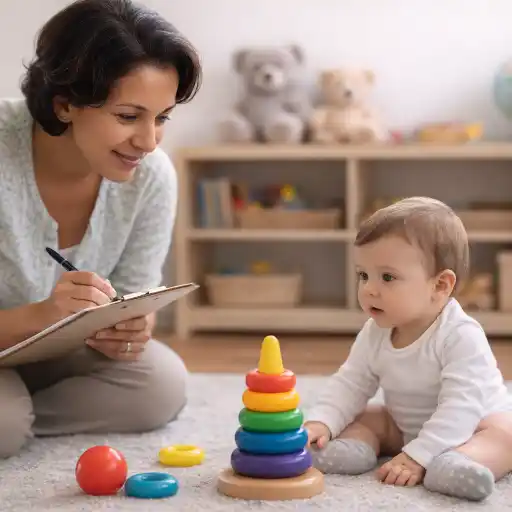
Write what another person could see or hear. Include the date, approximate time, routine or setting, object or person in view, infant’s position, observable gaze or body movements, and what happened next. Note environmental factors that may matter, such as distance, lighting, sound, or adult support. Keep the factual description separate from your later interpretation.
For example, rather than writing, “Mina loved the rattle but could not reach it,” record: “At 9:15 a.m. on the floor mat, Mina looked toward the red rattle on the low shelf for about 8 seconds, turned her head as it moved, and then looked toward the educator. The educator moved the rattle closer; Mina continued looking and vocalized.” The second note does not assume emotion or explain why Mina did not reach. It gives colleagues and family members a concrete account to consider.
- Identify what drew the infant’s attention: a person, object, movement, sound, or contrast.
- Describe gaze and movement precisely: looked toward, tracked, turned head, paused, shifted body, or looked away.
- Record relevant context and adult actions, including whether the object’s position changed.
- Use a brief interpretation only in a separate reflection field, and label it as a possibility.
A helpful check is the “camera test”: could a camera or another observer verify the sentence? If not, revise it into specific evidence. This supports objective documentation of observations and helps prevent assumptions from becoming labels.
How can observation stay responsive without requiring a grasp?
Observation should not become a performance prompt. Avoid repeatedly placing an object in the infant’s hand, moving it closer and closer until the child touches it, or treating a lack of reaching in one moment as proof of a deficit. A child may be attending visually, may need time, may prefer a different position, or may simply be ready to disengage. Respecting the infant’s cues is central to responsive care.
Set up a safe, age-appropriate opportunity that allows looking to count as participation. Place a suitable object within the infant’s field of view and at a comfortable distance; ensure the infant is supported in a safe position, and stay close. Pause to give time for the infant to look, shift attention, vocalize, or move. If the infant looks away, becomes unsettled, or signals fatigue, reduce stimulation or end the interaction. Keep active supervision foremost; documentation must never distract from care.
Providers can use a simple cycle:
- 👀 Notice: Identify the infant’s gaze, head turn, pause, or other observable cue.
- Wait: Allow time without prompting a specific action.
- Respond: Offer a warm comment or adjust the environment gently if appropriate.
- Revisit: Observe in another moment or routine to learn whether the interest recurs.
This approach protects the infant’s agency and makes room for varied ways to participate. As Head Start’s infant-toddler observation guidance illustrates, stepping back to notice what holds a child’s attention can reveal a promising interest and inform a thoughtful next experience.
How can a looking-and-interest log make notes useful over time?
A short, consistent log makes small observations easier to review and compare. Use the program’s approved form or record system, and include fields for date and time, context, object or event, what the infant looked at, duration if practical, associated movement or sounds, adult response, and a separate reflection or next-step field. The Infant Looking, Reaching, and Interest Observation Log can help providers organize these details and turn everyday moments into usable records.
Review notes across several days and contexts rather than drawing conclusions from a single episode. Does the infant repeatedly watch a moving object? Do they look longer when a familiar adult names it? Does the interest show up during floor play, a care routine, or outdoor time? Patterns may help educators choose materials, positioning, pacing, and interaction strategies that suit the individual infant. NAEYC’s guidance on using observation to guide teaching emphasizes reflecting on what is seen and using it to adapt strategies and design learning experiences.
Keep documentation concise, strengths-focused, and confidential. Follow program policy for records, photographs, and sharing. A log is a support for ongoing assessment and planning, not a diagnostic tool or a substitute for formal screening when concerns arise.
How should providers share observations and decide what comes next?
Share a specific moment with the family and invite their perspective. For example: “During floor play today, Mateo watched the cloth ball roll across the mat and turned his head as it moved. Have you noticed him tracking moving objects or watching a favorite toy at home?” This kind of conversation recognizes the family as an essential source of knowledge about the infant’s preferences, routines, language, and experiences.
Use observations to make small, flexible planning choices. If the infant repeatedly looks toward a soft, safe object, you might offer it again in a calm setting, adjust its position so it is visible, or narrate its movement while allowing time for the infant’s response. The aim is not to coax a grasp, but to create an accessible opportunity for the infant to explore in their own way. Responsive next steps should be based on the child’s cues and revisited as the infant’s interests change.
When an ongoing developmental concern is raised by staff or family, share factual examples privately, listen carefully, and follow program procedures for consulting the family and appropriate professionals. Observation can contribute valuable information, but providers do not diagnose. Developmental milestones are useful guides, not a reason to judge a child from a single moment. State requirements vary - check your state licensing agency.
Conclusion: How can providers document interest without requiring a grasp?
Providers can document an infant’s interest before reaching by treating gaze, tracking, head turns, pauses, and other visible cues as meaningful evidence. Record the context and actions objectively, keep interpretation separate, and offer safe opportunities to explore without prompting or requiring a grasp. Review observations over time, use them to shape responsive care, and invite families to add what they know.
The central practice is simple: notice, record, reflect, and respond at the infant’s pace. A thoughtful observation log helps make quiet moments visible and supports individualized planning—while honoring the fact that looking itself can be a meaningful way an infant participates.
Explore five relevant ChildCareEd courses
- CDA Infants/Toddlers: Benefits to Observing Buy Now $16.00
- Early Learning with Infants and Toddlers Buy Now $24.00
- Tracking Progress, Shaping Futures: Observation & Assessment Skills Buy Now $55.00
- Baby Play: Planning Infant and Toddler Activities Buy Now $16.00
- Baby Steps to Milestones ONLINE Buy Now $24.00
- 45 Hour Child Growth and Development
- CDA Infants/Toddlers: Benefits to Observing
- Pediatric RSV First Aid & CPR/AED
- CDA Infant/Toddler Credential with Portfolio Review
- CDA Bridge Bundle: Infant/Toddler without Portfolio Review
- CDA Bridge Bundle: Infant/Toddler
- 45-Hour Infant and Toddler Curriculum
- CDA: Stand With Respect and Professionalism
- Lesson Planning for Infants and Toddlers
- Goodbye Glitter Glue, Hello Growth: Child Development Milestones to Watch for in the New Year
- CDA Certification en Español: Recursos y Consejos para Educadores Bilingües
- Proporciones de Cuidado Infantil y Tamaños de Grupo por Edad en Virginia (Guía Rápida para Centros y Hogares)
- Cómo Trabajar en el Cuidado Infantil en Carolina del Norte: Requisitos y Pasos
- What sensory play ideas best support babies in child care?
- How Should Lesson Plans for Infants 0–12 Months Change by Age?
- How Can Child Care Providers Plan Infant Activities Around Developmental Milestones?
- How Can Child Care Providers Make Sensory Play for Babies Safe, Simple, and Developmentally Appropriate?
- How Can Child Care Providers Build a Developmentally Appropriate Curriculum for Infants?
- What Should Child Care Providers Look For in Fine Motor Skills by Age?
- How Can You Make a Design Activity Accessible to a Child with Cerebral Palsy?
- How Can Providers Notice Developmental Progress Hidden in an Infant’s Daily Routine?
- How Can Providers Notice Emerging Infant Skills Before They Become Reliable?
- How Do Infants Explore Familiar Objects in Different Places?
- How Can One Material Spark Different Discoveries for Infants and Toddlers?
- What Changes in Infant Exploration After You Rearrange the Room?
- Is a Child Ready for Letter and Number Tracing?
- What Do Different Box Lids Invite Toddlers to Discover?
- How Can Providers Document an Infant’s Interest Before They Reach or Grasp?
