A basket of cups, scarves, or large blocks can become a rich learning invitation when each child is free to explore in an age- and ability-appropriate way. The Baby Play: Planning Infant and Toddler Activities  Buy Now $16.00 course helps providers plan individualized experiences and balance adult-guided and child-directed play; it can strengthen your classroom practice while supporting relevant professional learning. Read on for a practical way to use one material with a mixed-age group—and explore the course for a deeper planning framework.
For additional perspectives, Playful Learning: Infant & Toddler Activities Buy Now $25.00 focuses on planning for individual ages and abilities, while Playful Spaces for Infants & Toddlers Buy Now $24.00 explores age-appropriate materials, inclusive environments, and opportunities for exploration.
Why plan one material for different discoveries?
In a room with infants and toddlers, a single activity cannot—and should not—ask every child to do the same thing. A material can stay consistent while the ways children engage with it vary according to their development, interests, sensory preferences, and current capabilities. This gives educators a manageable starting point without turning play into a uniform lesson.
Open-ended materials invite children to investigate at their own pace. A large fabric square, for example, may invite an infant to watch its movement, reach toward it, or feel it with a caregiver nearby. A toddler may carry it, hide a toy beneath it, or use it in pretend play. These are not lesser and greater versions of one task; they are distinct, meaningful encounters.
Planning this way can also make classroom practice more intentional. Instead of preparing separate activities for every child, providers select a safe material, consider possible entry points, and observe how children use it. Responsive adults can then describe discoveries, offer a small adaptation, or step back when children are engaged. Head Start describes play as a flexible, motivating context for learning, with attentive adults playing an important role in supporting exploration.
How do you choose a material that welcomes varied play?
Start with a material that is open-ended, familiar enough to invite confidence, and appropriate for the children in your care. Everyday objects and natural materials can connect classroom exploration with children’s homes and communities. The Virtual Lab School’s guidance on materials in infant and toddler environments emphasizes meaningful, developmentally appropriate choices that relate to children’s interests and experiences.
Before introducing anything, evaluate its safety and suitability for the specific group. Consider mouthing, choking hazards, allergies, cleaning requirements, and whether the material can be used safely by children with different mobility and communication abilities. State requirements vary - check your state licensing agency, and follow your program’s supervision and health policies.
- Choose one versatile material: large fabric pieces, sturdy cups, soft blocks, or a large ball.
- Offer a small number of pieces at first, adding more if play calls for it.
- Make the material visible and reachable; bring it to a nonmobile infant rather than expecting the child to reach an inaccessible setup.
- Notice children’s interests and family context when selecting familiar or culturally meaningful objects.
- ✨ Keep the invitation simple: a prepared space, a few safe items, and time to explore.
The goal is not to find a magical object that engages everyone in the same way. It is to select a material with multiple safe possibilities and then remain curious about what each child notices.
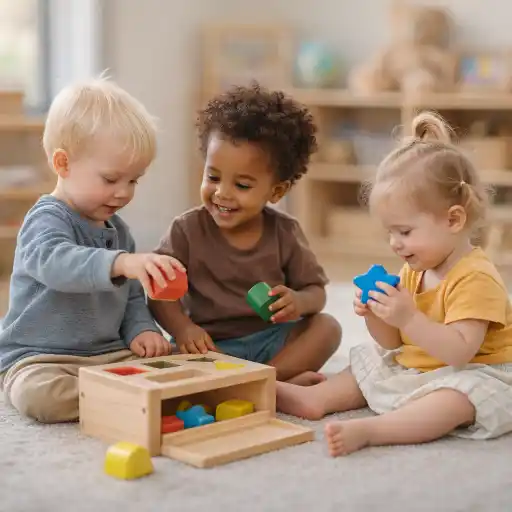
What might the same material offer at different developmental levels?
Consider a set of large, sturdy cups. For a young infant, a caregiver might hold one in the child’s view, move it slowly, and pause so the baby can track, gaze, or reach. An older infant may grasp, mouth when safe and developmentally expected, bang, or transfer a cup between hands. A toddler may stack cups, place one inside another, carry them, or experiment with putting large objects in and taking them out.
These variations support different kinds of participation while preserving the shared material. An infant’s discovery may be the cup’s sound or movement; a toddler’s may involve nesting, filling, or cause and effect. Children can also choose to watch first or return to the material later. Head Start’s resource on designing exploration experiences notes that open-ended play allows children to engage at an appropriate level and pace.
Use a simple planning matrix to clarify your options before play begins:
- Material: What is offered, and how will it be kept safe?
- Possible infant discovery: What could the child notice through looking, listening, reaching, or touching?
- Possible toddler discovery: Could the child move, combine, compare, fill, stack, or use it symbolically?
- Adult support: What will you observe, describe, or adapt without taking over?
- Evidence to notice: What actions, gestures, sounds, or words will help you plan a next step?
A matrix is a menu of possibilities, not a script. Follow the child’s cues and adjust to what actually happens.
How can educators support exploration without directing every move?
Begin by preparing a safe, uncluttered space and making the materials accessible. Then observe before intervening. Children may need time to watch, repeat an action, or approach in their own way. A responsive adult can stay close, offer emotional security, and use brief language to make a child’s action visible: “You tapped the cup. It made a sound.” For a toddler, “You put one cup inside another” acknowledges the exploration without prescribing what to do next.
Offer a light prompt or demonstration when it genuinely helps a child continue. For example, place a cup within reach, reposition materials for access, or model one possible action, then allow the child to decide whether to imitate, adapt, or ignore it. The Active Exploration resource highlights supporting children’s observation and autonomy by encouraging them to investigate in their own way.
Participation does not have to mean touching or manipulating. A child might watch, gesture, vocalize, use a mobility aid, or explore with a tool. Respect sensory preferences and communication differences; offer a nearby alternative when needed. If a child turns away or becomes distressed, pause and respond to that cue rather than insisting on engagement.
Document what you see in concrete language. “Maya placed three cups inside one another and then removed them” is more useful than “Maya understood nesting.” Objective notes help staff reflect on children’s interests and choose a suitable next invitation.
How can you keep the experience safe and inclusive?
Mixed-age play requires active supervision and thoughtful material selection. A material that is suitable for a mobile toddler may pose a choking or mouthing risk for an infant nearby. Inspect items before use, remove damaged materials, and arrange the space so educators can see and reach every child. When risks cannot be controlled in a shared area, use separate or carefully adapted setups.
Inclusion starts with multiple ways to engage. Adjust the material’s position, quantity, texture, or presentation to suit each child. A child who is not yet mobile may explore while supported in a safe position with the material brought within view and reach. A child who prefers not to touch might watch the adult move it, use a large tool, or join through sound, gaze, or gesture. Ask families about children’s interests, home experiences, and relevant sensory or health considerations.
- Keep infants’ mouthing behaviors and choking risks in mind; avoid small parts when they are accessible to young children.
- Check materials for cleanliness, breakage, sharp edges, and other hazards before and after use.
- Stay close and supervise actively, especially when children share materials or explore water and sensory items.
- Offer participation by watching, reaching, moving, communicating, or taking a break.
- Follow individualized guidance, program procedures, and applicable licensing rules.
Safety and inclusion are not add-ons to exploration. They are the conditions that allow children to engage with confidence and give educators the space to respond thoughtfully.
How can you reflect and extend discoveries over time?
After the experience, use your observations to decide whether to repeat the material, change one feature, or introduce a related invitation. If infants watched a scarf’s movement, you might offer a different safe fabric or explore it during a calm one-to-one interaction. If toddlers repeatedly nested cups, provide cups of varied sizes or another safe nesting set. Keep the central interest familiar while adding a manageable variation.
Consider what children did, not whether they completed an adult-designed outcome. Ask: Which actions did they repeat? How did they communicate? Who watched before joining? Did the setup allow children to reach and participate? What adjustment would make the next opportunity more accessible or engaging? These questions turn everyday play into an ongoing planning cycle: observe, prepare, offer, reflect, and adapt.
Share specific, strengths-based observations with families and colleagues. A short note such as “Several children explored the cups by tapping, nesting, and carrying them” communicates the learning more clearly than a broad label. Families may offer context or suggest familiar household materials, strengthening the connection between home and classroom. The NAEYC resource Using Materials Creatively to Enhance Toddler Learning Environments offers examples of following children’s interests and drawing on repurposed materials.
For a more structured way to translate developmental knowledge into individualized activity planning, explore Baby Play: Planning Infant and Toddler Activities Buy Now $16.00. It addresses individual planning and both teacher- and child-directed experiences.
Conclusion: How can one material support many discoveries?
One material can offer infants and toddlers very different, equally meaningful ways to investigate. Choose an open-ended, safe item; plan several possible entry points; and adapt the setup to children’s ages, abilities, interests, and sensory preferences. The adult’s role is to prepare, supervise, observe, and respond—not to require every child to use the material in the same way.
Use a planning matrix as a flexible reminder of possibilities, then let children’s actual actions guide your next step. When providers document discoveries and reflect with colleagues and families, simple materials can support purposeful, responsive play across a mixed-age group.
Related ChildCareEd courses
- Baby Play: Planning Infant and Toddler Activities Buy Now $16.00
- Playful Learning: Infant & Toddler Activities Buy Now $25.00
- Playful Spaces for Infants & Toddlers Buy Now $24.00
- Early Learning with Infants and Toddlers Buy Now $24.00
- Playing with a Purpose: Infant/Toddler Lesson Planning Buy Now $24.00
- Positive Attention: Interactions & Supervision of Infants & Toddlers
- 45 Hour Preschool Methods and Materials
- Teacher & Me Playtime
- 45 Hour Infant and Toddler Methods and Materials
- 45 Hour School Age Methods and Materials
- 45-Hour Infant and Toddler Curriculum
- Play, Learn, Grow
- Risk Reduction: Infants and Toddlers in Family Child Care
- Bye Bye Winter: The Role of Outdoor Play in Early Childhood Development
- Recursos en Español sobre el Sueño Seguro del Bebé
- Apoyo en Español para Capacitaciones Grupales Presenciales y por Zoom en Cursos Selectos
- ¿Qué Calificaciones Necesitas para Trabajar en Cuidado Infantil?
- ¿Cuáles son los pasos, requisitos y opciones en línea para la certificación de 90 horas en cuidado de Infantes/Toddlers en Maryland?
- 10 Ejemplos de Cómo la Cultura Influye en el Desarrollo Infantil
- Proporciones de Cuidado Infantil y Tamaños de Grupo por Edad en Maryland (Guía Rápida para Centros y Hogares)
- Proporciones de Cuidado Infantil y Tamaños de Grupo por Edad en Virginia (Guía Rápida para Centros y Hogares)
- Canciones, juegos y preguntas de círculo para niños
- La mejor manera de hacer seguimiento a la capacitación de su equipo de daycare How to Organize Staff Training for Your Child Care Center Cómo organizar la capacitación del personal para su centro de cuidado infantil
- Cómo simplificar la capacitación para sus empleados de daycare
- How can I use simple STEM activities to spark curiosity in preschoolers?
- Crunch, Stomp, Scoop! Fall Activities Toddlers Can’t Resist
- Proporciones para guarderías en casa bajo el Título 22: Cómo la mezcla de edades cambia su capacidad en California
- How Can Sensory Bin Ideas Promote Early Language Skills?
- How Can You Plan a Toddler Sensory Experience Around Curiosity, Not a Finished Product?
- How Can You Repeat a Toddler Activity Without Repeating the Exact Same Lesson?
- What Does a Toddler Block Area Need for Real Experimentation?
- How Can One Material Spark Different Discoveries for Infants and Toddlers?
