Infants learn through relationships, movement, sensory exploration, and repeated everyday experiences—not through rigid lessons. The Baby Play: Planning Infant and Toddler Activities  Buy Now $16.00 course can help you turn developmental knowledge into individualized activities while supporting focused professional learning in CDA Subject Area 2. For a broader planning framework, explore Meaningful Lesson Planning for Infants/Toddlers Buy Now $24.00.
Planning for infants can feel demanding because children in the same room may have dramatically different abilities, routines, temperaments, and communication styles. A thoughtful plan does not ask every child to perform the same skill at the same time. Instead, it gives caregivers a practical framework for observing each infant, selecting an achievable next step, and offering responsive experiences that support development while preserving safety, attachment, and joy.
Why should developmental milestones guide infant activity planning?
Developmental milestones are observable skills that most children demonstrate within a general age range. The CDC organizes milestones across how children play, learn, speak, act, and move, with reference points such as 2, 4, 6, 9, and 12 months. These markers are useful for planning because they help providers select materials and interactions that are neither unnecessarily difficult nor developmentally limiting.
Milestones should be used as a planning lens, not as a rigid timetable or a ranking system. Infants develop unevenly: one child may be highly mobile while another is especially engaged socially or vocally. Cultural practices, language, temperament, health, and opportunities for movement also influence how skills appear. NAEYC’s developmentally appropriate practice framework emphasizes individualized, culturally responsive care grounded in relationships.
The most effective plans connect a child’s current abilities to a small next step:
- Observe what the infant already does, enjoys, avoids, or attempts.
- Choose one attainable developmental goal.
- Offer repeated opportunities during play and care routines.
- Adjust the experience according to the infant’s cues.
- Document progress with specific, objective observations.
This approach supports #development without turning play into a test. It also helps directors coach teams using a shared professional language.
What activities are appropriate for infants from birth to 3 months?
For young infants, security and co-regulation come first. The caregiver’s voice, face, touch, and predictable response are central learning resources. Activities should be brief, calm, and embedded in holding, feeding, diapering, and supervised floor play.
Caregivers can position themselves within the infant’s visual field, speak slowly, imitate coos, and pause to allow a response. High-contrast images, a familiar face, gentle singing, and slowly moving objects can encourage visual attention and tracking. During awake, supervised tummy time, a caregiver’s face or a simple safe toy may motivate brief head lifting and turning.
At this age, the goal is not to create a formal group lesson. A meaningful plan might focus on “encouraging visual attention to a familiar caregiver” or “supporting brief head lifting during supervised floor play.” Observe when the infant is alert and comfortable; after feeding or near sleep, rest may be more appropriate than play.
- Use soft voices, slow movements, and familiar songs.
- Provide uncluttered floor space instead of extended time in containers.
- Pause frequently so the infant can participate through gaze, movement, or sound.
- Watch for overstimulation, including turning away, yawning, stiffening, fussing, or crying.
- Follow safe-sleep practices; tummy time is for awake, supervised periods only.
Documentation should describe visible behavior: “looked toward the caregiver’s voice and maintained gaze for four seconds,” rather than “was attentive.”
How can activities support development from 3 to 6 months?
Between approximately 3 and 6 months, many infants become more socially engaged and physically active. They may smile, laugh, coo, reach, grasp, push up on their forearms, roll, or begin sitting with support. Planning can therefore include more reciprocal interaction, object exploration, and opportunities to move freely on the floor.
Offer large, safe objects with contrasting colors, sounds, weights, and textures. Place an appealing object within reachable distance so the infant can practice looking, swatting, reaching, grasping, and bringing objects toward the mouth. Narrate the infant’s actions: “You reached for the ring,” or “You heard the shaker.” This links physical exploration with language and shared attention. For more ideas on supporting children’s natural development through play, see play activities that build fine motor skills.
Face-to-face games, mirrors, family photographs, board books, and songs can support social-emotional and communication development. A caregiver might repeat an infant’s vocalization, wait, and respond again, creating an early serve-and-return exchange. These short interactions can occur during floor play, diapering, or transitions.
- 🎵 Pair movement with singing, clapping, or rhythmic vocal play.
- Use toys that are easy to grasp and large enough to reduce choking risk.
- Provide supported sitting only when the infant is ready and the environment is secure.
- Repeat favorite experiences while varying materials slightly.
- Allow observation and rest; participation should never be forced.
Individualization remains essential. A six-month-old who is rolling confidently and a peer who is concentrating on head control can both receive appropriate support when adults adapt positioning, timing, and materials.
Which experiences encourage learning from 6 to 9 months?
From 6 to 9 months, many infants are developing mobility, intentional communication, object exploration, and early problem-solving. Some sit independently, transfer objects between hands, respond to their names, babble with repeated consonants, or search for objects that disappear. Movement varies: crawling is common for some children, while others roll, pivot, or scoot.
Create a safe environment that invites movement. Place a preferred toy slightly beyond reach, close enough to make the challenge achievable without creating frustration. Soft blocks, low cushions, sturdy containers, and large fabric pieces can support reaching, moving around, filling, dumping, and cause-and-effect exploration. Peek-a-boo and partially hiding a familiar toy encourage anticipation, memory, and object permanence.
Language planning should become increasingly responsive. Repeat the infant’s sounds, add simple words, and acknowledge gestures such as reaching, pointing, or raising the arms. If the program and family use signs, consistent gestures for “more,” “up,” and “all done” can expand communication opportunities.
- Rotate a few materials rather than presenting an overwhelming selection.
- Use containers, scarves, and large objects for early problem-solving.
- Build practice into meals, transitions, outdoor exploration, and floor play.
- Document how the infant approaches a challenge, not only whether the task is completed.
- Recheck the room for small parts, cords, unstable furniture, and pull-down hazards as mobility changes.
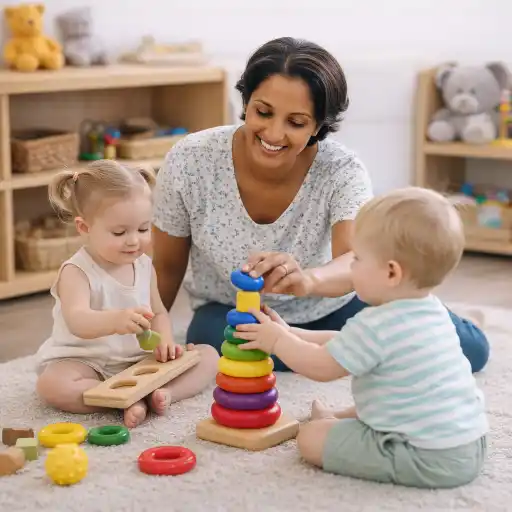
Harvard’s Center on the Developing Child notes that playful interactions help infants practice attention, working memory, and early self-control. The adult’s responsive presence makes simple play cognitively meaningful.
How should planning change from 9 to 12 months?
Older infants often show greater mobility, purposeful communication, imitation, and persistence. They may crawl, pull to stand, cruise, use a developing pincer grasp, imitate gestures, follow familiar words, and search for hidden objects. Plans can offer more choice and early independence while continuing to protect the infant’s need for connection and co-regulation.
Prepare low, safe invitations to explore: sturdy furniture for cruising, large containers for putting in and taking out, chunky blocks for stacking or dropping, and books with flaps or textured pages. Invite infants to participate in songs with pauses, imitate gestures, point to familiar people or objects, and make choices between two safe materials.
Caregivers can extend thinking without turning play into a performance. When an infant drops a block, describe what happened and allow time for repetition. When an infant points, name the object and respond to the communication. When frustration increases, simplify the challenge, provide limited assistance, or offer a break.
- Provide stable surfaces and close supervision during pulling up and cruising.
- Use large materials; pincer-grasp practice must never involve unsafe small objects.
- Support early literacy through picture naming, repetition, rhythm, and shared attention.
- Offer simple choices when appropriate, such as selecting between two books.
- Coordinate plans with families, especially around language, feeding, sleep, and gestures.
Walking is not the only meaningful indicator of progress. An infant who is not yet walking may be making significant gains in balance, communication, problem-solving, or social engagement.
How can providers document, adapt, and improve milestone-based plans?
A usable infant plan can fit on one page. Begin with one to three individualized goals, identify a few materials, connect activities to routines, and include one observation question. NAEYC recommends ongoing, purposeful observation and documentation that informs curriculum, communication with families, and program improvement.
- Observe: Identify the infant’s current abilities, interests, cues, and approaches.
- Plan: Select one achievable next step and a short experience.
- Interact: Follow the infant’s lead, narrate actions, and wait for responses.
- Document: Record a dated, objective anecdote tied to the goal.
- Reflect: Repeat, simplify, adapt, or extend the activity based on evidence.
For example, instead of writing “work on communication,” write: “During diapering, caregiver will imitate vocalizations and pause for a response; observe whether the infant initiates or sustains a vocal exchange.” This makes the plan actionable and helps staff notice progress across contexts.
Common mistakes include using one plan for every infant, scheduling lengthy teacher-led lessons, setting too many goals, presenting excessive materials, and treating milestone checklists as assessments. Educators observe and support; they do not diagnose. If an infant is not meeting one or more milestones, loses previously acquired skills, or prompts persistent concern, share objective observations with the family and encourage consultation with the child’s health care provider or early intervention system. State requirements vary - check your state licensing agency.
Family partnership improves planning. Begin with strengths, ask what the family notices at home, honor home languages and caregiving practices, and offer one realistic activity that fits family routines. The CDC provides milestone resources and checklists in multiple languages that can support respectful conversations.
Conclusion: How can infant activities be planned around developmental milestones?
Plan infant activities by combining developmental knowledge with close observation, responsive relationships, flexible routines, and family partnership. Use milestones to identify possible next steps, not to impose deadlines. Offer brief, repeated experiences that support multiple domains at once: a song can build connection and communication, a reachable toy can support motor and cognitive exploration, and a diapering conversation can strengthen language and trust.
The strongest infant curriculum is not a rigid schedule or a collection of expensive materials. It is the caregiver who notices, waits, responds, adapts, documents, and celebrates small gains. When providers use that cycle consistently, everyday care becomes intentional, inclusive, and developmentally meaningful.
Sources and further reading
- CDC Developmental Milestones
- NAEYC: Developmentally Appropriate Practice with Infants and Toddlers
- Head Start: Developmentally Appropriate Practice
- NAEYC: Observing, Documenting, and Assessing Development
- ZERO TO THREE: Infant and Toddler Development, Screening, and Assessment
- Harvard Center on the Developing Child: Brain-Building Through Play
- CDC Resources for Early Childhood Educators
- CDC Milestone Checklists in Multiple Languages
Related ChildCareEd courses
- Positive Attention: Interactions and Supervision of Infants and Toddlers: For Workforce Solutions
- CDA Infants/Toddlers: Lesson Planning Made Easy
- Children at the Wheel: Emergent Curriculum
- Baby Play: Planning Infant and Toddler Activities
- 45-Hour Infant and Toddler Curriculum
- Positive Attention: Interactions & Supervision for Infants & Toddlers
- Baby Steps to Milestones ONLINE
- Montessori Cultural Activities: Exploring the World Through Play and Learning
- Meaningful Lesson Planning for Infants/Toddlers
- Playing with a Purpose: Infant/Toddler Lesson Planning
- Actividades de Motricidad Gruesa que Desarrollan el Equilibrio, la Coordinación y la Fuerza
- Regulaciones de Licenciamiento de Cuidado Infantil en California para Centros y Hogares de Cuidado Infantil Familiar
- Proporciones de Cuidado Infantil y Tamaños de Grupo por Edad en Maryland (Guía Rápida para Centros y Hogares)
- Proporciones de Cuidado Infantil y Tamaños de Grupo por Edad en Nueva Jersey (Guía Rápida para Centros y Hogares)
- Proporciones de Cuidado Infantil y Tamaños de Grupo por Edad en Virginia (Guía Rápida para Centros y Hogares)
- Retraso del Habla en la Guardería: Cómo Pueden Ayudar los Proveedores
- Cómo simplificar la capacitación para sus empleados de daycare
- Mixed-Age Daycare Schedule: How to Plan a Day for Different Age Groups
- Should You Use Corrected Age for an 8-Week-Old Baby Born Prematurely?
- How Should Lesson Plans for Infants 0–12 Months Change by Age?
- Hello, Fall! Cozy Activities to Help Babies Explore the Season
- From Tummy Time to First Steps: Free Lesson Plans for Infants 0–12 Months
- How Can Child Care Providers Understand and Support Infant Milestones?
- How Can Child Care Providers Support Infant Development?
- How Can Child Care Providers Support Preschool Development Across the Whole Child?
- How Can Child Care Providers Plan Infant Activities Around Developmental Milestones?
- How Can Child Care Providers Support School-Age Development?
- How Can Child Care Providers Support Infant and Toddler Development?
- What Are the Social-Emotional Milestones From Birth to Age 5?
- How Can Providers Notice Emerging Infant Skills Before They Become Reliable?
