An infant who spots a familiar toy in a new part of the room may pause, reach, turn it over, or explore it all over again—small actions that reveal active learning. The Baby Play: Planning Infant and Toddler Activities  Buy Now $16.00 course can help you turn these everyday discoveries into individualized, developmentally appropriate play experiences. Explore the ideas below, and consider the course for a fuller framework for planning responsive activities and strengthening your classroom practice.
Why do familiar objects in new places matter?
To an adult, a familiar soft ball or cup may seem unchanged wherever it sits. For an infant, seeing that object in a different spot offers a fresh opportunity to notice, remember, and investigate. The child may recognize its shape or texture, yet also discover how it looks against a new background, feels from another position, or moves when handled in a different way.
Object play is not a task infants need to complete correctly. It is a natural, repeated process of looking, reaching, grasping, mouthing when safe, listening, and trying again. Research on everyday home play describes infants moving among many objects in brief bouts, with those varied interactions creating opportunities for learning across developmental domains. The adult’s role is to make room for this exploration and observe what the infant chooses to do.
These moments matter because they connect memory and perception with movement, attention, and early communication. A caregiver can support that connection without taking over: stay close, name what the child notices, and allow time for a response. Follow the infant’s #curiosity rather than expecting every child to explore in the same way or for the same length of time.
How do infants investigate similar objects across different locations?
Infants use their senses and bodies to learn about objects. They may look closely, reach from a new angle, grasp and release, shake, rub, or bring an age-appropriate item to the mouth. When a familiar object appears in another location, the child can compare what seems consistent—such as its color, shape, or sound—with what has changed, including its position, nearby objects, or the way it moves.
Early exploration is often brief and nonlinear. A baby might look at a ring, turn away, then return to it after noticing the same ring beside a book or near a caregiver. This shift is not necessarily loss of interest; infants’ attention naturally moves. Research on hand development also emphasizes how reaching, grasping, and manipulating objects build on one another as infants learn through action.
Caregivers can help by describing observable actions in simple language: “You found the ring beside the basket,” or “You turned it, and now the light looks different.” Pause after speaking. The infant might answer with a gaze, a movement, a sound, or another action. This responsive narration supports early language while keeping the child in charge of the exploration.
- Notice what the infant looks at, reaches for, repeats, or leaves behind.
- Offer time to explore rather than demonstrating a “right” way to use the object.
- Change your position, when appropriate, so the child can view an object from another angle.
How can providers plan safe, meaningful object invitations?
Begin with materials that are familiar, sturdy, clean, and appropriate for the child’s age and abilities. A familiar object can be offered in two safe locations—for example, first on the play mat and later beside a low basket—so the infant can notice both the object and its surroundings. The goal is not to test recognition; it is to offer an inviting context for self-directed exploration.
Choose only a small number of materials at a time. A soft toy, a large textured ring, or an unbreakable container may provide plenty to investigate. Consider whether the material can be mouthed safely, whether it has detachable parts, and whether it can be cleaned according to program procedures. As mobility and mouthing behavior change, recheck the play space and the materials.
- Place an object within comfortable reach, adapting the position to the infant’s mobility and posture.
- Offer duplicates of familiar materials when that supports calm exploration and reduces competition.
- Use simple contrasts—such as soft and firm or still and moving—without crowding the space.
- 🧸 Stay close and actively supervise; remove any item that is damaged or unsuitable.
Materials that connect with a child’s home and community can make exploration feel meaningful. Invite families to share information about familiar objects, routines, or words, while following program policies for borrowed items. Avoid placing loose small parts within reach, particularly when infants are mouthing objects. State requirements vary - check your state licensing agency.
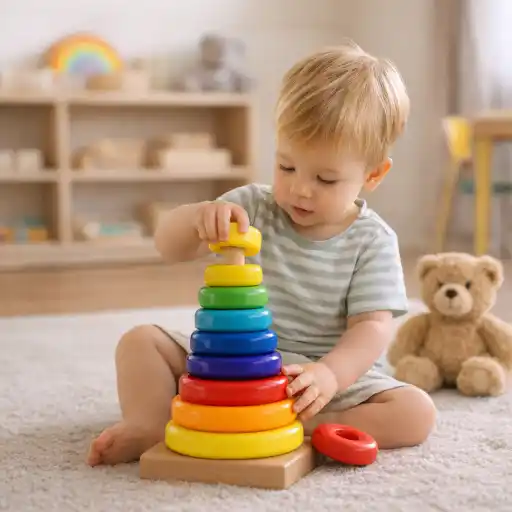
How can adults follow infant cues without directing the play?
Responsive support begins with watching. Engagement may appear as a steady gaze, relaxed body, reaching, kicking, vocalizing, or repeating an action. A caregiver can acknowledge these signals and describe what is happening, then wait. This balance—attentive presence with room for the infant to act—lets the child lead while preserving connection.
Infants also communicate when an experience is too much or no longer interesting. Looking away, fussing, stiffening, or turning the body may signal a need for a pause, comfort, or a change. Respond without pressure: reduce stimulation, offer a familiar interaction, or end the activity. A brief encounter is still valuable if the infant had time to participate and the adult respected the child’s cues.
Different infants may approach the same object in different ways. One may watch carefully before reaching; another may immediately grasp and shake it. Neither response is more advanced in every context. Adapt the invitation to the individual child’s abilities, sensory preferences, and communication style. For children who need additional support, consider positioning, accessible materials, and alternative ways to participate, such as watching or listening.
Try this simple interaction cycle:
- Notice: What does the infant attend to or repeat?
- Respond: Describe the action or offer a warm, brief comment.
- Wait: Give the infant time to continue, shift attention, or respond.
- Adjust: Continue, simplify, or stop based on the child’s cues.
How can educators document and extend discoveries?
Concise, objective observations help a team plan with intention without turning play into a checklist. Record what the infant did, where the object was, and how the adult responded. For example: “During floor play, Luis noticed the familiar cloth ball beside the basket, reached with his left hand, squeezed it, and then looked toward the caregiver.” This description gives colleagues useful information without assuming what the infant understood.
Use observations to choose a gentle next step. If a baby repeatedly reaches for a familiar object, offer it again in another safe position. If the infant watches it roll, provide an uncluttered space to observe the movement. You might also revisit the object during a routine or share the infant’s interest with the family. The next invitation should build on what the child actually showed—not on an expectation that every infant will demonstrate the same skill.
Directors can support consistency by encouraging brief notes during regular planning or handoffs and by helping staff reflect together. Ask: What captured the infant’s attention? What cues suggested comfort or a need for a break? What small change could invite another exploration? This makes everyday observation a practical tool for individualized care and thoughtful curriculum planning.
For more professional learning, these English-language ChildCareEd courses connect closely with the ideas in this article:
- Playful Learning: Infant & Toddler Activities Buy Now $25.00 — individual activity planning matched to children’s abilities.
- Playful Spaces for Infants & Toddlers Buy Now $24.00 — environments and materials that invite exploration.
- Tomorrow’s Einsteins: Infant and Toddler Science Buy Now $16.00 — supporting young children’s curiosity and inquiry.
Conclusion: How can providers nurture exploration across places?
Infants explore familiar objects in different locations by using their senses, movement, attention, and emerging memory. A changed setting can make an ordinary object interesting again, inviting the child to look, reach, handle, and notice. Providers can nurture these discoveries by offering a few safe, familiar materials, allowing time for child-led exploration, narrating without taking over, and responding to each infant’s cues.
Keep the experience flexible: safety and connection come first, and no single response is required. Observe what the child actually does, document it briefly, and use those observations to plan a thoughtful next opportunity. When caregivers treat everyday object play as meaningful learning, familiar things—and the new places where children find them—become rich invitations to explore.
- 45 Hour Infant and Toddler Methods and Materials
- Pediatric RSV First Aid & CPR/AED
- CDA Bridge Bundle: Family Child Care without Portfolio Review
- CDA Bridge Bundle: Infant/Toddler without Portfolio Review
- 45-Hour Infant and Toddler Curriculum
- Creating Environments that Nurture Growth and Community
- Texas Director Credential
- Every Moment Matters: Schedules and Transitions
- Supporting Families and Caregivers in Language and Literacy
- Recursos en Español sobre el Sueño Seguro del Bebé
- Capacitación en Salud y Seguridad Preventiva en Línea para Proveedores de Cuidado Infantil
- Cómo Iniciar el Proceso de Obtención de la Licencia de Cuidado Infantil
- Lista para Guardería en Casa en Illinois: Cómo Iniciar una Guardería en el Hogar
- Lista para Guardería en Casa en Texas: Cómo Iniciar una Guardería en el Hogar
- Cómo Ser Maestra de Preescolar en Dakota del Norte
- Capacitación Previa al Servicio para Proveedores de Cuidado Infantil en Dakota del Norte
- La mejor manera de hacer seguimiento a la capacitación de su equipo de daycare How to Organize Staff Training for Your Child Care Center Cómo organizar la capacitación del personal para su centro de cuidado infantil
- Cómo simplificar la capacitación para sus empleados de daycare
- Proporciones para guarderías en casa bajo el Título 22: Cómo la mezcla de edades cambia su capacidad en California
- Social Studies Activities for Toddlers: Start With Home, Helpers, and Their Little World
- How Can Child Care Providers Support Infant Development?
- How Can STEM Activities Turn Everyday Preschool Play Into Powerful Learning?
- How Can Day vs. Night Sorting Help Children Understand Time and Routine?
- What Developmental Milestones Should Teachers Know From Birth to Age 5?
- How Can Child Care Providers Build a Developmentally Appropriate Curriculum for Infants?
- How Do Color-Matching Activities Support Early Classification Skills?
- How Can You Plan for Two Toddlers the Same Age but with Different Skills?
- How Do Infants Explore Familiar Objects in Different Places?
- How Can One Material Spark Different Discoveries for Infants and Toddlers?
