Every baby arrives ready to explore the world through touch, sound, sight, movement, and other sensory experiences. This practical guide helps child care providers and directors design brief, intentional, and closely supervised sensory activities that support infants’ brain development, self-regulation, language, and emerging motor skills. It includes safe activity ideas using simple materials, supervision and sanitation checklists, strategies for following each infant’s cues, documentation methods connected to developmental goals, and adaptations for children with sensory differences. To strengthen staff planning, explore ChildCareEd’s self-paced online course Baby Play: Planning Infant and Toddler Activities  Buy Now $16.00, which helps educators select developmentally appropriate activities for children from birth through age three and use individualized planning to support growth. Programs can also use the free Designing Messy Play for Infants and Toddlers Buy Now $0.00 and Learning Experiences for Infant/Toddler Buy Now $0.00 resources for low-cost sensory and fine-motor ideas. Remember to avoid choking hazards, use materials that are safe for mouthing, supervise every experience closely, and check your state licensing agency for applicable requirements.
What is sensory play for babies and why does it matter?
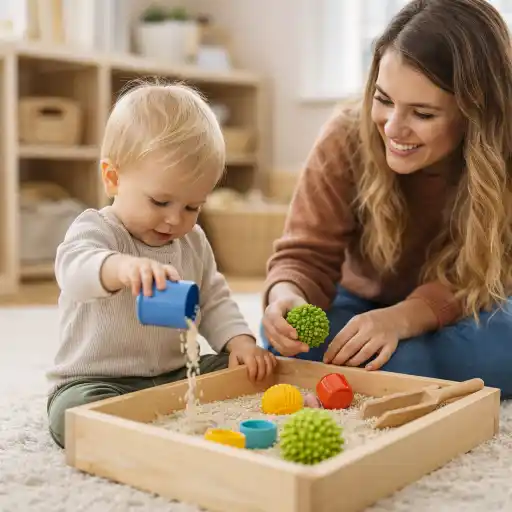
Answer: Sensory play invites infants to explore touch, sound, sight, smell, movement, and (when safe) taste in short, focused sessions. In infancy, these experiences are typically:
- Short and simple (5–10 minutes).
- Supervised within arm’s reach.
- Built from everyday, non-toxic materials.
Why it matters:
1) Brain and body integration — sensory play supports early neural pathways that link perception with action (see ChildCareEd’s overview of sensory play in early childhood here). 2) Language scaffold — naming textures and actions during play promotes vocabulary and early communication; the link between sensory experiences and language is well explained in applied resources like The Speech Practice. 3) Social-emotional regulation — gentle tactile input (soft fabrics, calm water wipes, sensory bottles) can soothe and help babies settle. Keep your focus on observing cues (relaxed body, focused gaze vs. turning away or stiffening) and adapting accordingly. Use the term #infants in notes and conversations so goals stay child-centered.
What safe, low-cost sensory play ideas can you set up quickly?
Answer: Choose 2–4 items and keep setups predictable. Below are options prioritized for infant development, sanitation, and ease of staff use. See more themes and bin ideas at ChildCareEd’s practical guides on creating sensory bins and sensory bottles Buy Now $0.00.
- 🧣 Texture touch station: 2–3 fabric squares (fleece, cotton, satin). Describe textures aloud: “soft, bumpy, smooth.” Keep fabrics larger than a toilet-paper-roll diameter to avoid choking.
- 🥄 Kitchen sound basket: unbreakable bowl + wooden spoon + measuring cup for gentle tapping and listening (avoid metal shards or sharp edges).
- 💧 Water wipe play: shallow tray with a damp washcloth and a dry cloth for contrast; adult holds container if water is used. (Always supervise; small water is a drowning risk.)
- 🪞Mirror moments: shatterproof baby mirror at tummy time to encourage eye contact and social engagement.
- 🔍 Discovery bag (press-and-watch): sealed heavy-duty zip bag with gel/water and flat large objects taped and secured (double-bag and tape edges).
- 🌿 Nature moments: shaded outdoor blanket, breeze, leaves to watch move (see outdoor safety guidance from the CDC).
Tip: For program consistency, rotate one item weekly and store kits in labeled bags so any staff member can set them up quickly. For more no-cost, classroom-ready ideas, see ChildCareEd’s post on no-cost sensory activities.
How do you set up, supervise, and document sensory play safely in child care?
Answer: Safety and intentional documentation make sensory play an asset to program quality. Follow these steps:
- 👀 Supervision: infants—adults within arm’s reach at all times. Toddlers—close visual supervision until they reliably follow safety rules. (Refer to ChildCareEd’s safety guidelines on sensory planning here.)
- ⚠️ Choose safe materials: avoid anything that fits through a toilet-paper roll; secure batteries and small parts; follow toy safety guidance from Nemours.
- 🧽 Sanitation: wash/replace materials between uses, launder fabrics, discard cracked or porous items. Use sealed containers for messy or food-based materials; consider single-use for infants if sanitation is difficult.
- 📋 Documentation: 1) Pick one learning goal (e.g., tracking, pincer grasp initiation, vocal turn-taking). 2) Record a short observation: Who, what, skill seen, next step. ChildCareEd’s resources on developmental outcomes can guide your notes (importance of sensory activities).
- 🔁 Policy reminders: post short rules ("Tools stay in tray," "No mouths") and inform families; state requirements vary - check your state licensing agency.
How can sensory play be linked to developmental goals and individualized planning?
Answer: Sensory play is ideal for meeting specific, measurable learning targets. Use these steps to connect play to goals:
For guidance on integrating these objectives into a coherent curriculum for infants and toddlers, consult the curriculum guide Tiny Tots, Big Learning: Crafting Curriculums for the Littlest Learners.
- Define one clear objective for each session (examples):
- Fine motor: reach, grasp, or begin pincer movement.
- Visual tracking & attention: follows a moving object for 3–5 seconds.
- Language: child vocalizes or responds when adult models a word.
- Choose materials that scaffold the objective (e.g., soft scarves for reaching; sensory bottles for sustained visual attention — see ChildCareEd’s sensory bottles Buy Now $0.00 tutorial).
- Use strategies that promote learning:
- Model language (narration, one- or two-word phrases).
- Pause to allow turn-taking and expectant waiting.
- Adjust challenge: simpler for infants (
- Observe and plan next steps: write a 1–2 sentence note in the child’s file: what they did, the skill level, and the next tiny step. Using sensory play in targeted ways aligns with evidence-based practice and training like ChildCareEd’s courses on play-based supports (Play with Purpose Buy Now
$55.00$40.00).
How can I avoid common mistakes and adapt sensory play for children with differing sensory needs?
Answer: Anticipate pitfalls and plan adaptations so sensory play is inclusive, safe, and effective.
Common mistakes and fixes (enumerated):
- 😬 Too many materials at once. Fix: Offer 1–2 items. Simplicity reduces overwhelm.
- 😩 Little or no cleanup plan. Fix: Use trays/dropcloths and teach tidy-up steps to staff and children.
- ⚠️ Unsafe small parts or poor sanitation. Fix: Follow the "toilet-paper-roll" rule and rotate washable or disposable materials; discard cracked pieces.
- 🚫 No documentation or goals. Fix: Link each setup to one learning objective and note observations.
Adapting for sensory differences:
- Low tolerance / over-responsive: use gentler textures, shorter sessions, dim lighting, and calm vocal modeling.
- Sensory seeking: include proprioceptive input (gentle compressions, safe pushing/pulling activities) and handheld organizing tools (fidget scarves, textured rings).
- Oral-motor explorers: use taste-safe fillers only when family consent and allergy checks are complete; otherwise, select non-food alternatives (see lists of non-food fillers at resources like You Clever Monkey and ChildCareEd suggestions).
FAQ (quick):
- Q: How often? A: Offer short sensory moments 2–4 times weekly; frequent short sessions beat one long event.
- Q: Can I use food? A: Only with a clear center policy, family consent, and allergy checks; otherwise, use non-food fillers.
- Q: What about water? A: Supervise closely and follow local rules; see CDC water and outdoor guidance here.
Why this matters now: Sensory play is a high-impact, low-cost pathway to early learning. When implemented with intentional goals, clear safety rules, and simple documentation, it becomes a routine program strength that supports infants’ #growth across domains.
Conclusion
Practical next steps for your program:
- Choose one simple sensory kit (e.g., texture squares + mirror + sensory bottle) and try it for one week.
- Train staff with a one-page safety checklist (arm’s reach rule, small-parts check, cleaning steps).
- Record one short observation per child and set a tiny next-step goal.
For step-by-step setups, downloadable ideas, and classroom-ready templates, prioritize ChildCareEd resources such as sensory play for infants, the sensory bin guide, and sensory bottle ideas at Make Your Own Sensory Bottles Buy Now $0.00. Keep it simple, safe, and tuned to each baby’s cues — your everyday moments will become meaningful steps in their development. #babies #infants #play #safety
- 45 Hour Child Growth and Development
- 45 Hour Preschool Methods and Materials
- Baby Play: Planning Infant and Toddler Activities
- Effective Approaches for Autism and Inclusion
- Play with Purpose: Supporting Children with Autism
- Risk Reduction: Infants and Toddlers in Family Child Care
- Texas Director Credential
- Wellness in Action: Teaching Healthy Habits to Children
- Montessori Cultural Activities: Exploring the World Through Play and Learning
- CDA Certification en Español: Recursos y Consejos para Educadores Bilingües
- ¿Cuáles son las mejores actividades del Día de la Tierra para niños en casa o en el aula?
- Capacitación en Salud y Seguridad Preventiva en Línea para Proveedores de Cuidado Infantil
- Actividades de Otoño Fáciles para Preescolares esta Temporada
- How can Texas infant and toddler caregivers ensure safe sleep, support brain development, and use responsive routines?
- How does the brain develop in early childhood?
- How can visuals, routines, and gentle words support Georgia preschoolers with special needs?
- 5-Week-Old Baby Milestones: What to Expect
- How can I create a nurturing infant environment in my childcare program?
- What are the best infant care practices for New York child care providers?
- Celebrando la amistad en el cuidado infantil durante el Día de los Mejores Amigos
- Canciones, juegos y preguntas de círculo para niños
- Daycare Activity Ideas for Infants, Toddlers, and Preschoolers
- How Can Texas Providers Learn from San Antonio’s Infant-Toddler Expansion About Six-Week Learning?
- What sensory play ideas best support babies in child care?
- Baby’s First Fall: Simple Ways to Explore the Season Through Play
- Hello, Fall! Cozy Activities to Help Babies Explore the Season
- Rosh Hashanah Sensory Bin Ideas: Apples, Honey, Shofars, and Sweet New Year Play
- How Can Child Care Providers Make Sensory Play for Babies Safe, Simple, and Developmentally Appropriate?
- How Can You Plan Infant Play When the Best Moment Lasts Only a Few Minutes?
