Babies learn through ordinary moments of touching, listening, looking, moving, and connecting with trusted adults—not through complicated equipment. Baby Play: Planning Infant and Toddler Activities  Buy Now $16.00 can help you turn these moments into intentional experiences while strengthening your planning practices and supporting relevant professional learning goals.
Why does sensory play matter for babies?
Sensory play is any experience that invites a baby to notice and respond to sensory information, including touch, sight, sound, smell, movement, balance, and body awareness. For infants, the most valuable experiences are usually brief, predictable, and relational. A caregiver’s voice during a diaper change, a mirror during tummy time, or a soft cloth placed within reach can be meaningful learning opportunities.
These experiences support development across several domains. When a baby reaches toward a scarf, the child is coordinating vision, movement, attention, and emerging motor control. When the caregiver says, “You found the soft cloth,” the experience also becomes a language interaction. Cause-and-effect learning develops when a baby shakes a rattle and hears a sound or presses a sealed bag and watches its contents move.
Research-informed early childhood resources consistently connect sensory experiences with physical, cognitive, language, and social-emotional development. However, sensory play should never be treated as a race to provide maximum stimulation. The goal is responsive exploration: one manageable experience, a calm adult, and enough time for the baby to participate at their own pace.
- Support #growth in reaching, grasping, tracking, and body awareness.
- Build early vocabulary through narration and responsive conversation.
- Strengthen trust when adults notice and respect children’s cues.
- Offer repeated opportunities for curiosity, attention, and cause-and-effect learning.
How can providers choose developmentally appropriate sensory experiences?
Developmental appropriateness begins with the individual baby rather than a fixed activity calendar. Consider the child’s age, current abilities, temperament, health information, feeding stage, and responses to previous experiences. A newborn may benefit from face-to-face interaction and high-contrast images, while an older infant may be ready to reach for textured objects, squeeze a damp cloth, or explore a shallow water activity with close adult support.
Use a simple planning sequence:
- Observe: What is the baby already attempting—tracking, reaching, grasping, mouthing, sitting, crawling, or vocalizing?
- Select one goal: For example, visual tracking, grasp development, vocal turn-taking, or tolerance of a new texture.
- Offer one or two materials: A limited choice reduces unnecessary stimulation.
- Interact responsively: Narrate what the baby sees or feels, then pause for the child’s response.
- Adapt: Make the experience easier, gentler, shorter, or more familiar when needed.
For infants, “less is more” is a practical professional principle. A carefully selected mirror and caregiver interaction may be more developmentally valuable than a crowded sensory bin. Avoid comparing babies with one another; developmental ranges are broad, and activity ideas are invitations—not milestone tests.
Which simple sensory activities work well in infant care?
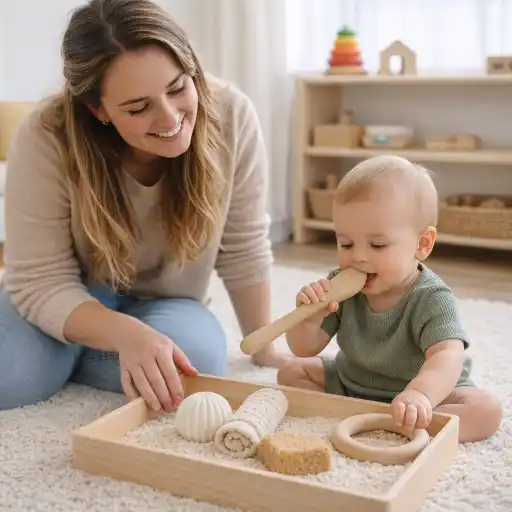
Effective infant activities can be prepared with clean, familiar materials. Keep sessions short—sometimes only a few minutes—and remain engaged throughout.
- 🧣 Texture touch: Offer one large, breathable fabric square, such as fleece or cotton, near the baby’s hands or feet. Name words such as “soft,” “smooth,” or “bumpy.” Remove fabric immediately if it covers the face.
- Mirror moments: Place an unbreakable baby mirror near the child during supervised tummy time or supported sitting. Comment on facial expressions and movements.
- Sound basket: Use a large, unbreakable bowl, wooden spoon, and sturdy measuring cup. Help the baby explore gentle tapping and contrasts such as fast/slow or loud/quiet.
- Water wipe play: Offer a damp and dry washcloth for an older infant to touch. If water is present, use only a very shallow amount and maintain constant supervision.
- Sealed discovery bag: Place water or gel in a heavy-duty bag, double-bag it, seal it, and tape it securely to a tray or floor. Inspect it continuously and discard it at the first sign of damage.
- Nature observation: In a shaded area, invite babies to watch leaves move, notice light and shadow, and feel a gentle breeze while remaining protected from direct sun and unsafe plants.
Food-based sensory experiences require additional planning. Use them only when they fit the child’s developmental readiness, family communication, allergy procedures, and program policy. Feeding is not a substitute for play, and providers should never pressure a child to taste or touch food. For older infants who are developmentally ready and can be closely supervised, a taste-safe mud activity may offer another tactile exploration idea, but “taste-safe” does not mean risk-free or suitable for every baby.
How do providers keep sensory play safe and sanitary?
Because infants explore with their mouths, safety planning must come before creativity. The CDC emphasizes close attention to choking hazards during eating, and the same vigilance is appropriate when babies handle play materials. Avoid any loose object that could fit inside a toilet paper roll, including beads, buttons, coins, marbles, water beads, small pom-poms, and detachable toy parts.
- Stay within arm’s reach and maintain active supervision.
- Choose large, sturdy, non-toxic, washable materials with no sharp edges.
- Secure lids, bags, bottles, and containers; inspect them before and during use.
- Keep water away from the baby’s nose and mouth, and never leave a child alone near water.
- Clean and disinfect reusable materials according to program procedures.
- Launder fabrics and discard items that crack, peel, leak, become porous, or cannot be cleaned thoroughly.
- Check family records for allergies, medical needs, and sensory preferences.
- Follow emergency procedures and maintain current infant first aid and CPR knowledge.
State requirements vary - check your state licensing agency. Directors can strengthen consistency by creating a one-page sensory-play checklist covering materials, supervision, sanitation, family communication, and documentation. The CDC’s early care guidance also reinforces the provider’s responsibility to prevent injury, address water safety, and maintain healthy environments.
How can caregivers read infant cues and adapt the experience?
Responsive sensory play depends on observing behavior rather than assuming enjoyment. Signs of engagement may include a relaxed body, steady breathing, focused eyes, reaching, kicking, smiling, or purposeful vocalizations. These signals suggest that the experience is manageable and interesting.
Babies may need a pause when they repeatedly turn away, stiffen, arch their backs, spread their fingers, yawn, rub their eyes, gag, cry, or breathe rapidly. These behaviors are communication, not misbehavior. A child may be tired, hungry, uncomfortable, or overwhelmed by the intensity, novelty, or duration of the experience.
When a baby signals “enough,” respond calmly:
- Remove or reduce the sensory material.
- Lower your voice and simplify the environment.
- Offer holding, a familiar object, or a quiet routine.
- Try again another day with a gentler version—or decide that the activity is not appropriate for that child right now.
Adaptation may involve dimmer lighting, softer textures, slower movement, fewer materials, additional physical support, or more predictable repetition. Children with sensory differences deserve access to exploration without being forced to tolerate distress. If concerns involve feeding, hearing, vision, movement, persistent difficulty regulating, or missed developmental milestones, share observations with the family and encourage consultation with an appropriate health or developmental professional.
How can directors connect sensory play to planning and documentation?
Intentional documentation does not require lengthy reports. A concise note can show what the caregiver offered, how the baby responded, what skill was observed, and what adjustment should come next. For example: “During mirror play, Maya tracked her reflection from left to right for approximately four seconds, smiled, and reached toward the mirror. Next step: offer the mirror again during alert tummy time and pause for vocal turn-taking.”
Use observations to guide individual planning rather than to label children. A weekly sensory kit might include a mirror, two washable fabrics, a soft rattle, and a board book. Rotate one item at a time, record children’s responses, and share meaningful observations with families. This approach makes sensory play sustainable for busy teams and helps staff see learning within routines.
Useful planning questions include:
- What developmental goal does this experience support?
- What safety risks could arise, and how will we prevent them?
- Which cues will tell us to continue, modify, or stop?
- How will the activity be adapted for a child with sensory, motor, communication, or medical needs?
- What did we learn that should influence the next experience?
For additional professional learning, providers may explore Playful Spaces for Infants & Toddlers Buy Now $24.00, Effective Supervision in Child Care Buy Now $25.00, Effective Approaches for Autism and Inclusion Buy Now $55.00, and Baby Steps to Milestones Buy Now $35.00. Each course addresses a different part of creating responsive, safe, and inclusive experiences.
Conclusion
How can child care providers make sensory play for babies safe, simple, and developmentally appropriate? Start with one child, one clear goal, and one manageable experience. Use everyday materials, supervise within arm’s reach, eliminate choking and water hazards, sanitize carefully, and let the baby’s cues guide the pace.
The strongest sensory curriculum is not the most elaborate. It is consistent, relational, observant, and flexible. When caregivers transform a soft cloth, a familiar song, a mirror, or a gentle outdoor observation into an intentional interaction, babies gain meaningful opportunities to explore while feeling secure. Simple planning and thoughtful reflection allow these small moments to support broad development across the infant year.
- Basic Health & Safety and Breastfeeding Awareness
- Success in Safety for Babies
- Baby Play: Planning Infant and Toddler Activities
- Special Babies
- Play with Purpose: Supporting Children with Autism
- Creating Engaging and Meaningful Learning Experiences
- Risk Reduction: Infants and Toddlers in Family Child Care
- Texas Director Credential
- Montessori Cultural Activities: Exploring the World Through Play and Learning
- Bye Bye Winter: The Role of Outdoor Play in Early Childhood Development
- Recursos en Español sobre el Sueño Seguro del Bebé
- ¿Cuáles son las mejores actividades del Día de la Tierra para niños en casa o en el aula?
- Capacitación en Salud y Seguridad Preventiva en Línea para Proveedores de Cuidado Infantil
- Proporciones de Cuidado Infantil y Tamaños de Grupo por Edad en Maryland (Guía Rápida para Centros y Hogares)
- Proporciones de Cuidado Infantil y Tamaños de Grupo por Edad en Virginia (Guía Rápida para Centros y Hogares)
- Actividades de Otoño Fáciles para Preescolares esta Temporada
- Consejos de Supervisión Activa para Salones de Preescolar y el Juego al Aire Libre
- Cómo Trabajar en el Cuidado Infantil en Wisconsin: Requisitos y Pasos
- How can I create a nurturing infant environment in my childcare program?
- Canciones, juegos y preguntas de círculo para niños
- Cómo simplificar la capacitación para sus empleados de daycare
- How Can Texas Providers Learn from San Antonio’s Infant-Toddler Expansion About Six-Week Learning?
- What sensory play ideas best support babies in child care?
- Home Daycare Ideas That Make Your Space Feel Safe, Fun, and Professional
- Baby’s First Fall: Simple Ways to Explore the Season Through Play
- Hello, Fall! Cozy Activities to Help Babies Explore the Season
- What Makes Babies Stressed in Child Care? 7 Nursery Changes That Can Help
- How Can Child Care Providers Support Healthy Brain Development in Young Children?
- How Can Child Care Providers Make Sensory Play for Babies Safe, Simple, and Developmentally Appropriate?
