Are you wondering whether a child’s grasp, scribbles, or scissor use reflects expected development—or signals a need for closer observation? This guide translates age-related fine motor patterns into practical classroom observations, adaptations, and family conversations. For deeper preparation, explore How Preschoolers Develop  Buy Now $32.00 to strengthen your understanding of milestones and age-appropriate instruction, and consider Developmental Screening in Early Childhood Buy Now $16.00 to build skills in documenting concerns and collaborating with specialists.
Fine motor skills involve the coordinated use of the hands, fingers, wrists, arms, and eyes to manipulate objects and complete tasks. They support feeding, dressing, construction, drawing, cutting, and emergent writing. However, development is not a rigid staircase: children may reach skills in different sequences, and factors such as prematurity, opportunity, culture, temperament, disability, and health can influence performance.
The CDC developmental milestone resources describe skills most children demonstrate by particular ages, while occupational therapy resources emphasize looking for progression rather than treating a single age marker as a pass-or-fail test. Providers should therefore combine age-based guidance with repeated observation across routines and settings.
Why does fine motor development matter in child care?
Fine motor competence is closely connected to participation and independence. A child who can use a spoon, turn pages, manipulate blocks, or manage fasteners has more opportunities to engage in classroom routines without constant adult assistance. These experiences also support planning, attention, bilateral coordination, visual-motor integration, and confidence.
For providers, monitoring fine motor skills is not about labeling children. It is about making the environment more responsive. A child who struggles with a standard crayon may succeed with a short, thick crayon, a vertical easel, or a brief hand-strengthening activity. A child who avoids puzzles may need fewer pieces, reduced visual clutter, or a preferred theme.
Developmentally appropriate practice begins with strengths. Ask: What can the child do independently? What materials invite participation? What level of support allows the child to experience success while still doing the work?
- Observe skills during play, meals, dressing, art, and transitions.
- Notice effort, strategy, endurance, accuracy, and the amount of adult support required.
- Offer repeated, playful practice rather than pressure to produce a perfect product.
- Use #milestones as guides for planning and communication, not diagnoses.
What should providers look for from birth through 12 months?
Infants develop the foundations of fine motor control through reaching, grasping, visual tracking, postural stability, and exploration. During the first months, providers may observe hands moving from tightly closed fists toward more open, purposeful movements. Infants often bring hands to the mouth, watch their hands, swipe at toys, and gradually sustain a grasp when an object is placed in the palm.
Between approximately three and six months, many infants begin reaching with greater intention, holding a rattle briefly, bringing both hands together, and pushing up on forearms during supervised tummy time. These movements build shoulder and trunk stability, which later supports controlled hand use. By around six to nine months, children may shake or bang objects, transfer toys from one hand to the other, rake food toward themselves, and begin picking up larger pieces of food.
From nine to twelve months, providers may see voluntary release, placing objects into containers, pointing, banging two objects together, turning several book pages at once, and developing a pincer grasp for small foods. Always follow feeding guidance and choking-prevention requirements; small objects require close supervision and may be inappropriate for infants.
- Provide safe, washable objects with varied textures, sizes, and weights.
- Arrange toys within reach, allowing infants to initiate movement.
- Offer supervised floor play and tummy time when infants are awake and ready.
- Describe actions: “You reached, grasped, and moved the ring.”
- 😊 Celebrate attempts and persistence rather than demanding a specific response.
Individual variation is expected. Repeated difficulty reaching, grasping, transferring objects, or using both sides of the body should be documented and discussed with the family, especially if skills are lost.
What fine motor patterns are common from 12 to 24 months?
Toddlers typically expand fine motor control through self-feeding, container play, stacking, scribbling, pointing, and practical routines. Between twelve and eighteen months, many children use both hands together, isolate the index finger, place objects into containers, clap, scribble spontaneously, and begin using a spoon and cup with assistance. They may stack a few blocks and turn pages, although several pages may move together.
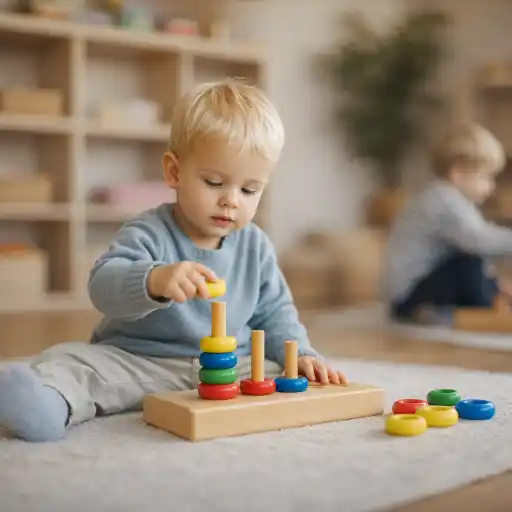
Between eighteen and twenty-four months, children often build towers of approximately three or four blocks, place rings on a stacker, turn individual pages more consistently, and hold crayons with the thumb and fingers rather than a whole-fist grasp. They may begin to imitate simple lines and enjoy cause-and-effect toys that require pushing, pulling, twisting, or sliding.
Under age three, choking hazards must be taken seriously. Separate small-part materials, supervise closely, and follow program policies; state requirements vary - check your state licensing agency. If a toddler consistently avoids using one hand, cannot release objects, or shows little progress across several weeks, record objective examples and partner with the family.
What should providers expect from ages two to three?
Between two and three years, children often gain greater control over tools, fasteners, puzzles, and early drawing tasks. They may use utensils and an open cup with some spilling, screw and unscrew lids, string several large beads, turn pages one at a time, stack six to eight blocks, and use scissors to make snips. Many children imitate or copy vertical lines, horizontal lines, and circles after modeling.
At this stage, the goal is not a mature pencil grasp or precise coloring. The goal is growing control, coordination, and willingness to use tools. Provide short crayons, chunky markers, large-hole lacing cards, child-safe scissors, stickers, and construction materials. Vertical surfaces can encourage wrist extension and shoulder stability; playdough and outdoor digging can build hand strength in motivating ways.
Observe whether the child can stabilize paper with one hand while manipulating a tool with the other. Bilateral coordination is especially important for cutting, opening containers, dressing, and later writing. Give clear demonstrations and then allow uninterrupted practice.
- Begin cutting with short snip strips and wide, straight paths.
- Use large beads or pipe cleaners before introducing smaller threading materials.
- Offer puzzles with a manageable number of pieces and clear visual cues.
- Connect sorting, counting, and color naming to fine motor activities.
- Adapt seating, paper position, or tool size when fatigue affects performance.
Concern is more meaningful when it is persistent, occurs across settings, and limits participation. A child who occasionally refuses a difficult task may simply need choice or rest. A child who consistently cannot grasp, release, stack, scribble, or use both hands should receive thoughtful monitoring and family collaboration.
What skills commonly emerge from ages three to five?
Preschoolers typically make rapid gains in precision, visual-motor integration, self-care, and tool use. Around three to four years, many children can string smaller beads, use utensils with less spilling, fold and crease paper, snap clothing, manipulate large buttons, draw a two-part person, imitate a cross, and cut along a thick straight line. They may begin using a more mature pencil grasp, although grasp patterns can still vary.
From four to five years, children often button clothing, manage more fasteners, lace a card, copy diagonal lines, squares, triangles, and X shapes, draw a person with several parts, and cut simple shapes. By five years, many children can build complex constructions, copy a rectangle, connect two dots with a straight line, copy letters and numbers, write some or all of their name, cut more complex shapes, and use a child-safe butter knife with supervision.
These patterns should guide invitations, not force uniform performance. Offer writing in meaningful contexts: menus in dramatic play, maps in the block area, signs outdoors, journals in the art center, and name cards during arrival. Fine motor practice is stronger when children have a reason to use their hands.
- Progress from thick lines and simple shapes to increasingly complex patterns.
- Use playdough, construction toys, tweezers, lacing, stickers, and cutting projects.
- Practice dressing and food preparation as functional motor learning.
- Observe posture, hand preference, pressure, endurance, and frustration tolerance.
- Pair fine motor work with language, problem-solving, and social interaction.
Conclusion: What should child care providers remember?
What should providers look for in fine motor skills by age? Look for a broad developmental progression: purposeful reaching and grasping in infancy; transferring, releasing, stacking, and scribbling during toddlerhood; and increasingly precise drawing, cutting, construction, dressing, and writing-related actions during the preschool years.
Use age expectations as flexible reference points, not rigid deadlines. Observe across meaningful routines, document specific behavior, adapt materials, and celebrate incremental progress. When concerns persist, skills regress, or families share worries, respond early through respectful communication and appropriate screening or referral. Your careful observations can help children receive the support they need while preserving their dignity, curiosity, and joy in learning.
- 45 Hour Child Growth and Development
- SIDS: Saving Babies: A Change of Position, A Change in Tradition
- CDA Family Child Care Credential
- Tracking Progress, Shaping Futures: Observation & Assessment Skills
- 45 Hour School Age Methods and Materials
- 24 Hour Texas Pre-Service
- CDA Bridge Bundle: Family Child Care without Portfolio Review
- Early Childhood Education
- Terrible Two's Can Be Terribly Fun!
- Identifying Developmental Milestones in Children
- How to boost fine motor skills: Holiday Edition
- DIY Snow Globes: The Fine Motor Craft That’ll Keep Kids (and Adults) Busy for Hours
- Regulaciones de Licenciamiento de Cuidado Infantil en California para Centros y Hogares de Cuidado Infantil Familiar
- Proporciones de Cuidado Infantil y Tamaños de Grupo por Edad en Maryland (Guía Rápida para Centros y Hogares)
- Lista para Guardería en Casa en Illinois: Cómo Iniciar una Guardería en el Hogar
- Lista para Guardería en Casa en California: Cómo Iniciar una Guardería en el Hogar
- Retraso del Habla en la Guardería: Cómo Pueden Ayudar los Proveedores
- Capacitación Previa al Servicio para Proveedores de Cuidado Infantil en Dakota del Norte
- How Do Art Activities Support Cognitive Growth in North Dakota Preschoolers?
- How can North Dakota classrooms build toddler fine motor skills with simple activities?
- What Kindergarten Readiness Skills Should My Program Build?
- How Can Child Care Providers Understand and Use Developmental Milestones from Birth to Age Eight?
- Can a simple friendship bracelet craft strengthen fine motor skills in your daycare?
- What should providers expect at different ages and when should they recommend further evaluation?
- Proporciones para guarderías en casa bajo el Título 22: Cómo la mezcla de edades cambia su capacidad en California
- How Can Child Care Providers Strengthen Fine Motor Development Through Play and Daily Routines?
- What Should Child Care Providers Look For in Fine Motor Skills by Age?
- ¿Cómo puede la retroalimentación visual apoyar la fluidez en la multiplicación?
