A simple box can become a small laboratory when a toddler lifts, slides, or turns its lid. For a practical framework for turning this curiosity into developmentally appropriate activities, explore ChildCareEd’s Playing with a Purpose: Infant/Toddler Lesson Planning  Buy Now $24.00 course; it helps providers plan meaningful experiences for children from birth through age three. The ideas below offer a low-cost way to notice what children are learning as they explore.
Why can a box lid become a meaningful learning invitation?
For toddlers, opening and closing a box is not merely a way to reach what is inside. It is an opportunity to coordinate the eyes and hands, strengthen small muscles, test an idea, and repeat an action to see what happens. A box offers a clear relationship between action and result: lift the lid, and the contents appear; replace it, and they disappear. Repetition gives children time to build confidence and refine their approach.
The activity also supports early thinking. A child may notice that one lid lifts easily while another slides into grooves or requires a turning motion. These discoveries introduce comparison, cause and effect, persistence, and simple problem-solving. Naming actions—“lift,” “slide,” “turn,” “open,” and “close”—connects movement with language without interrupting the child’s concentration.
For educators, the value lies in the process, not in whether a child completes the task exactly as an adult expects. Observe what the child tries, what attracts attention, and whether the child returns to a particular lid. A thoughtfully prepared box can invite exploration while giving providers useful clues about interests, emerging skills, and next steps.
What discoveries do lift, slide, and turn lids invite?
Different lids create different physical and cognitive challenges. A hinged lid may invite a toddler to grasp an edge and lift it. A sliding cover draws attention to direction and alignment: the child may need to guide it along a track. A screw-top lid asks the child to stabilize the container with one hand while turning with the other. These actions are not a developmental checklist; each child’s experience depends on age, strength, prior practice, and interest.
- Lift: Children explore hinges, resistance, and what is concealed beneath a cover.
- Slide: Children experiment with direction, position, and how a cover fits into a track.
- Turn: Children coordinate both hands and investigate rotation and how parts connect.
- Match: Children can compare lids and containers, noticing which pieces fit together.
- Repeat: Opening and closing again helps children test whether the same action produces the same result.
These actions can support fine-motor coordination, concentration, independence, and early problem-solving. Keep the challenge inviting rather than frustrating: the lid should be manageable for the child, and an adult can offer a small amount of help when needed. A simple prompt such as “You turned it” describes the child’s strategy and leaves room for further discovery.
How can providers prepare a safe, engaging box activity?
Start with a few clean, sturdy boxes or containers with different opening mechanisms. Choose materials appropriate for the children who can access the activity, including infants or younger toddlers who may mouth objects. Avoid small detachable parts, sharp edges, pinch points, damaged materials, and lids that could trap fingers. Check that each container can be opened and closed without excessive force, and follow your program’s cleaning procedures.
Set the materials on a low, stable surface or a defined mat so children can see and reach them. Begin with two or three containers rather than a crowded collection; a modest selection can help toddlers focus on how each one works. You might place a large, safe object inside a box to spark interest, but ensure it cannot create a choking hazard and can be retrieved easily.
- Offer different mechanisms, such as a hinged lid, a sliding cover, and a large, easy-turn lid.
- Demonstrate slowly if useful, then pause and let the child decide what to try.
- Use brief, descriptive language: “The lid slides,” or “You lifted it.”
- ✨ Follow the child’s lead: watching, touching, trying once, or returning later are all valid ways to participate.
State requirements vary - check your state licensing agency. Keep active supervision in place, especially when children of different ages share a space, and remove any item that becomes damaged or unsafe.
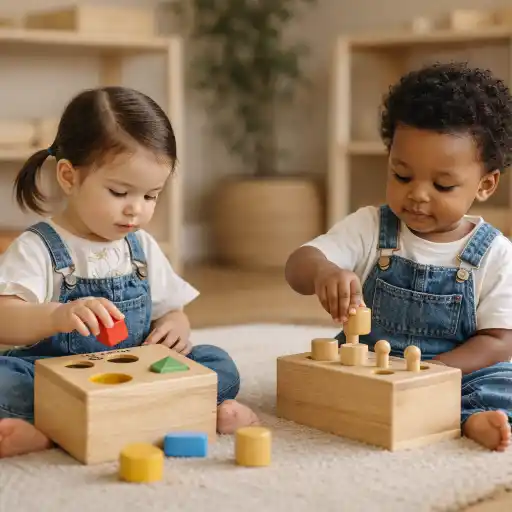
How can adults extend exploration without taking over?
Responsive support begins with observation. Give toddlers time to approach the box, handle it, and attempt an opening before stepping in. If a child seems engaged, a brief comment can make the action visible: “You pushed the cover along the track.” If frustration grows, adjust the experience—loosen a lid, steady the container, or show one movement—then return control to the child.
Questions can extend thinking when they are offered sparingly and with genuine curiosity. Try “What do you notice?” or “How could we open this one?” Then wait. Silence is useful; toddlers need time to process language, plan a movement, and respond in their own way. Some children may communicate through gestures, sounds, gaze, or movement rather than words.
To add a manageable next step, change one feature at a time. Introduce a different-sized box, offer a matching lid to find, or place a large familiar object inside. You can also create a simple back-and-forth routine: the child opens the box, an adult names what is inside, and the child decides whether to close it. Avoid turning the activity into a test or repeatedly insisting on a particular action. The goal is to preserve the child’s agency while making room for new possibilities.
What common pitfalls should providers avoid?
Even a simple activity can lose its appeal when adults unintentionally make it too difficult, too busy, or too directed. A lid that requires considerable strength may discourage a child; too many boxes can overwhelm attention. Likewise, frequent instructions can interrupt the careful trial and repetition through which toddlers investigate how objects work.
- Choosing a lid that is too challenging: Begin with an easy mechanism and offer harder options only when the child appears ready.
- Using unsafe or unsuitable containers: Inspect for loose parts, sharp edges, pinch hazards, cracks, and cleanliness before every use.
- Expecting one “right” sequence: A child may carry, turn, inspect, or simply watch the box. Observe before redirecting.
- Overprompting: Use a short comment or question, then allow time for the child to act.
- Forgetting access and supervision: Arrange materials within reach and remain positioned to see and respond to children.
Keep brief notes on what the child explored—for example, whether they lifted, slid, or turned a lid, and what held their attention. These observations can guide the next invitation and help colleagues share a consistent, child-centered approach.
Conclusion: What can toddlers discover through different box lids?
Lift, slide, and turn lids offer toddlers distinct ways to investigate movement, fit, cause and effect, and the contents of a container. With safe materials, a focused setup, active supervision, and time for repetition, providers can support fine-motor practice, concentration, language, and emerging problem-solving without turning play into a prescribed task.
The central question is not whether a toddler opens every box, but what the child notices and tries along the way. Offer a few suitable containers, observe closely, describe actions, and adjust the challenge to the child. Those small choices turn an everyday box into a purposeful invitation to explore.
For additional guidance on planning age-appropriate infant and toddler experiences, consider ChildCareEd’s Playful Learning: Infant & Toddler Activities Buy Now $25.00, Baby Play: Planning Infant and Toddler Activities Buy Now $16.00, Playful Spaces for Infants & Toddlers Buy Now $24.00, and The Best Promotion is Play Buy Now $24.00. Course details and any training-hour acceptance should be checked against your program’s and state’s requirements.
- 45 Hour Child Growth and Development
- Turning Behavior Around for Toddlers and Preschoolers
- Moving About the Classroom: Effective Transitions for Everyday
- CDA Infant/Toddler Credential
- The ABCs of Behavior: Turning Challenges into Learning Opportunities
- Birth to Five CDA Credential with Portfolio Review
- 45 Hour Infant and Toddler Methods and Materials
- Pediatric RSV First Aid & CPR/AED
- CDA Bridge Bundle: Infant/Toddler
- 😅❌ ¿Cómo Puedo Manejar a un Niño que Dice “¡NO!” a Todo en el Aula?
- 👧 ¿Cómo iniciar y abrir una guardería en Texas? Lo que necesitas saber
- Qué capacitación se requiere para ser director de cuidado infantil en Texas?
- Recursos en Español sobre el Sueño Seguro del Bebé
- Que es Título 22 en California?
- Capacitación en Salud y Seguridad Preventiva en Línea para Proveedores de Cuidado Infantil
- Lista para Guardería en Casa en Illinois: Cómo Iniciar una Guardería en el Hogar
- Lista para Guardería en Casa en Texas: Cómo Iniciar una Guardería en el Hogar
- Cómo Ser Maestra de Preescolar en Dakota del Norte
- Capacitación Previa al Servicio para Proveedores de Cuidado Infantil en Dakota del Norte
- Canciones, juegos y preguntas de círculo para niños
- STEM for Preschoolers: Fun Activities That Encourage Curiosity
- How Do Light vs. Heavy Activities Build Early Measurement Skills?
- How Can Teachers Build Learning Centers on a Tight Budget?
- How Can You Choose Recycled Classroom Materials With a Real Purpose for Play?
- What Low-Cost Preschool Materials Still Meet Your Learning Goals?
- How Can Low-Cost Preschool Materials Still Meet Your Learning Goals?
- Why Does Big Not Always Mean Heavy in Preschool?
- What Do Different Box Lids Invite Toddlers to Discover?
