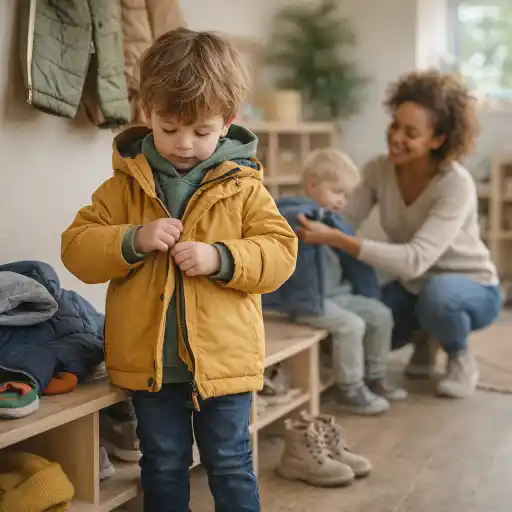
When the class is ready for outdoor play, a pile of coats, tangled sleeves, and waiting children can turn a simple transition into a daily bottleneck. A clear, supportive routine can help preschoolers practice dressing, managing belongings, and asking for help while keeping the group moving. Explore Every Moment Matters: Schedules and Transitions  Buy Now
$55.00$45.00 for practical ways to plan smoother transitions, and consider Supporting Children’s Independence Buy Now $24.00 for a deeper look at scaffolding children’s growing autonomy. These courses can strengthen your classroom practice; continue reading for simple changes you can try at the coat hooks today.
Why is the coat pile more than a transition problem?
Putting on a coat involves more than getting dressed quickly. A child has to locate the right garment, orient it, find the sleeves, coordinate both arms, pull the coat over the shoulders, and perhaps manage a zipper. Backpacks add another sequence: find the right bag, place it in its assigned spot, and keep it from blocking the walkway. These repeated tasks give children authentic opportunities to practice motor coordination, sequencing, language, problem-solving, and care for personal belongings.
The routine also shapes the emotional tone of the move outdoors. If adults routinely take over because the group is running late, children may have little chance to practice. If adults expect children to manage every step without support, a difficult fastener or crowded space can become frustrating. The aim is neither speed nor perfect independence. It is meaningful participation with appropriate help.
Transition guidance from CSEFEL recommends planning for transition time, using clear verbal or visual cues, and adapting support to individual children. Its classroom example includes an adult staying nearby to help a child with a coat while encouraging growing independence. That balance matters: a child who finds their hook, starts a sleeve, or asks for help has made progress. Notice those steps as part of #independence and growing #confidence.
How can the coat area prevent the fall traffic jam?
Begin with the physical setup. An accessible, well-organized dressing area makes the next action easier to see and reduces avoidable crowding. Place low hooks or cubbies within children’s reach and identify each space with a photograph, symbol, or name card. Keep coats, backpacks, and spare clothing from spilling into the route to the door. Make sure adults can see and supervise children as they move through the area.
Consider whether children have enough room to spread out a coat and move their arms safely. A stable bench or chair can support children who dress more comfortably while seated. Put a visual sequence where children can see it while using the hooks, not across the room. When many children need the same small area, stagger the group into manageable waves. Children who are waiting can look at a book, sing a familiar transition song, or help check a weather picture in a supervised spot.
- Assign a clear place for coats and a separate place for backpacks.
- Use a simple photo or symbol label children can recognize.
- Keep pathways clear and leave enough room for sleeves and bodies to move.
- Send children who need extra time to the dressing area first.
- Use small groups rather than inviting the whole class to the hooks at once.
These environmental supports reduce waiting and give adults more opportunity to coach rather than rush. NAEYC identifies routines and transitions as essential parts of a supportive classroom. The goal is a predictable flow that still leaves room for individual pacing—not a perfectly silent or identical line.
How do you teach coats, zippers, and backpacks step by step?
Teach the sequence during a calm moment, before the first chilly, hurried departure. Demonstrate slowly and use a few consistent words. A basic coat sequence might be: “Find your coat. Find the sleeves. Put your arms in. Pull it onto your shoulders. Zip, if you can.” For backpacks, use a separate short sequence: “Find your bag. Put it on your hook. Check your coat.” Adjust the steps to match the classroom’s actual routine.
Some children may enjoy practicing the coat flip: place an open jacket with the inside facing up and the collar near the child’s feet, invite the child to put their hands into the sleeves, then lift the coat up and over the shoulders. Demonstrate and supervise closely, and treat this as one possible method—not a rule. A child may prefer to sit, put one arm in at a time, or use another familiar technique. Comfort and safety come first.
Use a visual routine strip with a few clear photos or drawings, placed at child height. Point to the next image, give a short cue, and allow time for the child to act before adding another prompt. Try backward chaining when a task feels demanding: help with most steps, then let the child complete the final step, such as pulling up a zipper that an adult has started. Gradually invite the child to do more of the sequence.
- Model one step at a time, then pause for the child to try.
- Offer one brief prompt, such as “Find the zipper tab.”
- Let children manage the parts they can, even when you assist with another step.
- Practice with manageable clothing and fasteners when there is no rush.
For ready-to-use child-facing supports, consider ChildCareEd’s visual arrival routine resources Buy Now $1.50, which include routine materials featuring tasks such as putting away a backpack and taking off a jacket.
How should adults decide when to wait, prompt, or help?
A useful sequence is observe, wait, prompt, help as needed, and then return the task to the child. If a child is safe, calm, and actively trying, pause before stepping in. A few seconds can give the child time to plan a movement or use a strategy they already know. Waiting is attentive support: stay close, supervise, and notice where the child is getting stuck.
If the child seems unsure or distracted, try the least intrusive cue likely to help. Point to the visual, gesture toward a sleeve, or offer one simple phrase: “Where does your arm go?” Then give the child time to respond. If the child asks for help, becomes distressed, or cannot safely continue, assist with the difficult part while keeping them involved. For example, hold the coat steady while the child pushes an arm through, or start the zipper while the child pulls it up.
Support should respond to the child and the task, not a fixed expectation. A familiar lightweight jacket may be manageable while a bulky winter coat is not. Sensory preferences, motor coordination, language, fatigue, and past experience can all affect participation. Observe what is difficult before assuming a child is unwilling.
- 👀 Observe whether the child is safe, engaged, and attempting a step.
- Wait briefly when the child is trying and has time to continue.
- Prompt with one cue, gesture, or visual if the child appears stuck.
- Help collaboratively when needed, then step back as soon as the child can proceed.
Use specific, respectful feedback: “You found the sleeve and kept trying,” rather than comparing children’s speed or saying “Hurry up.” If a difficulty persists across routines, share concrete observations with the family and collaborate on supports. Do not diagnose from a dressing task; families can decide whether to discuss concerns with a qualified professional.
How can visuals, play, and family partnership make the routine stick?
Visuals work best when they reflect the real steps of the classroom routine. Use a few clear images—such as coat, sleeves, zipper, backpack, and door—rather than a crowded chart. A child who uses a home language, gestures, sign, or another communication tool may benefit from visuals and short cues adapted to their communication. Invite children to point to or move a picture as they finish a step; this makes the sequence something they can use, not simply something adults display.
Playful practice can make repetition feel inviting. Try a “coat detective” game where children match a coat to its hook symbol, or create a short rhyme about sleeves and zippers. Use dress-up play, a doll, or a pretend backpack during a calm part of the day. Keep practice brief and celebrate a meaningful attempt, such as finding the right opening or hanging a bag independently.
Coordinate with families to learn which clothing, fasteners, and routines are familiar and comfortable for the child. Share the classroom sequence and invite families to suggest strategies that work at home. Consistency across caregivers helps, but it does not mean every child receives identical support. Keep adults aligned on shared cues while adapting the level of help.
Common pitfalls are rushing, crowding the doorway, giving several instructions at once, and treating speed as the measure of success. Plan adequate transition time and use small groups, visible cues, and calm language instead. State requirements vary - check your state licensing agency when changing procedures, equipment, or clothing-related safety practices.
Summary: What makes fall layers a learning routine?
The coat pile becomes more manageable when the environment, routine, and adult support work together. Make hooks and belongings accessible, teach a short sequence before the rush, use clear visual and verbal cues, and schedule enough time for children to participate. Give each child the least support that works, then step back when they are ready to continue.
Progress may look like finding a hook, starting a sleeve, managing one zipper step, putting away a backpack, or asking for help appropriately. Those small actions matter. They build self-care skills and help children participate more confidently in daily transitions. Start with one practical change—such as staggered dressing waves or a picture strip by the hooks—and observe what helps your group. For a broader look at planning routines and transitions, explore Every Moment Matters: Schedules and Transitions Buy Now $55.00$45.00.
Five English-language courses for related professional learning
- Every Moment Matters: Schedules and Transitions Buy Now
$55.00$45.00 — routine and transition planning. - Supporting Children’s Independence Buy Now $24.00 — strategies for fostering children’s autonomy.
- Moving About the Classroom: Effective Transitions for Everyday Buy Now $35.00 — preschool transition activities and predictable routines.
- Student Success: Expectations & Independence Buy Now $16.00 — matching expectations and support to children’s development.
- DAP for Preschool Buy Now $24.00 — developmentally appropriate practice in preschool settings.
- Moving About the Classroom: Effective Transitions for Everyday
- Teacher-Child Interactions for Stronger CLASS® Outcomes
- Birth to Five CDA Credential with Portfolio Review
- Art from the Heart for Preschoolers: Open Ended Art Projects that Build Self-Esteem
- Emergent Learning & Development
- Creating Environments that Nurture Growth and Community
- Lesson Planning for Preschoolers
- Texas Director Credential
- 45-Hour Infant and Toddler Curriculum
- Every Moment Matters: Schedules and Transitions
- Safe sleep basics (and common mistakes to avoid)
- 💛🧩 ¿Cómo puedo hacer que mi enseñanza sea inclusiva para los niños con autismo?
- Actividades de Motricidad Gruesa que Desarrollan el Equilibrio, la Coordinación y la Fuerza
- Proporciones de Cuidado Infantil y Tamaños de Grupo por Edad en Maryland (Guía Rápida para Centros y Hogares)
- Proporciones de Cuidado Infantil y Tamaños de Grupo por Edad en Nueva Jersey (Guía Rápida para Centros y Hogares)
- Actividades de Otoño Fáciles para Preescolares esta Temporada
- How can we use nature-based learning through Minnesota's outdoor seasons?
- Autumn Activities for Toddlers and Preschoolers
- Why is outdoor education essential for children growing up in North Dakota?
- Calabazas, hojas y manzanas: actividades de otoño para preescolares
- Celebrando la amistad en el cuidado infantil durante el Día de los Mejores Amigos
- How can childcare programs teach young children about the Everglades safely while growing curiosity?
- Canciones, juegos y preguntas de círculo para niños
- Cómo simplificar la capacitación para sus empleados de daycare
- How can preschool teachers teach mindfulness and calm-down skills so young children actually use them?
- How Can Child Care Programs Use Easy Nature‑Based Activities for Every Season?
- What’s Happening Outside? Fall Science Adventures for Preschoolers
- Can You Build It With Fall? Nature-Based Building Challenges for Preschoolers
- How Can Child Care Programs Prevent Winter Playground Slips, Falls, and Cold-Weather Injuries?
- How Can Preschoolers Manage Fall Layers More Independently?
