Some of preschool’s most meaningful learning happens far from a worksheet: in a block tower that finally stands, a new way to join a game, or a question a child returns to all week. Brief, intentional observations can help you recognize these small wins and turn children’s changing interests into responsive activities. For a deeper foundation in documenting progress and planning next steps, explore ChildCareEd’s Preschool Assessments & Observations  Buy Now $24.00 course, which builds practical observation and assessment skills for individualized learning.
Why does learning progress matter beyond worksheets?
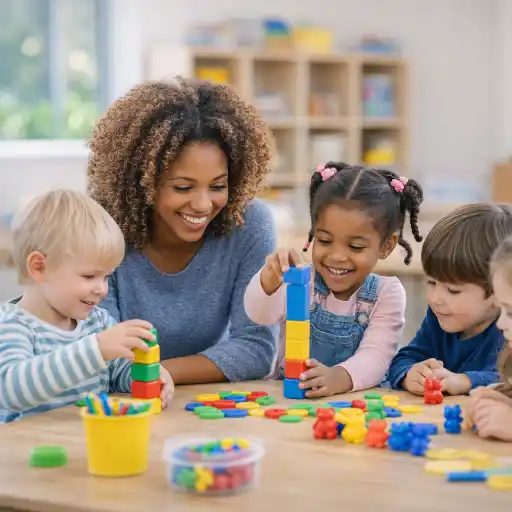
Worksheets can show one kind of performance at one moment, but they rarely capture the full range of what preschoolers know and can do. Children often reveal their thinking through play, conversation, movement, routines, and relationships. A child who explains how a bridge needs a “strong bottom,” negotiates a turn, or persists with a tricky zipper is demonstrating learning that may not fit neatly into a paper task.
Noticing these moments helps educators plan from actual evidence rather than assumptions. Development is uneven, and a child may show a skill in one setting, language, or relationship before using it elsewhere. A fuller picture comes from observing across contexts and over time, not judging progress from a single product.
Small achievements also matter to children and families. NAEYC’s developmentally appropriate practice guidance emphasizes celebrating progress and using ongoing observations to inform experiences and teaching. Recognizing a new strategy or growing confidence can help a teacher choose the right next challenge while communicating that the child’s efforts are seen.
- Notice learning in play, transitions, peer interactions, and everyday routines.
- Look for strategies and attempts, not only finished products or correct answers.
- Use several observations before deciding what a child may be ready to explore next.
What kinds of small wins should educators look for?
Emerging learning can be quiet, brief, or easy to overlook in a busy room. Watch for changes in how a child approaches a task, communicates an idea, or participates with others. Progress may mean trying a new strategy, staying with a challenge a little longer, asking for help with words, or inviting a peer into play.
Interests can be clues, too. A child who repeatedly collects leaves may be exploring classification, patterns, or the natural world. A child who turns dramatic play into a restaurant may be practicing symbolic thinking, language, early writing, and social negotiation. These possibilities are not conclusions; they are questions that guide what to observe again.
Consider scanning across learning domains instead of looking only for academic markers:
- Thinking: testing ideas, comparing objects, noticing cause and effect, or changing a plan.
- Communication: using new words, gestures, home language, drawings, or back-and-forth conversation.
- Social-emotional learning: entering play, waiting, expressing a need, recovering after a setback, or showing care.
- Physical development: coordinating tools, balancing, manipulating small materials, or becoming more independent in routines.
- Creative expression: inventing a song, building an imagined world, or representing an idea in a new way.
As NAEYC describes in its guidance on using observation to guide teaching, paying attention to children’s interests and actions can inform both teaching strategies and new learning experiences. Keep the child’s individuality at the center: the same behavior may have different meaning depending on context, language, experience, and the support available.
How can brief observations capture meaningful evidence?
A useful observation does not need to be lengthy. It needs enough specific detail to help you remember what happened and consider a reasonable next step. Capture the date, setting or routine, relevant materials, the child’s observable actions, and exact words when possible. Record facts first; interpretations belong in a separate reflection.
For example, instead of writing, “Milo is great at problem-solving,” try: “At 10:10 in the block area, Milo’s bridge tipped when he placed a wide block on top. He moved two wide blocks to the base and said, ‘Now it stays.’ He rolled a toy car across.” The second note preserves evidence that can be revisited and discussed with colleagues or family.
Choose a simple format that fits your classroom. Quick jottings can capture a moment; an anecdotal note adds a little more context. A photo or work sample, when permitted by program policy, can complement a short caption. The Head Start overview of written observations distinguishes jottings, anecdotal notes, and more detailed running records.
- Use concrete verbs: stacked, pointed, asked, offered, compared, or tried.
- Include the child’s words rather than guessing what they meant.
- Write promptly when supervision allows; do not let documentation interrupt active supervision.
- 🌱 Capture strengths and attempts as deliberately as concerns or challenges.
Short, objective notes are more useful than broad labels such as “shy,” “behind,” or “always distracted.” A growing set of specific observations makes small changes easier to see.
How can a weekly snapshot turn observations into responsive plans?
A weekly snapshot can make observation manageable by creating a small, repeatable cycle: notice, record, reflect, plan, and look again. Rather than trying to document every child every day, choose a practical focus—perhaps a small group of children, one routine, or a learning domain—and rotate attention so each child is represented over time.
At the end of the week, review notes and ask: What did the child try? What held their attention? What support helped? Did the same interest or strategy appear in more than one setting? Then plan a modest opportunity that extends the learning without taking over the child’s play.
For example, if several children have been making roads for toy vehicles, add ramps, tubes, maps, or signs and observe what questions emerge. If one child is repeatedly sorting natural objects, offer a collection tray, magnifiers, and language for describing size, texture, and shape. A responsive plan is an invitation, not a test: children remain free to engage in their own ways.
The Weekly Tiny Wins Snapshot: Preschool Observation and Planning Printable Buy Now $0.00 can provide a simple structure for recording progress and connecting observations to planning. Use a tool like this to support professional reflection, not to create a checklist of everything a child should accomplish.
- Notice: Identify a moment, interest, strategy, or interaction.
- Record: Write an objective, brief description.
- Reflect: Consider what the evidence might suggest, while keeping interpretations tentative.
- Respond: Adjust materials, questions, grouping, or teacher support.
- Revisit: Observe again and consider whether the plan created a meaningful opportunity.
How can teachers share progress and avoid common pitfalls?
Families often appreciate concrete examples more than broad statements such as “She had a good day.” Share a brief moment, explain what you noticed, and invite the family’s perspective: “Today, Lina lined up pinecones from smallest to largest and told a friend, ‘This one is tiny.’ Does she enjoy collecting or sorting things at home?” This approach treats families as partners and recognizes that they know their child in contexts teachers may not see.
Take care to make documentation inclusive and fair. Children may show knowledge in different languages, through movement or gesture, or with familiar materials and people. Review whose learning is being documented and whether records focus disproportionately on children who need immediate attention. Protect confidentiality, follow program policies for records and images, and separate observation from interpretation.
Common pitfalls are manageable with a few habits:
- Writing labels instead of evidence: Describe what you saw or heard before interpreting it.
- Relying on one moment: Look for patterns across days, activities, and relationships.
- Documenting only worksheet outcomes: Observe play, routines, conversation, and peer interaction, too.
- Planning from adult preference alone: Use children’s interests and strengths as a starting point for activities.
- Trying to record everything: Set a manageable focus and rotate observation opportunities.
Observation is not diagnosis. When a pattern raises a developmental concern, follow program procedures, collaborate respectfully with the family, and use appropriate screening or referral pathways. State requirements vary - check your state licensing agency.
Conclusion: How can we make hidden progress visible?
Preschool learning is larger than what appears on a worksheet. Children show growth as they persist, change strategies, communicate, connect with peers, explore interests, and take increasing responsibility in everyday routines. Brief, factual observations help educators recognize those small wins without asking children to perform on demand.
A weekly rhythm of noticing, recording, reflecting, planning, and revisiting turns observation into responsive teaching. Keep notes concise and strengths-based, consider children across settings and languages, and invite family knowledge into the picture. Most importantly, let what you observe shape practical next steps—materials to add, questions to ask, or time to explore. With a manageable system, teachers can make children’s learning more visible and create experiences that build on what each child is already beginning to do.
To continue strengthening your practice, explore Preschool Assessments & Observations Buy Now $24.00, Observations And Goal Setting in Childcare Buy Now $24.00, Assessing through Observation Buy Now $24.00, Tracking Progress, Shaping Futures: Observation & Assessment Skills Buy Now $55.00, and Planning for Every Child: Responsive Strategies in Action Buy Now $55.00.
- 45 Hour Child Growth and Development
- 45 Hour Preschool Methods and Materials
- What Makes Me Special: An Overview of Autism and ADHD
- CDA Bridge Bundle: Preschool
- 45 Hour School Age Methods and Materials
- CDA Bridge Bundle: Family Child Care
- CDA Bridge Bundle: Family Child Care without Portfolio Review
- CDA Bridge Bundle: Infant/Toddler without Portfolio Review
- CDA Bridge Bundle: Preschool without Portfolio Review
- CDA Certification en Español: Recursos y Consejos para Educadores Bilingües
- Celebrando la amistad en el cuidado infantil durante el Día de los Mejores Amigos
- Canciones, juegos y preguntas de círculo para niños
- How can child care programs build prewriting skills without worksheets?
- Are You Ready to Be a Lead Teacher? 7 Signs You’re Prepared to Step Up
- Which Low-Cost Printables Make the Biggest Classroom Impact?
- What Are the Best Print-and-Play Activities for Substitute Teachers?
- How Much Structured Learning Do Preschoolers Really Need?
- How Can Providers Show Families the Learning Behind Play?
- Which Printable Activities Belong in Every Preschool Classroom?
- ¿Todos los niños deben participar en el tiempo de círculo?
- What Should Child Care Providers Prioritize When Preschool Readiness Goals Compete for Time?
- How Can You Plan Staff Training That Engages Experienced Child Care Teachers?
- How Can Teachers Balance Alphabet Worksheets with Preschool Conversation?
- How Can Preschool Teachers Balance Alphabet Worksheets with Conversation?
- What Common Kindergarten Readiness Mistakes Should Preschool Teachers Avoid?
- What Should Teachers Look for When Deciding Whether an Activity Is Truly Developmentally Appropriate?
- What Does the Science of Reading Mean for Preschool Teachers?
- How Can Preschool Teachers Build Number Sense Before Introducing Worksheets?
- How Can Preschool Teachers Recognize Learning Progress That Worksheets Miss?
