Letter-tracing pages can build familiarity with alphabet shapes and offer useful fine-motor practice—but they work best when they lead into talk, play, and discovery. Explore ChildCareEd’s DAP for Preschool  Buy Now $24.00 to strengthen your understanding of developmentally appropriate teaching, and consider Language and Literacy Foundations in Pre-K Buy Now $16.00 for practical ways to enrich everyday communication. These courses can help you connect intentional letter practice with children’s interests and developmental needs; continue reading for simple classroom ideas you can use right away.
Why balance tracing with conversation and play?
Preschool literacy is broader than forming neat letters. Children develop alphabet knowledge alongside oral language, sound awareness, vocabulary, comprehension, social interaction, and early writing. A tracing page may invite attention to a letter’s shape and support hand control, but a conversation gives the symbol meaning: children can name the letter, talk about a picture, connect it to a familiar word, or share a personal association.
This balance reflects developmentally appropriate practice: adults plan with children’s developmental patterns, individual strengths, and family and community contexts in mind. NAEYC describes playful learning as a way to pair intentional goals with children’s active engagement and agency. A worksheet, therefore, can be one tool in a rich experience—not the whole literacy lesson.
Meaningful exchanges also help educators see more than a finished page can show. A child may not yet trace a letter smoothly but may recognize it in their name, notice its sound, or explain an idea with confidence. Those observations help teachers respond to the learner rather than focusing only on the product.
- Keep tracing brief and purposeful, then extend the target through talk and play.
- Value children’s attempts, questions, and explanations as evidence of learning.
- Make room for movement, choice, and different ways to participate.
How can you turn a tracing page into a conversation?
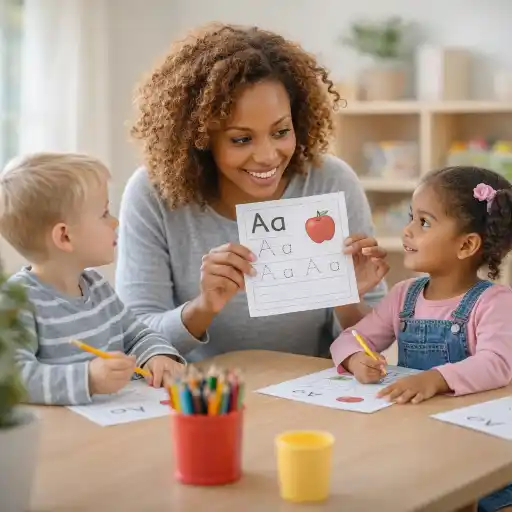
Start with a small amount of adult language and plenty of space for children to respond. The ChildCareEd Trace & Color the Alphabet A–M | Letter Tracing & Fine Motor Worksheets Buy Now $1.49 resource includes uppercase and lowercase tracing, extra writing lines, a large letter to color, and a familiar picture with a beginning-sound phrase. Use those features as invitations to talk, not a script children must recite.
For example, with A and an apple picture, you might say, “This is an apple. Have you tasted one?” Pause and listen. Follow a child’s idea—perhaps they describe a snack, a color, or a family outing—then gently connect it back: “Apple starts with /a/. Can you hear that at the beginning?” If a child is not ready to identify a sound, simply model it without requiring an answer.
- Ask open questions: “What do you notice about this letter?” or “What does this picture remind you of?”
- Invite children to point, name, gesture, draw, or answer in a home language.
- Describe letter features in simple language: “B has a straight line and two curves.”
- Offer tracing by finger, crayon, or another comfortable tool; the goal is engagement, not perfect formation.
Keep the interaction reciprocal: wait, notice what the child says or does, and build on that contribution. A warm exchange can turn a few minutes of pencil work into language-rich learning.
How can you connect letters to play and everyday experiences?
Children are more likely to revisit letters when those symbols connect to something they care about. Choose a letter from a child’s name, a favorite book, a classroom object, or an ongoing play theme. After tracing M, for example, children might look for M on name cards, build the letter with blocks, or make a pretend menu featuring muffins. The purpose is not to transform every moment into a formal lesson; it is to make print visible and meaningful within children’s activity.
Short playful extensions can also support sound awareness and vocabulary. NAEYC’s guidance on word play highlights how rhymes, alliteration, movement, songs, and conversations can be woven into ordinary preschool routines. Try a quick name-and-sound game, clap syllables in familiar words, or search for objects that begin with a target sound when children are ready.
- 📚 Add letter cards, picture books, clipboards, and signs to dramatic-play areas.
- Make letters with playdough, large blocks, chalk, or a finger in a sensory tray.
- Invite children to find the featured letter on labels or book covers.
- Connect a picture to a shared experience: “What do we do with a ball outside?”
When children lead the direction of play, teachers can observe, offer a new word or prompt, and step back. Play-based learning guidance from NAEYC emphasizes that learning goals can be thoughtfully integrated into joyful, active experiences.
How do you keep tracing developmentally appropriate and inclusive?
Preschoolers vary in attention, letter familiarity, language experience, hand strength, visual-motor coordination, and interest in paper tasks. A developmentally appropriate approach adjusts the activity while preserving the learning intention. Some children may trace several letters; others may explore one letter, color its picture, or talk about it with an adult. There is no need for every child to complete the same number of lines.
Consider children’s individuality and the cultural and linguistic contexts they bring. Include names, familiar words, books, and images that reflect children’s families and communities. If a pictured item is unfamiliar, explain or replace it with a known object before asking a child to discuss its beginning sound. Children can show understanding through speech, pointing, drawing, movement, or communication supports.
- Offer thick crayons, larger print, a stable surface, or shorter tracing paths as needed.
- Allow breaks and movement; stop when attention or comfort declines.
- Accept home-language responses and invite families to share relevant words or stories.
- Provide sensory or constructive alternatives, such as forming a letter with clay or blocks.
Use brief observations to guide what comes next: note whether a child recognized a shape, used a tool comfortably, connected a picture to a word, or chose to tell a story.
What common worksheet pitfalls should teachers avoid?
The concern is not that worksheets are always inappropriate. A short, optional tracing activity may be useful when it fits the child’s interests and is part of a broader literacy plan. Pitfalls arise when page completion becomes the primary measure of learning or when paper practice displaces conversation, play, books, movement, and meaningful writing. A tidy worksheet does not necessarily reveal whether a child understands a letter or can use that knowledge elsewhere.
Another common misstep is turning the experience into a rapid-fire quiz. Repeatedly asking “What letter is this?” can narrow children’s participation and make the interaction feel evaluative. Instead, model, comment, wait, and follow the child’s ideas. If a child is uncertain, offer a helpful cue rather than pressing for an immediate correct answer. Remember that letter naming, sound awareness, and pencil control are related but distinct skills.
- Avoid expecting identical pace, grip, or finished work from every child.
- Don’t equate tracing accuracy with overall literacy development.
- Don’t interrupt every child’s story to correct pronunciation or spelling.
- Use worksheet time as one short experience among many, not a substitute for play.
Directors can help by supporting staff planning and reflection: What was the learning intention? How did children respond? What conversation or play opportunity could extend it? These questions shift attention from how many pages were completed to what children are exploring and communicating.
Conclusion: How can teachers balance alphabet worksheets with preschool conversation?
Teachers can balance alphabet worksheets with conversation by treating tracing as a brief entry point to richer literacy experiences. Choose a meaningful letter, invite children to notice its shape and picture, listen to their ideas, and extend the learning through play, movement, books, and everyday print. The ChildCareEd A–M resource offers a ready-to-use way to introduce letter forms and fine-motor practice, while responsive adult interaction makes the experience relevant and engaging.
Keep the goal modest, the tone warm, and the pathway flexible. Children may show learning by tracing, naming, pointing, building, drawing, or telling a story. Observe these strengths and use them to plan a sensible next step. For a deeper framework, explore ChildCareEd’s DAP for Preschool Buy Now $24.00 and its practical focus on applying developmentally appropriate practice in preschool classrooms. A worksheet can be part of literacy learning; relationships, curiosity, and purposeful language make it come alive.
Further learning: five ChildCareEd courses
- 45 Hour Child Growth and Development
- CDA Preschool Credential
- CDA Preschool Credential with Portfolio Review
- Birth to Five CDA Credential with Portfolio Review
- CDA Bridge Bundle: Preschool
- CDA Bridge Bundle: Family Child Care without Portfolio Review
- CDA Bridge Bundle: Infant/Toddler without Portfolio Review
- CDA Bridge Bundle: Preschool without Portfolio Review
- Texas Director Credential
- CDA Certification en Español: Recursos y Consejos para Educadores Bilingües
- 💛🧩 ¿Cómo puedo hacer que mi enseñanza sea inclusiva para los niños con autismo?
- Proporciones de Cuidado Infantil y Tamaños de Grupo por Edad en Nueva Jersey (Guía Rápida para Centros y Hogares)
- Proporciones de Cuidado Infantil y Tamaños de Grupo por Edad en Virginia (Guía Rápida para Centros y Hogares)
- Cómo Celebrar el Día Nacional del Kindergarten
- Celebrando la amistad en el cuidado infantil durante el Día de los Mejores Amigos
- Canciones, juegos y preguntas de círculo para niños
- Is My Preschooler Ready for Kindergarten? Milestones Beyond ABCs and 123s
- How Can You Build a Preschool Literacy Center Without Spending Hours Planning?
- How Much Structured Learning Do Preschoolers Really Need?
- How Can Child Care Providers Support Early Writing Without Using Worksheets?
- What Is Purposeful Play—and Why Is It Replacing Worksheets?
- How Can Teachers Build Early Literacy Without Screens or Worksheets?
- What Should a 3-Year-Old Be Learning at Preschool?
- How Can Child Care Providers Move Children from Letter Recognition to Beginning-Sound Awareness?
- How Can Child Care Providers Teach Less-Frequent Letters Without Relying on Worksheets Alone?
- How Can Hands-On Dot-Marker Activities Build Alphabet Knowledge?
- How Can Transportation Interests Motivate Beginning Readers?
- How Can Teachers Balance Alphabet Worksheets with Preschool Conversation?
- How Can Preschool Teachers Balance Alphabet Worksheets with Conversation?
