When preschool readiness goals compete for time, start with the routines, relationships, and experiences that help children participate confidently throughout the day. At the beginning of the year, the First Week of School Checklist for Early Childhood Classrooms Buy Now $0.49 can help you organize classroom preparation, introduce daily routines, and establish family communication so those foundations receive attention. The Are They Ready for Kindergarten? Buy Now $35.00 course offers focused learning on cognitive, physical, and social-emotional readiness to support balanced planning. Read on for practical ways to set priorities, combine learning opportunities through play, and explain your choices to families.
Why does prioritizing readiness goals matter?
Preschool educators balance many worthwhile goals: language and literacy, early mathematics, social-emotional development, physical coordination, independence, and curiosity. When time is limited, trying to teach every skill as a separate lesson can fragment the day and leave children with less time for sustained exploration. Prioritizing does not mean abandoning important domains; it means choosing experiences that address several goals meaningfully and responding to what children need next.
Readiness is a developmental process, not a pass-or-fail checklist. The Head Start Early Learning Outcomes Framework organizes learning across broad developmental domains, reinforcing that children’s growth is interconnected. Developmentally appropriate practice also asks educators to consider what is typical for an age group, what is distinctive about each child, and the family and community context in which learning occurs.
This matters for equity as well as effectiveness. A narrow focus on visible academic outputs can miss a child’s communication, belonging, persistence, motor development, or growing independence. A child who is still learning how to enter play or ask for help may need those participation skills supported so they can fully access books, math materials, and peer learning.
Use a strengths-based question to guide decisions: “What would help this child participate, connect, and take the next step?” That shift keeps planning responsive rather than driven by pressure or comparison. State requirements vary - check your state licensing agency.
How can educators decide which goals come first?
Start with program requirements and the learning framework or curriculum your setting uses. Then use current observations, family knowledge, and children’s interests to identify the most useful next steps. A goal deserves priority when it supports access to learning, addresses a meaningful developmental need, or can be practiced naturally across the daily routine.
Rather than ranking literacy above social-emotional learning—or the reverse—look for foundations that enable children to engage. For example, asking for a turn supports communication and peer relationships while helping a child remain involved in block play. Remembering a short direction during cleanup builds attention, language comprehension, and independence. These are not competing outcomes when adults plan intentionally.
- Begin with evidence: What does the child already do independently, with prompts, or in a familiar setting?
- Choose a manageable focus: Select one or two near-term targets for a child or small group rather than creating an overloaded list.
- Consider access: Which skill or adaptation would help the child take part more fully in classroom life?
- Check relevance: Does the goal connect to the child’s interests, home language, family priorities, or current play?
- Review over time: Notice whether the support is helping, and adjust the plan when circumstances change.
Use these questions in team planning, not as a rigid scoring system. The goal is an intentional choice that staff can explain, observe, and revisit.
How can one experience support several readiness domains?
Well-chosen play and routines often develop multiple abilities at once. A pretend market can invite children to write or draw signs, count objects, compare quantities, negotiate roles, remember a plan, and practice waiting. Outdoors, children may measure a shadow, describe what they notice, coordinate their movements, and collaborate on an investigation. These experiences offer rich practice without turning the day into a series of disconnected drills.
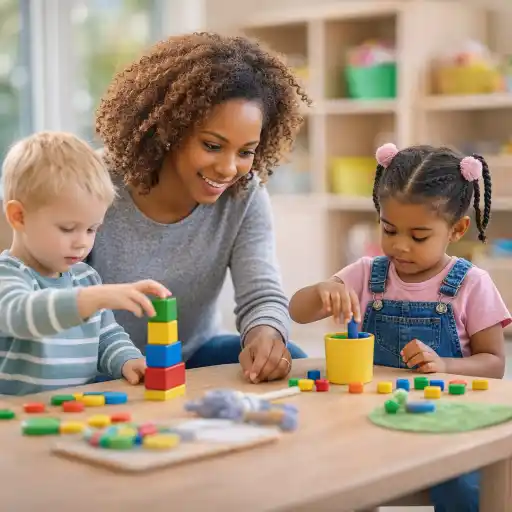
The National Academies’ vision for high-quality preschool curriculum cautions against false either-or choices, such as play versus academics. Purposeful curriculum can combine engaging content, child agency, responsive teaching, and clear learning objectives. The educator’s role is to notice learning and make a timely contribution: introduce a word, model a strategy, pose a question, or offer a new material—then allow children to continue exploring.
- During a read-aloud, invite children to predict, retell, notice a character’s feelings, and count repeated objects.
- At snack, encourage children to open containers, request what they need, compare amounts, and help with simple routines.
- In block play, add a photo or drawing prompt and ask what might make a structure stable; children can plan, test, revise, and explain.
- 🌱 Use a transition song or visual cue to practice sequence, listening, self-regulation, and independence without extending group time.
Keep the adult’s move brief and purposeful. If children’s play is already deep and collaborative, observation and responsive support may be more valuable than adding another instruction.
How should observation shape priorities for individual children?
Observation helps educators distinguish a real learning need from an assumption based on one moment. Look across settings and days: a child who is quiet during large group may communicate richly in dramatic play; a child who avoids drawing may show strong fine-motor control while building or using tools. Short, objective notes help teams recognize these patterns and identify useful supports.
Document what happened, the context, and the assistance provided. For example: “At the block area, Lee pointed to the bridge and said ‘help’ after the educator modeled the phrase,” is more actionable than “Lee has poor language.” This kind of evidence can inform a small goal, such as providing visual choices or creating repeated opportunities to request materials during play.
Partner with families to understand a child’s strengths, interests, language experiences, routines, and priorities. The National Academies emphasizes that curricula should honor children’s cultures and languages and collaborate with families. A child’s home language is an asset; educators can support communication and belonging while learning how the child expresses ideas across languages and contexts.
Revisit goals after a reasonable period of consistent support. If progress is limited, consider whether the materials, timing, environment, communication mode, or adult strategy needs to change. When developmental concerns persist, follow program procedures and collaborate with the family and qualified professionals. Observation should guide support, not label a child or predict their potential.
What common prioritization mistakes can programs avoid?
One common pitfall is treating school readiness as a race to cover content. Rushing through many objectives can reduce meaningful practice and make children’s learning appear narrower than it is. A second is over-relying on worksheets or whole-group instruction because progress seems easier to document. Children also demonstrate knowledge through conversation, movement, construction, pretend play, problem-solving, and daily routines.
Another mistake is assuming the same goal should be equally urgent for every child. Readiness is uneven and individual: one preschooler may need support with peer entry, another with language-rich conversation, and another with self-help routines. A shared curriculum can still be responsive when educators adapt prompts, materials, challenge levels, and ways to participate.
- Instead of “more goals,” choose a few meaningful priorities and embed them in several parts of the day.
- Instead of labeling a child, record observable actions and the supports that helped.
- Instead of replacing play with academics, identify the language, math, and problem-solving already present in children’s play and extend it.
- Instead of expecting instant independence, model, co-regulate, offer visual or verbal cues, and gradually reduce support.
- Instead of making decisions alone, include families and colleagues in interpreting observations and setting priorities.
Directors can support staff by protecting sustained play, ensuring access to appropriate materials, and making time for brief collaborative reflection. Consistency grows when teams share clear goals and practical strategies, not when educators are handed an ever-longer checklist.
Conclusion: What should take priority when readiness goals compete?
When preschool readiness goals compete for limited time, prioritize the learning that helps children participate, connect, and make meaningful progress—then weave other domains into those experiences. Consider each child’s developmental needs, strengths, interests, family context, and the requirements of your program. A whole-child approach does not minimize literacy or mathematics; it makes room for them alongside relationships, regulation, movement, independence, and curiosity.
In practice, observe before choosing, set a small number of actionable goals, integrate learning through play and routines, and review whether your support is working. Share the reasoning and children’s progress with families and colleagues. Thoughtful prioritization is not about doing less for children; it is about making limited time more coherent, inclusive, and valuable. For further professional learning, explore these English-language ChildCareEd courses:
- Roadmapping Preschool Curriculum
 Buy Now $24.00 — planning developmentally appropriate, individualized experiences and kindergarten foundations.
 - DAP for Preschool Buy Now $35.00 — applying developmentally appropriate practice in preschool settings.
- From Tantrums to Triumphs: Equipping Preschoolers with Self-Regulation Skills Buy Now $25.00 — practical strategies for emotional regulation and classroom participation.
- Emergent Learning & Development Buy Now $35.00 — connecting preschool learning experiences with children’s emerging skills.
- 45 Hour Child Growth and Development
- CDA Preschool Credential with Portfolio Review
- 45 Hour Preschool Methods and Materials
- Birth to Five CDA Credential with Portfolio Review
- CDA Bridge Bundle: Preschool
- CDA Bridge Bundle: Family Child Care without Portfolio Review
- CDA Bridge Bundle: Infant/Toddler without Portfolio Review
- CDA Bridge Bundle: Preschool without Portfolio Review
- Texas Director Credential
- Supporting Children's Independence
- 😫🧸 ¿Qué hacer cuando un bebé no quiere dormir la siesta en el aula?
- 🚨 Reporte Obligatorio en Nevada
- Requisitos Para Ser Maestra Principal En Un Daycare: Lo Que Necesitas Para Empezar
- Recursos en Español sobre el Sueño Seguro del Bebé
- Cómo usar tu certificación de 90 horas en Maryland para completar tu CDA
- Capacitación en Salud y Seguridad Preventiva en Línea para Proveedores de Cuidado Infantil
- Regulaciones de Licenciamiento de Cuidado Infantil en California para Centros y Hogares de Cuidado Infantil Familiar
- Proporciones de Cuidado Infantil y Tamaños de Grupo por Edad en Maryland (Guía Rápida para Centros y Hogares)
- Horas de Capacitación Anual para Proveedores de Cuidado Infantil en Maryland
- Lista para Guardería en Casa en California: Cómo Iniciar una Guardería en el Hogar
- Lista para Guardería en Casa en Texas: Cómo Iniciar una Guardería en el Hogar
- Por Qué la Supervisión Activa Es Clave para la Seguridad en el Cuidado Infantil
- Retraso del Habla en la Guardería: Cómo Pueden Ayudar los Proveedores
- Cómo Trabajar en el Cuidado Infantil en Wisconsin: Requisitos y Pasos
- Capacitación Previa al Servicio para Proveedores de Cuidado Infantil en Dakota del Norte
- Capacitación Previa al Servicio para Proveedores de Cuidado Infantil en Maryland
- Capacitación Previa al Servicio para Proveedores de Cuidado Infantil en Georgia
- Canciones, juegos y preguntas de círculo para niños
- What Should Child Care Providers Prioritize When Preschool Readiness Goals Compete for Time?
