When kindergarten expectations feel like a long checklist, it can be hard to protect the play young children need. A balanced approach connects meaningful learning goals to children’s curiosity, and The Best Promotion is Play  Buy Now $24.00 offers practical ideas for strengthening play-based classroom practice. For a broader foundation in developmentally appropriate planning and individualizing instruction, explore Roadmapping Preschool Curriculum Buy Now $24.00 as a helpful next step.
Why does balancing play and readiness matter?
Childcare teachers often hear two messages at once: prepare children for school, and honor their development, interests, and need to play. These aims are not opposites. School readiness is broader than knowing letters or completing paper tasks; it includes communication, approaches to learning, physical development, social-emotional competence, and early thinking. Head Start’s approach describes readiness as a partnership among children, families, and schools, with development considered across multiple domains (Head Start Approach to School Readiness).
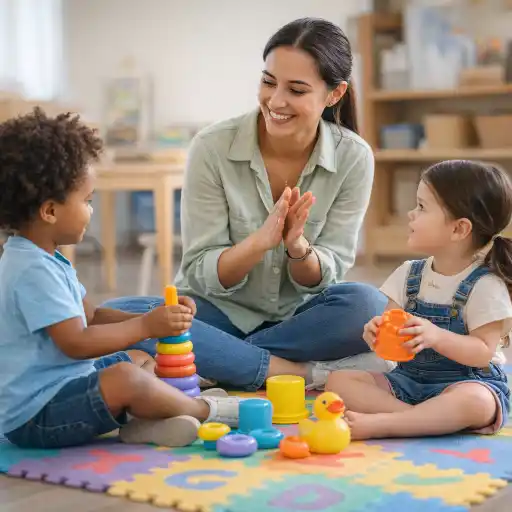
Play offers children authentic reasons to use emerging skills. A pretend market can invite counting, writing, negotiation, vocabulary, and flexible thinking; block play may involve spatial reasoning, persistence, and collaboration. Research has also found associations between preschool play time, self-regulation, and later prereading and math skills, although findings should be interpreted in the context of the study rather than treated as a guarantee (study of play time and early skills).
For educators, the challenge is not choosing between “play” and “academics.” It is designing a day where children have agency and sustained exploration, while teachers intentionally notice and extend learning. This approach can also make expectations easier to explain to families and colleagues: the learning is visible in children’s actions, words, strategies, and relationships.
What does school readiness look like beyond academic checklists?
Readiness is best understood as a set of developing capacities, not a pass-or-fail test. Children may show strength in storytelling while still needing support with transitions, or demonstrate number sense through building rather than a formal quiz. A whole-child perspective helps educators recognize progress in varied forms and plan support without defining a child by a single score.
Use the domains in your state or program’s early learning framework as planning lenses. Head Start’s framework includes approaches to learning; social and emotional development; language and literacy; cognition; and perceptual, motor, and physical development. These areas overlap. For instance, taking turns in a game combines social understanding, memory, language, and rule-following.
- Language and literacy: conversation, storytelling, listening, print awareness, and emergent writing.
- Early math and cognition: counting, sorting, comparing, patterns, spatial language, and problem-solving.
- Social-emotional learning: cooperation, self-regulation, expressing needs, and seeking help.
- Physical development and independence: movement, tool use, self-help routines, and care for materials.
- Approaches to learning: curiosity, persistence, flexible thinking, and confidence to try.
NAEYC frames playful learning as a way to bring rich curriculum together with engaging, child-responsive teaching (the power of playful learning). Keep goals ambitious but appropriate to children’s developmental levels, individual strengths, languages, and experiences. State requirements vary - check your state licensing agency.
How can teachers weave learning goals into play?
Start with a clear but modest intention: What might children explore or practice? Then prepare materials and allow their ideas to shape how the experience unfolds. In guided play, the teacher creates conditions for learning and offers a prompt or resource, while children retain meaningful choice. This is different from directing every action toward one predetermined product.
Imagine children setting up a pretend clinic. Add clipboards, appointment cards, dolls, and simple signs. Children may write marks, count supplies, explain symptoms, take turns, and invent roles. A teacher can extend the learning with a question such as, “How will you keep track of who is next?”—then pause rather than supply the answer. In block play, adding pictures of bridges or measuring tools can encourage design and spatial language without turning construction into a copying exercise.
- Observe first: notice what children are trying, saying, and negotiating.
- Choose one or two linked goals, such as comparing quantities or using descriptive words.
- Offer open-ended materials that can support different ideas and abilities.
- Use brief prompts, vocabulary, modeling, or a small challenge when it serves the play.
- Step back when children are engaged; let them test, revise, and solve problems.
😄 A child’s unexpected idea can become the richest learning moment—follow it when it is safe and relevant. Sustained play matters because children often need time to develop a plan, negotiate with peers, and return to an idea. The NAEYC discussion of observing, planning, and guiding describes teachers as thoughtful observers who extend learning without taking over (observing, planning, and guiding).
How can a daily schedule make room for both play and focused instruction?
A balanced schedule does not require every minute to be playful or every goal to be taught through centers. It combines routines, child-directed play, guided experiences, movement, read-alouds, and brief focused instruction. The right proportions depend on children’s ages, program context, staffing, and applicable requirements. Protect an uninterrupted block when possible so children can become deeply involved instead of repeatedly stopping just as their play develops.
Teachers can embed early literacy and math naturally: count cups at snack, notice letters in children’s names, compare block towers, or retell a story with puppets. A short small-group activity may introduce a sound or demonstrate a game; children can then explore the idea in a meaningful context. The OECD notes that child-centered and staff-initiated practices can be combined, with choices made according to learning purpose and children’s development (OECD discussion of early learning pedagogy).
- Build a predictable flow with transitions children can understand.
- Protect extended play and include outdoor, active, and quiet options.
- Use short focused lessons selectively, then provide chances to apply ideas.
- Review whether transitions or adult interruptions are cutting play short.
- Adapt routines and materials for children’s access, language, sensory, and developmental needs.
For program leaders, shared planning helps staff connect goals with daily experiences without turning every center into a lesson. A simple weekly plan can identify the intended skill, materials, possible teacher prompts, adaptations, and evidence to notice. This keeps the curriculum intentional while preserving children’s ownership of play.
How can observation show learning and guide next steps?
Observation makes the learning in play visible. Rather than relying only on worksheets or end products, record what a child says, tries, changes, or does with peers. A concise note such as “During block play, Jayden counted six blocks, noticed the tower leaned, and widened its base” offers evidence of number use, observation, and problem-solving. It also suggests a next step, such as adding photographs of different structures or inviting children to compare designs.
Use a practical cycle:
- Observe children in play, routines, conversations, and small groups.
- Record specific words or actions without judgment.
- Interpret cautiously, considering context, home language, ability, and available support.
- Plan a manageable next step, such as a new material, peer pairing, visual cue, or question.
- Revisit the experience and adjust based on what children show.
Assessment should guide instruction and individualization, not label children or rank them. Head Start’s readiness approach emphasizes using progress information to individualize and working with families in setting goals (readiness goals and family partnership). Share observations with families in plain, strengths-based language, and invite their perspectives about children’s interests, languages, and skills at home.
Programs can support staff by making documentation manageable: brief notes, photographs where permitted, work samples, or a shared observation template. Check program privacy policies and local requirements when collecting or sharing records.
What common pitfalls can programs avoid?
Even committed educators can feel pressure to demonstrate readiness through visible paper products or rapid coverage of skills. A worksheet may have a limited purpose, but it does not show the full range of children’s thinking, collaboration, communication, or ability to apply a concept. The goal is not to reject every structured task; it is to ensure those tasks serve a clear purpose and do not displace richer experiences.
- Rushing play: Reduce unnecessary interruptions and preserve longer blocks where schedules allow.
- Taking over: Offer a prompt, model, or material, then return decision-making to children.
- Equating readiness with drill: Link literacy and math goals to conversation, movement, stories, games, and exploration.
- Comparing children: Review each child’s growth over time and consider individual development and context.
- Assuming all children participate in the same way: Provide different entry points, communication supports, and adapted materials.
- Making unsupported promises: Explain what an activity supports without claiming it guarantees later outcomes.
Families may ask for more worksheets because paper feels familiar and measurable. Respond with respect: share a photograph, the child’s words, the learning goal, and a concrete example of progress. Invite families to visit or try a simple play activity at home. Research and professional guidance support combining intentional instruction with child-centered learning, rather than treating the approaches as mutually exclusive.
Directors can help by aligning staff expectations, offering planning time, and discussing how standards appear in everyday play. State requirements vary - check your state licensing agency, and consult your program’s curriculum and assessment guidance.
Conclusion: How can teachers balance play with readiness expectations?
Teachers can balance play-based learning with school readiness by defining readiness broadly, setting purposeful goals, and embedding those goals in engaging experiences that preserve children’s agency. Play gives children opportunities to use language, early math, self-regulation, physical skills, and social competence in connected, meaningful ways. Brief direct teaching can complement these experiences when it is developmentally appropriate and followed by opportunities to explore and apply learning.
Begin with a manageable change: protect one uninterrupted play period, select a learning intention for a center, or record one specific example of a child’s thinking. Use observations to plan next steps and communicate progress with families and colleagues. When programs combine thoughtful planning, responsive guidance, and respect for each child’s development, play and school readiness can reinforce one another.
For professional learning, explore these English-language ChildCareEd courses:
- The Best Promotion is Play Buy Now $24.00 — strategies for creating engaging play environments.
- Roadmapping Preschool Curriculum Buy Now $24.00 — developmentally appropriate planning and kindergarten preparation.
- Emergent Learning & Development Buy Now $35.00 — learning objectives and experiences for preschool children.
- Observations And Goal Setting in Childcare Buy Now $24.00 — using observations and goals to inform planning.
- Early Mathematics Through Play Buy Now $24.00 — practical approaches to playful early math.
The central question is not whether children should play or prepare for school. It is how educators can make purposeful, responsive play part of preparation—and give children room to learn with curiosity and confidence.
Key words: #play #readiness #learning #observation #families
- 45 Hour Child Growth and Development
- Teach with Respect ONLINE
- Student Success: Expectations & Independence
- Balancing Physically Active Play in Child Care
- 45 Hour Preschool Methods and Materials
- What Makes Me Special: An Overview of Autism and ADHD
- 45 Hour School Age Methods and Materials
- Bienvenido! Welcoming All Families
- Balancing Active Play in Child Care
- CDA Certification en Español: Recursos y Consejos para Educadores Bilingües
- 10 Ejemplos de Cómo la Cultura Influye en el Desarrollo Infantil
- Proporciones de Cuidado Infantil y Tamaños de Grupo por Edad en Virginia (Guía Rápida para Centros y Hogares)
- Actividades de Otoño Fáciles para Preescolares esta Temporada
- Celebrando la amistad en el cuidado infantil durante el Día de los Mejores Amigos
- Canciones, juegos y preguntas de círculo para niños
- What Kindergarten Readiness Skills Should My Program Build?
- Is Your Child Ready for Kindergarten? A Kindergarten Readiness Checklist
- After-School Activities for Kids: Calm, Creative, and Active Ideas for Every Energy Level
- Active Supervision Examples: 10 Real Classroom Scenarios—Safe or Unsafe?
- Is My Preschooler Ready for Kindergarten? Milestones Beyond ABCs and 123s
- How Can Child Care Programs Build Meaningful School Readiness?
- How Can Teachers Support Children Starting Kindergarten This Fall?
- How Can Child Care Providers Support Kindergarten Emotions on the First Day of School?
- How Can Preschool Programs Prepare Children for Kindergarten Without Pushing Academics Too Early?
- What Does Kindergarten Readiness Really Mean in 2026?
- How Can Preschool Teachers Build Kindergarten Readiness Without Turning Pre-K Into Kindergarten?
- How Can Childcare Teachers Balance Play-Based Learning with School Readiness Expectations?
