Safe meals require more than careful cooking—they require coordinated routines, informed staff, and individualized plans for children with allergies. The Food Preparation and Nutrition  Buy Now $32.00 course can help providers strengthen food handling, storage, and allergy-prevention practices while supporting relevant professional development hours. For more focused emergency preparation, explore the Prevention of and Response to Allergic Reactions Buy Now $8.00 course.
Why do food safety and allergy management matter in preschool?
Preschool children are particularly vulnerable to foodborne illness because their immune systems are still developing. The CDC notes that children under five are more likely to become seriously ill from certain foodborne germs, and illness can lead to dehydration and hospitalization. A safe classroom therefore depends on consistent routines rather than good intentions alone.
Food allergies add another layer of responsibility. An allergic reaction can develop quickly, and symptoms may differ from one child or incident to another. The CDC identifies milk, eggs, fish, crustacean shellfish, wheat, soy, peanuts, and tree nuts as major sources of serious reactions in the United States; sesame is also recognized as a major allergen under current federal labeling requirements.
Strong systems protect children while preserving inclusion. Children with allergies should be able to participate in meals, celebrations, sensory activities, and field trips without being isolated. State requirements vary - check your state licensing agency.
What daily food safety routines should every classroom use?
Preschool programs should translate food safety principles into predictable, observable steps. The Institute of Child Nutrition’s Child care centre food guide emphasizes personal hygiene, time and temperature control, cleaning and sanitizing, and safe preparation for young children.
- Wash hands with soap and water before food preparation, before eating, and after meals. Children and adults should participate.
- Clean and sanitize tables, high-touch surfaces, utensils, and food-contact areas according to product directions.
- Separate raw animal foods from ready-to-eat foods and use clean equipment for serving.
- Use a food thermometer and follow safe cooking, cooling, refrigeration, and reheating procedures.
- Choose pasteurized dairy and juice, thoroughly washed produce, fully cooked eggs and meats, and other safer foods for children under five.
- Keep children seated and actively supervised while eating, and prepare foods to reduce choking hazards.
Remember the CDC’s four-part framework: clean, separate, cook, and chill. Directors can reinforce these habits with posted checklists, temperature logs, and brief observations during meals.
How can programs prevent allergen exposure and cross-contact?
Cross-contact occurs when an allergen unintentionally transfers to food, hands, utensils, surfaces, or classroom materials. For a child with a serious allergy, a small amount may be enough to trigger a reaction. Prevention must extend beyond the kitchen to tables, dramatic-play materials, sensory bins, celebrations, and field trips.
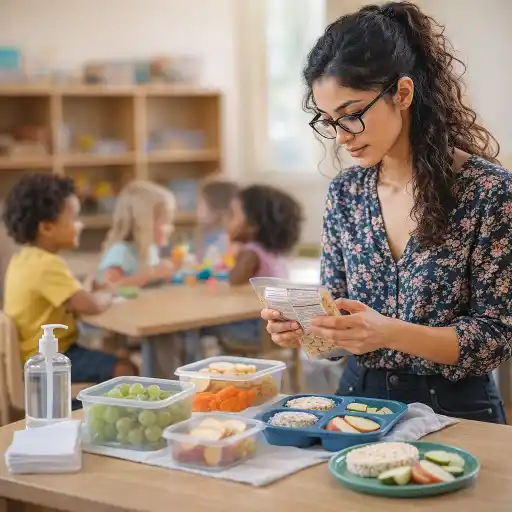
- Collect allergy information during enrollment and update it whenever a family reports a change.
- Read ingredient labels every time, since formulations and brands can change.
- Use designated utensils, cutting boards, serving tools, and storage areas when appropriate.
- Do not allow children to share food, cups, utensils, or tasting materials.
- Wash hands with soap and water after eating; hand sanitizer alone may not remove food allergens.
- Choose non-food materials for sensory play and art whenever possible, or verify every ingredient with the child’s family.
- Label allergy-safe foods clearly and assign one staff member to verify ingredients before serving.
Programs should avoid promising an entirely allergen-free environment. Instead, establish layered safeguards, document responsibilities, and communicate honestly with families.
What should an individualized allergy care plan include?
Each child with a diagnosed food allergy should have a written, current plan completed and signed by the child’s health care provider. The plan should be concise enough for rapid use but detailed enough to guide prevention and emergency response.
- Identification: child’s name, photograph, classroom, and emergency contacts.
- Allergens: exact foods or ingredients to avoid and approved substitutions.
- Symptoms: the child’s typical mild and severe reaction signs.
- Medication: medication name, dose, authorization, storage location, and trained administrators.
- Emergency response: numbered actions for suspected anaphylaxis, including when to administer epinephrine, call 911, contact the family, and document the event.
Keep the original plan in the child’s confidential health record and a copy with emergency medication in an unlocked, inaccessible-to-children location. Authorized staff should know where to find it. Plans should travel with the child during transportation and field trips, along with medication and a charged phone.
How should staff recognize and respond to an allergic emergency?
Training should cover hives, swelling, coughing, wheezing, throat tightness, vomiting, abdominal pain, dizziness, pallor, unusual sleepiness, and difficulty breathing. Symptoms can occur without hives, so staff should take sudden changes seriously. Anaphylaxis is a medical emergency that may become life-threatening within minutes.
When anaphylaxis is suspected, staff should follow the child’s written plan and program policy. In general, the response includes administering epinephrine as directed, calling 911, notifying the family, monitoring the child, and documenting the incident. Emergency medical services should be contacted after epinephrine administration even if the child appears better.
Directors should train more than one staff member on every shift, including substitutes and transportation staff. Use trainer devices for practice and conduct short drills that rehearse:
- Recognizing symptoms and locating the child’s plan.
- Retrieving medication without leaving other children unsupervised.
- Using an epinephrine trainer according to the prescription instructions.
- Calling 911 and communicating the classroom location clearly.
- Assigning supervision, family notification, and documentation roles.
Training does not replace medical advice or state-specific medication requirements. Directors should verify authorization, storage, delegation, and documentation rules with their licensing agency and health consultant.
How can directors build a reliable program-wide system?
Effective management is a leadership process, not a single form. Directors should create written procedures that connect enrollment, meal planning, classroom practice, staff training, family communication, and incident review.
- At enrollment: collect health care provider plans, medication authorizations, emergency contacts, and family instructions.
- Before meals: review allergy lists, verify labels, assign serving and cleaning roles, and inspect food surfaces.
- During meals: actively supervise, prevent sharing, and keep children seated.
- After meals: clean and sanitize surfaces, wash hands, and document any concerns.
- During events: communicate menus early and establish procedures for birthdays, potlucks, and brought-from-home foods.
- After an incident: provide required notifications, document facts, review what happened, and update procedures without blaming individuals.
For seasonal celebrations, staff can also draw on guidance for healthy holiday eating habits when planning festive, nutritious options for children.
Common mistakes include relying on one trained employee, checking labels only once, storing medication where substitutes cannot find it, and using food in activities without reviewing ingredients. Simple role assignments, refresher training, and quarterly practice can reduce these vulnerabilities.
Useful professional learning options include Illness, Medication, and Allergies in Child Care Buy Now $32.00, which addresses illness signs, medication administration, and food allergies; Elijah’s Law: Allergy Awareness Training Buy Now $16.00; and Health and Nutrition Buy Now $24.00, which connects children’s nutritional needs with chronic health conditions and food allergies.
Conclusion: What are the essential takeaways?
How can preschool classrooms strengthen food safety and allergy management? By combining reliable food-handling practices with individualized allergy plans, trained staff, active supervision, and respectful family partnerships.
Directors can begin with five actions:
- Collect and regularly update provider-signed allergy care plans.
- Make handwashing, cleaning, label verification, safe temperatures, and no food sharing routine expectations.
- Prevent cross-contact in kitchens, classrooms, sensory activities, and celebrations.
- Train multiple staff members to recognize reactions and follow emergency plans.
- Review incidents, drills, and documentation to improve the system continuously.
These practices support #children, strengthen #staff confidence, and create safer, more inclusive #classrooms. Consistency is the goal: when every adult follows the same #safety procedures, children can enjoy meals and learning with greater protection and dignity.
- Beyond the Classroom: Connecting Families to Essential Services
- Emergent Learning & Development
- Basic Health & Safety and Breastfeeding Awareness
- Medication Administration and the Prevention of and Response to Food and Other Allergies in the Child Care Environment
- Nutrition Essentials for Child Care Providers
- Food Preparation and Nutrition
- Medication Administration and the Prevention of and Response to Food and Other Allergies in the Child Care Environment
- Texas Director Credential
- 45-Hour Infant and Toddler Curriculum
- Memorial Day Activities
- 🧼Band-Aids, Germs & Giggles: Why Basic Health & Safety Training Is a Big Deal in Child Care
- 10 Ejemplos de Cómo la Cultura Influye en el Desarrollo Infantil
- Proporciones de Cuidado Infantil y Tamaños de Grupo por Edad en Virginia (Guía Rápida para Centros y Hogares)
- Lista para Guardería en Casa en Texas: Cómo Iniciar una Guardería en el Hogar
- Creative National Ice Cream Day Ideas for the Classroom
- How can child care programs keep children healthy every day?
- How can Michigan daycares teach healthy eating habits to toddlers?
- How can North Dakota child care programs make the most of CACFP for healthy meal planning?
- Cómo simplificar la capacitación para sus empleados de daycare
- How can child care programs keep kids safe on the Fourth of July in North Dakota?
- How can my North Dakota program make the most of food programs like CACFP?
- How should Minnesota child care programs handle allergies and special diets?
- How can child care programs build effective food allergy awareness and emergency response plans?
- How can child care programs effectively manage food allergies to keep children safe?
- How can child care programs build healthy eating habits that last?
- How can gardening activities transform early childhood classrooms?
- From Mealtime to Manners: How Cultural Influences Show Up in Everyday Child Care
- How Can Preschool Classrooms Strengthen Food Safety and Allergy Management?
- How Can Child Care Providers Strengthen Food Safety Practices?
