Want children in your care to enjoy nutritious meals today and carry healthy choices into adulthood?
Building lasting eating habits starts with predictable routines, thoughtful menus, and family partnerships your program can implement now. As a next step, consider the ChildCareEd course On My Plate: Children's Nutrition  Buy Now $24.00 to strengthen menu planning and classroom practices while earning useful training hours; you might also pair it with Nutrition Essentials for Child Care Providers Buy Now $16.00 for deeper guidance on feeding across ages.
Why it matters: early childhood is a window of opportunity—what children taste, how meals are served, and the attitudes modeled by adults shape lifelong #nutrition patterns. Strong routines and positive #mealtimes reduce behavior challenges, support cognition, and improve overall classroom climate. This article gives practical, research-informed steps you can apply today to support #children and strengthen relationships with #families so healthy choices become the norm.
What are the core principles that make healthy eating habits stick?
Start from a clear set of principles that guide daily choices. Evidence and field practice point to a small number of high-impact elements: predictable meal/snack schedules; repeated, low-pressure exposure to a variety of foods; adult role-modeling and family-style service where developmentally appropriate; child participation in food tasks; and respectful attention to cultural preferences and dietary restrictions. These elements support autonomy, taste-flavor learning, and self-regulation—key developmental outcomes for young children.
Practical anchors:
- Make meal and snack times consistent so children learn internal hunger/fullness cues.
- Offer a “rainbow” of fruits and vegetables across the week rather than forcing single items.
- Integrate food learning into curriculum (gardening, sensory exploration, stories). For a playful way to introduce gut health and nourishing foods, use this child-friendly guide to feeding the “gut gnomes”.
- Model balanced choices and talk positively—children adopt adult norms.
Related guidance and research come from agencies you can cite for staff training and policy work (see the CDC overview Good Nutrition Starts Early). Use these principles when you review menus, train staff, or design family communications—the payoff is improved engagement, calmer classrooms, and healthier long-term outcomes.
How can providers design menus and routines that support lifelong healthy habits?
Menu design must be intentional: balance across food groups, age-appropriate portions, and predictable cycles that rotate textures and flavors. Start with simple rules drawn from USDA MyPlate and local best practices: fruits/vegetables at every meal, whole grains most days, lean proteins and healthy fats, water available throughout the day, and minimal added sugars. Programs participating in CACFP can align menus to reimbursement standards; local CACFP authorities and resources can help with planning and purchasing. Ohio providers can also explore Ohio Healthy Programs (OHP), which supports healthy habits, nutritious menus, and family engagement in child care settings.
Practical steps for directors and lead teachers:
- Use a weekly menu template and post it for families; rotate one new food each week so children get repeated exposure.
- Plan family-style or assisted self-serving for preschoolers to build autonomy and portion sense; adapt service methods for infants and toddlers.
- Train kitchen staff on safe preparation and batch-friendly recipes that keep costs reasonable—consider a course such as Food Preparation and Nutrition Buy Now $32.00 to standardize safe practices.
- Keep substitutions ready for allergies and cultural preferences so menus are inclusive rather than exclusionary.
Small tweaks—like trimming serving sizes, cutting grapes safely, or swapping sugary sides for fruit—stack up into measurable improvements across the program.
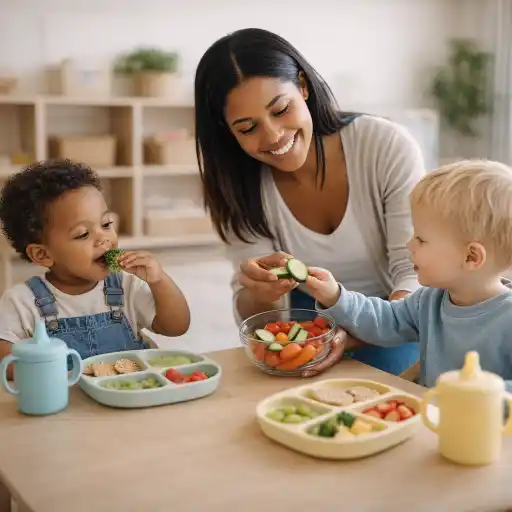
How can child care programs engage families and the community to make habits last?
Partnerships extend healthy patterns beyond your walls. Families influence daily intake most of all, so communication should be simple, culturally responsive, and strengths-based. Use short weekly notes, share photos (with permission), and invite families to low-barrier participation opportunities (recipe swaps, garden projects, tasting days). Two-way communication—asking families about favorite foods and cultural practices—builds trust and makes menus relevant.
Staff pursuing a CDA can also review CDA guidance on child health and nutrition, including breastfeeding and the role of parents in early childhood education.
Engagement tactics that work:
- Send a one-line weekly tip and the posted menu so families can mirror foods at home.
- Offer asynchronous involvement: take-home taste tests, photos, or a single-question survey.
- Host occasional family events—short, hands-on, and scheduled at different times—to maximize participation.
- Tap community partners (local farm programs, CACFP sponsors, SNAP-Ed) for resources and support.
For templates and family-engagement scripts, see ChildCareEd’s guidance such as How can child care programs engage families in nutrition and health education?. And remember: state requirements vary - check your state licensing agency when planning shared food events or menu changes.
How should providers handle picky eating, allergies, and mealtime safety without undermining healthy habits?
Picky eating, allergies, and choking risks are everyday realities. Address them with consistent policies that protect safety while preserving positive mealtime culture. For picky eaters, repeated exposure without pressure is the best evidence-based approach: offer small portions, pair new foods with preferred items, and involve children in preparation. The CDC’s tips on picky eaters explain the developmental normalcy of refusal and useful tactics (Tips to Help Your Picky Eater).
Allergy and safety essentials:
- ⚠️ Keep current allergy lists in classrooms and kitchens; label foods and train staff on emergency plans.
- Cut high-risk foods (grapes, hot dogs, raw carrots) into safe shapes for young children.
- Practice food hygiene to prevent cross-contact; a course like Healthy Starts: Safety, Nutrition, and Wellness in Child Care Buy Now $55.00 reinforces safe systems.
- For infants, follow individualized feeding plans, paced bottle/breastfeeding guidance, and age-appropriate introductions—see The First Year: Feeding Infants Buy Now $16.00 for practical instruction.
By separating safety procedures from feeding philosophy (no coercion, focus on autonomy), programs keep mealtimes nurturing and developmentally supportive.
How can programs measure success and avoid common pitfalls?
Measurement should be simple and useful. Track small process and outcome indicators that fit your staffing capacity: number of family contacts per month, frequency a new food is offered, percent of children served family-style, or a log of one new fruit/vegetable exposure. Use brief surveys or an accomplishment board for staff and families to celebrate progress.
Common mistakes and how to avoid them:
- ❌ Overloading families with long messages — Fix: one short tip or photo per week.
- ❌ Forcing or bribing children to eat — Fix: low-pressure exposure and modelling.
- ❌ Ignoring cultural foodways — Fix: invite family recipes and integrate familiar foods alongside new options.
- 🍎 Underestimating the role of the environment — Fix: build pleasant, unrushed mealtimes and train staff to sit with children when possible.
FAQ (quick answers for directors):
- Q: How often should we introduce a new food? A: Rotate one new item per week and serve it repeatedly over several weeks.
- Q: How to involve families with limited time? A: Offer take-home taste ideas and one-question texts they can answer in 30 seconds.
- Q: Can we use family-style with infants? A: No—use developmentally appropriate self-feeding supports for infants and toddlers with supervision.
- Q: Where can staff get training? A: ChildCareEd offers courses like Nutrition Essentials Buy Now $16.00 and others linked above to increase staff confidence and meet training needs.
Conclusion
Building lasting healthy eating habits is practical and achievable when you combine solid principles, intentional menu design, family partnerships, and consistent safety practices. Start with predictable #mealtimes, small weekly menu goals, and one straightforward family engagement step. Train staff with targeted courses (for example, On My Plate Buy Now $24.00, Nutrition Essentials Buy Now $16.00, and Food Preparation and Nutrition Buy Now $32.00) to standardize practice and increase confidence. Measure small wins, avoid high-pressure feeding, and adapt menus to respect culture and allergy needs. With steady effort, your program can shape #healthy patterns that benefit #children, families, and your classroom for years to come.
- 45 Hour Child Growth and Development
- 45 Hours Director-Administration ONLINE
- CDA Family Child Care Credential
- Positive Attention: Interactions & Supervision for Infants & Toddlers
- Texas Director Credential
- Building a Healthier Tomorrow: Preventing Childhood Obesity
- Wellness in Action: Teaching Healthy Habits to Children
- On My Plate: Children's Nutrition
- Healthy Cooking for Picky Kids
- National Eat Your Vegetables Day June 17
- Ohio Healthy Programs (OHP)
- National Nutrition Month #HealthConscious #LivingHealth
- Eat, Play, Grow: Essential Nutritional Tips for Growing Minds
- Snack Attack! The Best Brain Foods for Growing Minds
- Cocoa, Cookies, and Cognitive Development: The Holiday Nutrition Guide for Little Learners
- A Nutcracker’s Guide to Nutrition: Teaching Healthy Holiday Eating Habits
- Kickstart a Healthy Routine for Kids That Actually Sticks Past January
- CDA Certification en Español: Recursos y Consejos para Educadores Bilingües
- How can child care programs teach great nutrition and healthy eating habits?
- How can preschool programs build healthy eating habits for young children?
- How Can New York Childcare Providers Prevent Childhood Obesity with Better Nutrition?
- How can Michigan daycares teach healthy eating habits to toddlers?
- How can child care programs promote nutrition and healthy eating habits?
- How Can Early Childhood Programs Encourage Healthy Habits?
- How can early childhood programs effectively support children's oral health?
- How can child care programs build healthy eating habits that last?
- How Do Fruits vs. Vegetables Sorting Mats Build Healthy Eating Habits?
- How Can Child Care Providers Build Healthy Habits for Young Children?
