Autumn turns an ordinary outdoor space into a living classroom: leaves change, seeds appear, and familiar paths invite new questions. With purposeful, playful activities, child care providers can support children’s movement, inquiry, language, and social connection without elaborate materials. Explore Creating the Natural Outdoor Classroom  Buy Now $16.00 for practical strategies to make nature-rich outdoor learning more intentional, and consider Building Early Science Foundations Buy Now $16.00 to deepen your approach to children’s questions, experiments, and discoveries.
Why does fall offer such valuable learning opportunities?
Fall gives children visible, touchable evidence of change. Leaves shift color and texture, daylight changes, and seeds, cones, and fallen branches become invitations to notice and wonder. These experiences make ideas such as seasonal cycles, plant parts, and animal habitats more concrete than a picture or explanation alone.
Nature-based play can support development across domains at once. A child comparing leaves is practicing observation and classification; describing a crunchy, damp leaf builds vocabulary; carrying a basket and stepping over roots develops coordination and balance. When children decide what to investigate together, they also practice cooperation, persistence, and communication.
A systematic review of nature play in early childhood describes how natural settings can enrich play quality and offer varied opportunities for children’s cognitive, motor, language, and social-emotional development. A review of outdoor learning in early childhood also highlights holistic well-being and hands-on learning, while noting that educators benefit from support in planning and implementing outdoor experiences.
- 🌿 Sensory discovery: notice colors, sounds, scents, and textures.
- Movement: walk, balance, reach, carry, and explore varied surfaces.
- Curiosity: ask questions, make predictions, and revisit discoveries.
- Connection: care for living things and learn alongside peers.
For providers, the key is not to make every outdoor moment a formal lesson. Purposeful invitations and responsive conversation allow play to remain joyful while making learning visible.
Which outdoor fall activities build skills across developmental domains?
Choose short, repeatable activities that invite children to participate in different ways. A small set of picture prompts is often more engaging than a long checklist. The fall-hunt suggestions in this ChildCareEd guide offer ways to turn seasonal noticing into language, science, and movement experiences.
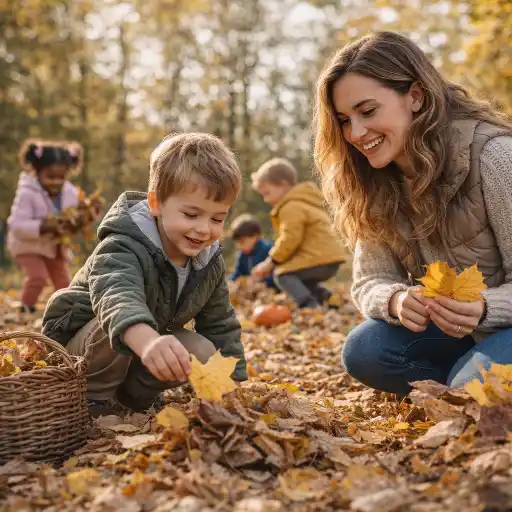
- Color and texture hunt: Look for a yellow leaf, a rough surface, a smooth stone, or something that makes a sound. Children can point, describe, photograph, or draw what they notice.
- Leaf detectives: Compare fallen leaves by shape, size, color, and veins. Sort them, count each group, and make a simple class graph.
- Sound walk: Pause to listen for wind, birds, footsteps, or rustling branches. Invite children to describe sounds as near, far, soft, or loud.
- Nature movement trail: Step over a low line, reach for a leaf, walk on a marked path, or carry a light basket. Offer a seated observing or directing role, too.
- Open-ended building: Use inspected, fallen materials to make a pretend animal shelter or pathway. Ask what might make it sturdy, then let children test and revise.
These activities nurture #curiosity and connect #sensory exploration with early #math, language, science, and #movement. Follow children’s interests: if a group becomes absorbed in a shadow or a single pinecone, staying with that discovery may be more valuable than moving on to the next prompt.
How can educators extend outdoor discoveries into curriculum?
Meaningful extensions begin with what children have actually noticed. After a walk, invite them to sort leaves, dictate observations, draw a detail, or revisit a question. Keep the investigation open-ended: the aim is to support thinking and expression, not to deliver a single correct answer too quickly.
Use simple prompts such as “What do you notice?”, “What do you think will happen?”, and “How could we find out?” If children wonder why one leaf is crisp and another flexible, they could compare dry leaves with leaves lightly misted by an adult and observe changes over time. Their predictions and explanations can become part of a class display.
- Science: Observe plant parts, fallen seeds, seasonal changes, or animal signs from a respectful distance.
- Math: Count, sort, compare sizes, order objects, or graph children’s findings.
- Literacy: Make a shared nature book using drawings, photographs, dictated words, and children’s home languages.
- Art and engineering: Create temporary patterns with fallen materials or design a shelter for a toy animal.
- Physical development: Incorporate walking, reaching, balancing, and carrying in ways that suit each child.
Research on outdoor play has reported positive associations with preschoolers’ school-readiness indicators, including early learning and psychosocial development; such findings are associations, not proof that one activity causes a specific outcome. As the CDC’s outdoor play and safety guidance notes, outdoor play also gives children room to move, try skills, and encounter new experiences. Thoughtful observation helps providers connect those experiences to individual interests and next steps.
How can fall activities be safe, inclusive, and comfortable?
Preparation protects both children’s well-being and their freedom to explore. Before each outdoor block, scan the route and play area for traffic risks, broken equipment, sharp objects, standing water, animal waste, unstable branches, poisonous plants, and choking hazards. Choose a bounded space with clear sight lines, establish adult supervision zones, and count children during transitions.
Check weather and local air quality, and plan for layers, shade, drinking water, and appropriate breaks. The CDC recommends attention to sun and heat, hydration, insect bites, playground hazards, and constant supervision near water. For activities involving water, maintain close, uninterrupted supervision and follow program policies.
Inclusion means offering multiple ways to participate while preserving the learning purpose. Children can walk, sit, point, listen, photograph, draw, use a magnifier, or work with a peer. Picture cues, predictable routines, accessible paths, lightweight tools, and quiet observation options can make the experience more welcoming.
- Use pictures or objects as clues for children who are emergent readers or multilingual learners.
- Do not let children taste or handle unfamiliar plants, mushrooms, berries, or animal materials.
- Inspect natural materials; avoid small items for children who may mouth objects.
- Check family information and program policies before using food, scents, sunscreen, or insect repellent.
- Keep an indoor alternative ready for unsafe weather or air-quality conditions.
State requirements vary - check your state licensing agency for supervision, ratios, outdoor clothing, permissions, and material-use rules. Active supervision remains essential even when children are engaged in a quiet activity.
How can teams observe learning and avoid common pitfalls?
Observation can be brief and useful without interrupting play. Record what a child did or said, then consider which skills or questions may be emerging. For instance, “Riley placed three leaves in size order and said, ‘This one is the biggest’” captures observable evidence more accurately than a broad judgment about ability.
Use a simple planning cycle: observe children’s interests, interpret the learning you see, offer a related invitation, and revisit what happened. A photograph, a child’s quote, and a short note can help staff plan together and share the value of outdoor learning with families.
Common pitfalls are usually manageable with a few adjustments:
- Turning a hunt into a race: Offer a few clues, then leave room for children’s own discoveries.
- Over-directing play: Ask open questions and allow children time to test their ideas.
- Offering too many materials: Start with a small selection that is easier to supervise and explore deeply.
- Assuming one activity suits everyone: Provide varied roles, tools, movement choices, and communication supports.
- Skipping follow-up: Revisit discoveries through stories, sorting, drawings, or a class display.
For additional professional learning, consider CDA: Creating the Outdoor Classroom Buy Now $16.00 for guidance on designing an intentional outdoor environment, Active Supervision: A Strategy That Works Buy Now $35.00 for supervision practices, and Basic Science in Early Childhood Buy Now $25.00 for developmentally appropriate inquiry. Review course details and confirm whether any training meets your program’s or state’s requirements.
Conclusion: What makes outdoor fall learning meaningful?
Outdoor fall activities support children’s development when educators combine thoughtful preparation with room for genuine exploration. Nature invites children to move, notice, compare, communicate, create, and collaborate, while everyday materials provide accessible starting points for science, math, literacy, and art.
Begin with one safe, inclusive invitation: a leaf comparison, sound walk, simple hunt, or open-ended building challenge. Observe what children find meaningful, extend their questions with conversation and materials, and document a small piece of their thinking. The central goal is not to complete a checklist; it is to help children feel capable, connected, and curious as they learn outdoors.
- CDA Home Visitor Subject Area 3 Part 3 Birth to 5
- The Montessori Assistant's Toolkit
- Pediatric RSV First Aid & CPR/AED
- CDA Bridge Bundle: Family Child Care without Portfolio Review
- Art from the Heart for Preschoolers: Open Ended Art Projects that Build Self-Esteem
- CDA: Creating the Outdoor Classroom
- CDA Bridge Bundle: Infant/Toddler without Portfolio Review
- CDA Bridge Bundle: Preschool without Portfolio Review
- Wellness in Action: Teaching Healthy Habits to Children
- Family Child Care: Building, Premises, and Outdoor Safety
- CDA Certification en Español: Recursos y Consejos para Educadores Bilingües
- How can we use nature-based learning through Minnesota's outdoor seasons?
- Autumn Activities for Toddlers and Preschoolers
- Pumpkin, Leaves, and Apples: Fall Activities for Preschoolers
- How can seasonal activities (spring, summer, fall, winter) combine fun with clear educational goals?
- Too Wiggly to Sit? Fall Movement Activities Toddlers Will Love
- Crunch, Stomp, Scoop! Fall Activities Toddlers Can’t Resist
- Hello, Fall! Cozy Activities to Help Babies Explore the Season
- How Can Fall Sensory Activities Support Infant and Toddler Development?
- How Can Preschool Teachers Use Fall Activities to Strengthen Family Engagement?
- How Can Fall Classroom Activities Teach Positive Behavior?
- How Can Child Care Providers Make Fall Activities Inclusive for Every Child?
- How Can Outdoor Fall Activities Support Children’s Development?
- How Can Fall Activities Build Kindergarten Readiness Skills?
- How Can Fall Classroom Activities Demonstrate CDA Competencies?
- How Can You Adapt Fall Learning Activities for Children of Different Ages?
- How Can Teachers Use Fall Classroom Experiences to Document Children’s Development?
- How Can Everyday Fall Routines Support Infant and Toddler Development?
- How Can Responsive Teaching Make Fall Classroom Activities More Effective?
- How Can Simple Fall Activities Support Kindergarten Readiness Through Play?
