Autumn’s leaves, apples, pumpkins, and changing weather offer more than seasonal fun—they give children real materials for practicing skills they will use in kindergarten. To connect playful activities with developmental goals, explore ChildCareEd’s Are They Ready for Kindergarten? Buy Now $35.00 training, which helps providers consider cognitive, physical, and social-emotional readiness and plan supportive classroom strategies.
Why can seasonal play support readiness so effectively?
Kindergarten readiness is a whole-child process, not a checklist of academic tasks. Children benefit from opportunities to communicate, collaborate, move, solve problems, manage feelings, and gradually take responsibility for everyday routines. Fall activities can bring these domains together in concrete, enjoyable experiences: sorting leaves involves observation and classification; a shared pumpkin investigation encourages questions and conversation; and a nature walk invites movement, attention, and cooperation.
Seasonal materials also give educators a natural way to follow children’s interests. A child who notices that one leaf is “crunchier” than another is already comparing and using descriptive language. An adult can extend that thinking with a genuine question—“What do you notice about the edges?”—without turning play into a quiz. The federal What Works Clearinghouse practice guide recommends intentional, engaging experiences that nurture social-emotional learning, executive function, mathematical thinking, vocabulary, letters and sounds, and shared reading.
Most importantly, readiness grows through repeated, responsive interactions. A lively fall activity is useful not because it looks academic, but because children have time to explore, talk, make choices, and try again. These purposeful experiences build confidence and belonging as well as emerging #skills.
How can fall activities strengthen language, literacy, and early math?
Use seasonal objects to make words and mathematical ideas visible. During a leaf walk, invite children to describe color, shape, texture, and size. At a sorting table, they can group leaves by one feature, explain their choices, and reconsider categories as they notice new details. These simple conversations support vocabulary and classification, while counting each group or comparing which has more introduces meaningful early #math.
- 🍂 Leaf-counting collection: Gather a few safe, fallen leaves. Count them together, sort by color or size, and make a simple picture graph.
- Apple comparison: Compare apples by color, weight, or size. Use words such as heavier, lighter, more, and fewer. If tasting is appropriate, check family allergy information and program food policies first.
- Fall story basket: Read a seasonal book and invite children to retell a part using a leaf, toy animal, or picture card as a prop.
- Sound and letter search: Look for objects whose names begin with a familiar sound. Emphasize listening and playful discovery rather than requiring children to memorize a list.
Shared reading is especially adaptable: on one reading, talk about new words; on another, invite predictions or retelling. The NAEYC summary of the federal school-readiness guide recommends connecting vocabulary and book discussions to children’s experiences. For focused professional learning on these routines, consider Reading Aloud and Storytelling  Buy Now $16.00, which addresses engaging read-alouds, comprehension, and vocabulary development.
How do nature investigations and movement build thinking and motor skills?
Outdoor fall experiences support observation, persistence, and physical confidence. Plan a short, bounded nature walk with a few picture prompts: find something red, notice a sound, or compare a large leaf with a small one. Children can point, draw, photograph, or describe what they notice; participation does not depend on collecting every item. Back indoors, revisit discoveries with magnifiers, sorting trays, art materials, or a class-made nature book.
Simple investigations introduce scientific reasoning. Ask children to predict whether an apple or leaf will float, test the idea in a supervised water tub, and talk about what happened. Invite them to notice seasonal changes over several days or compare the shapes and textures of fallen leaves. The learning comes from asking, observing, testing, and explaining—not from memorizing a single answer.
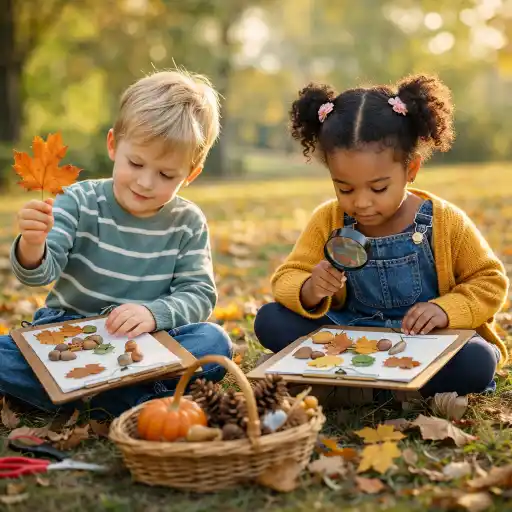
Movement matters too. Walking over varied surfaces, balancing, reaching, carrying a small basket, and joining a leaf-themed movement game help develop coordination and body awareness. Fine-motor opportunities can be added through play dough, leaf rubbings, large tongs, painting, or tearing paper for a collage. Select materials appropriate to children’s ages and abilities; small natural objects can pose choking risks. Maintain active supervision and inspect outdoor areas for hazards and allergens.
Keep the experience inclusive: offer seated observation, visual supports, partner roles, and alternatives to touching materials. The goal is meaningful participation, not identical performance. Purposeful lesson planning can help staff match activities to developmental goals; Lesson Planning for Preschoolers Buy Now $24.00 offers guidance on developmentally appropriate planning and classroom practice.
How can autumn play foster social-emotional growth and independence?
Kindergarten involves joining a group, communicating needs, handling transitions, and practicing self-help. Fall activities give children a low-pressure place to practice these capacities with adult support. In a small-group pumpkin painting project, children can decide on a plan, share materials, listen to one another, and manage the natural frustrations that arise when ideas differ. A teacher can model language such as, “Can I use the brush when you’re finished?” and help children find a solution without taking over.
Nature walks and sensory stations can also support attention and regulation. A quiet moment to listen for birds or notice the feel of a leaf gives children practice pausing and focusing. When a child feels overwhelmed, offer a calm choice—watch from a comfortable spot, hold a familiar tool, or take a brief break with an adult. These supports show children that participation can look different for different people.
Build independence through ordinary routines around the activity. Invite children to carry their own picture card, put tools in a labeled basket, wash hands, hang a coat, or help tidy the work area. Give enough time for effort, and step in only as much as needed. Predictable expectations and warm guidance help children learn that they can ask for help, contribute to a group, and try again. These social and self-help foundations are just as relevant to readiness as early academic concepts.
How should providers plan, adapt, and document fall learning?
Start with one clear learning intention and a manageable setup. For example, a leaf-sorting station might target descriptive language and classification; a fall movement game might focus on listening, following a simple cue, and balance. Choose materials that are easy to supervise and clean, and provide options for children with different sensory, language, mobility, or fine-motor needs. State requirements vary - check your state licensing agency, especially for outdoor supervision, food use, small parts, and water activities.
Then observe without interrupting the play. Record brief, objective evidence: “Amir grouped four leaves by size and said, ‘These are the little ones,’” is more useful than a broad judgment such as “Amir understands sorting.” Use what you notice to plan a next step, such as adding picture labels, introducing comparison words, or inviting the child to explain a group to a peer.
- Keep it focused: Offer a few activities rather than filling every center with seasonal materials.
- Follow children’s curiosity: A checklist can prompt noticing, but it should not become a race or a test.
- Adapt the route to the learner: Invite children to touch, point, describe, draw, or photograph discoveries.
- Plan for safety: Check materials, allergies, weather, outdoor boundaries, and cleanup before starting.
- Share strengths with families: Describe a specific moment of curiosity, cooperation, language, or growing independence.
For additional professional development on planning intentional preschool experiences, explore Roadmapping Preschool Curriculum Buy Now $24.00, which focuses on developmentally appropriate, inclusive learning experiences and skills that support kindergarten preparation.
What are the main takeaways for building readiness through fall activities?
Fall activities can support kindergarten readiness when providers connect engaging materials with opportunities to communicate, reason, move, cooperate, and practice independence. A leaf sort, outdoor hunt, shared story, or pumpkin investigation can become meaningful curriculum through thoughtful questions and repeated opportunities—not through worksheets or pressure to perform.
Begin with one activity, identify a skill you want to encourage, and prepare a safe, accessible way for every child to join. Observe what children do and say, build on their interests, and share small successes with families. Readiness develops over time and looks different from child to child; the aim is to help each learner feel capable, connected, and curious as they move toward kindergarten.
- CDA Home Visitor Subject Area 3 Part 3 Birth to 5
- CDA Home Visitor Subject Area 2 Part 3 Birth to 5
- TEAM: Together Everyone Achieves More
- From Tantrums to Triumphs: Equipping Preschoolers with Self-Regulation Skills
- Art from the Heart for Preschoolers: Open Ended Art Projects that Build Self-Esteem
- Are They Ready for Kindergarten?
- Creating Engaging and Meaningful Learning Experiences
- Letter & Number Planning in Child Care
- Spicing Up the Classroom: Learning Centers
- Supporting Children's Independence
- CDA Certification en Español: Recursos y Consejos para Educadores Bilingües
- Ready, Set, Kindergarten!
- What Skills Really Matter for Kindergarten Readiness (and Why Worksheets Aren't the Answer)?
- Cómo Celebrar el Día Nacional del Kindergarten
- How can we prepare preschoolers for kindergarten success?
- Calabazas, hojas y manzanas: actividades de otoño para preescolares
- Celebrando la amistad en el cuidado infantil durante el Día de los Mejores Amigos
- Canciones, juegos y preguntas de círculo para niños
- What Kindergarten Readiness Skills Should My Program Build?
- How can we prepare children for the transition to kindergarten in New York?
- How can child care programs build strong readers before kindergarten?
- How can preschool programs best prepare children for kindergarten?
- Is Your Child Ready for Kindergarten? A Kindergarten Readiness Checklist
- Is My Preschooler Ready for Kindergarten? Milestones Beyond ABCs and 123s
- How Can Child Care Programs Build Meaningful School Readiness?
- How Can Teachers Support Children Starting Kindergarten This Fall?
- How Can Fall Activities Build Kindergarten Readiness Skills?
- How Can Simple Fall Activities Support Kindergarten Readiness Through Play?
- How Can Gratitude Activities Support Kindergarten Readiness?
- What Common Kindergarten Readiness Mistakes Should Preschool Teachers Avoid?
