Autumn’s leaves, textures, and traditions can spark joyful learning—but only when every child has a comfortable way to join. Explore practical ways to adapt seasonal activities, strengthen safety, and honor each family’s experiences; for deeper support with inclusive lesson design, consider ChildCareEd’s Inclusive Lessons for Preschoolers  Buy Now $16.00, which offers strategies for creating welcoming activities for diverse learners.
Why does inclusion matter in fall activities?
Seasonal activities can bring children together around shared discoveries: comparing leaves, painting pumpkins, listening to autumn stories, or noticing changes outdoors. Yet a familiar activity may unintentionally create barriers. A child may find a texture uncomfortable, have difficulty gripping a tool, use a communication device, avoid noisy groups, or come from a family that does not observe a particular holiday. Inclusion means planning so each child can participate meaningfully without having to explain or overcome an unnecessary obstacle.
That planning benefits the whole group. When children can choose how to explore, communicate, and show what they notice, they practice agency, curiosity, and respect for differences. The principle described in adapting the activity, not the child is especially useful: preserve the learning purpose, then adjust materials, space, or steps to make access possible.
Start with observation rather than assumptions. Notice when a child becomes engaged, what causes discomfort, and which supports help them participate. Keep the goal meaningful and flexible: children can explore fall colors through touch, sight, movement, photographs, communication boards, or simply careful observation. These varied pathways build #belonging and support every child’s sense of competence.
How can you design fall activities with multiple ways to participate?
Offer choices from the beginning instead of waiting until a child struggles. A fall leaf investigation, for example, might include a table for sorting leaves, a picture-matching option, a quiet observation space, and a chance to describe or draw a leaf. Children can join for a short turn or return later; participation does not need to look identical to be purposeful.
- For leaf art, offer crayons, stampers, pre-cut shapes, or a partner who stabilizes the paper. Children may make a leaf rubbing, choose colors, or direct an adult where to place materials.
- For a seasonal story, use props, picture cards, gestures, repeated phrases, or movement. Accept speech, signs, pointing, AAC, and facial expressions as communication.
- For a nature hunt, provide picture clues and options to point, photograph, collect approved fallen items, or observe from a seated spot.
- For sensory exploration, make touching optional. Children can use tools, watch a demonstration, or choose a different material.
Use universal design ideas: explain and demonstrate, provide visual and verbal cues, and allow more than one way to respond. A predictable sequence—“choose, explore, share, clean up”—can reduce uncertainty. In the classroom, the use of visual schedules and accessible materials can support children across abilities and ages.
Keep expectations respectful. Avoid making a child’s participation conditional on speaking, tolerating a texture, or finishing a product. When children have real choices, seasonal play becomes an invitation rather than a test.
How do you adapt sensory, movement, and communication supports?
Fall is rich in sensory input: crunchy leaves, cool air, busy outdoor spaces, strong smells, and messy art materials. Children experience these sensations differently. Some may seek movement and touch; others may prefer quiet observation or need a break from sound and crowds. Build flexibility into the activity instead of labeling a child’s response as unwillingness.
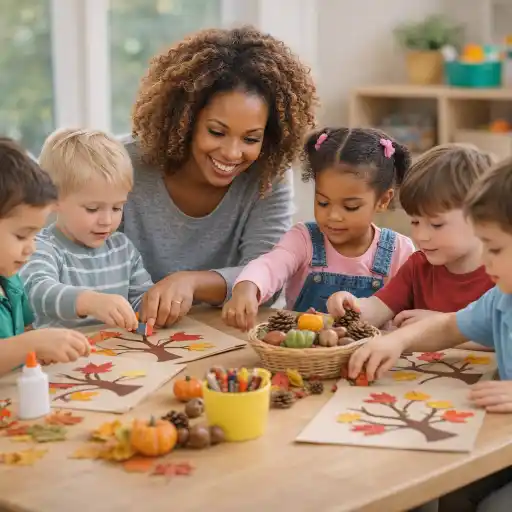
Consider the practical “Space, Stuff, and Steps” approach. Adjust the space by reducing clutter, offering a calmer corner, or choosing a smaller group. Adjust the stuff by changing tool size, texture, contrast, or placement: thick-handled brushes, large picture cards, a tray that keeps materials in reach, or a tool for scooping rather than direct touch. Adjust the steps by modeling one action at a time, using a visual sequence, and allowing extra processing time.
- 🍂 Offer a quiet indoor leaf-viewing station alongside active outdoor exploration.
- Use a visual schedule or first-then cue to prepare children for transitions and unfamiliar experiences.
- Invite children to communicate choices through words, gestures, pictures, signs, or AAC.
- Provide movement roles such as carrying a light basket, pointing out colors, or leading a short route, as appropriate.
- Keep a calm area available as an access support—not as a reward, punishment, or forced time-out.
Ask families what helps their child feel comfortable and successful. If a child has an IFSP, IEP, or specialist recommendations, coordinate with the family and relevant professionals about strategies that should be followed. The goal is to support independence while offering only the assistance needed. These responsive practices help children explore #sensory experiences at their own pace.
How can providers make seasonal themes culturally welcoming?
Fall themes often include harvest, food, and holidays. These topics can be engaging, but no single celebration or tradition represents every child. Use open-ended language—“Some families enjoy this,” or “What do you notice?”—rather than suggesting that all families celebrate, eat, or feel the same way. Invite family stories, words, photographs, or ideas only when caregivers wish to share; participation should be optional and low-pressure.
Use books, images, music, and classroom materials that represent varied family structures, cultures, languages, abilities, and ways of living. When children share something from home, do not ask one child to speak for an entire culture or community. Make room for listening, drawing, pointing to a photo, or passing. For broader curriculum planning, inclusive harvest-season experiences can connect nature exploration with family knowledge while avoiding assumptions about shared customs.
Food activities require particular care. Check each child’s allergy and medical plans, follow program procedures for food handling, and prevent cross-contact. Never require tasting or bringing food from home. Picture cards, pretend produce, drawing, and storytelling can support the same learning goals without food exposure or family expense.
Children can also explore autumn through universally accessible concepts: color changes, weather, plants, animal habitats, and how people prepare for cooler seasons. This keeps the curriculum rich while making room for many perspectives. Let #families choose how—and whether—they contribute.
How can you keep fall activities safe and manageable?
Inclusion and safety work together. Before an activity, consider children’s ages, developmental skills, allergies, mobility, sensory preferences, and any relevant family or specialist guidance. Inspect outdoor areas for hazards and check weather conditions. Maintain active supervision, especially around water, uneven ground, small objects, and group transitions. State requirements vary - check your state licensing agency.
Natural materials can be engaging, but leaves, seeds, acorns, and small decorations may present choking, allergy, or irritation risks. Choose age-appropriate materials and keep small items out of reach of children who mouth objects. Clean reusable tools and surfaces, and set out only the quantity staff can supervise effectively. If an item’s safety is uncertain, use a photograph or larger classroom-made alternative.
Common pitfalls are usually avoidable with a little advance planning:
- One activity, one response: Offer different tools, roles, and ways to communicate rather than expecting every child to create the same product.
- Too much sensory input: Keep a quieter option available and let children observe or step away.
- Unplanned food use: Check allergy plans and permissions, follow sanitation practices, and provide non-food participation.
- Overly complex directions: Demonstrate, use short steps, and give children time to process.
- Celebration assumptions: Avoid presenting one holiday or family practice as universal; use respectful, optional invitations.
Make the setup workable for staff, too. Prepare a small number of stations, label materials, clarify adult supervision roles, and plan a simple cleanup routine. A predictable, well-supervised experience gives children space to explore without putting extra pressure on the team.
How can teams learn from children and improve activities?
Inclusive planning is an ongoing process, not a checklist completed once each autumn. After an activity, reflect on who participated, how they communicated, and which parts supported or limited engagement. Brief objective notes can guide the next version: “Sam chose a picture card to identify a red leaf,” or “A quieter space helped several children stay with the story.” Avoid interpreting a child’s behavior without context.
Use a simple cycle: observe, identify a possible barrier, try one adaptation, and notice what changes. If a child turns away from a bin, consider the texture, smell, noise, group size, or instructions before deciding what to change. Share strengths-based observations with families and ask what they have noticed at home. Small adjustments—larger tools, visual cues, shorter turns, or a different role—can make a substantial difference.
Directors can help by giving staff planning time, keeping a shared list of successful adaptations, and ensuring substitutes understand important supports and safety procedures. For focused professional learning, Effective Approaches for Autism and Inclusion Buy Now $55.00 explores strategies for adapting materials, supporting communication, and addressing sensory needs. The Building Equity: Inclusionary Practices in Preschool Buy Now $10.00 course offers another practical learning option for educators seeking to strengthen inclusive classroom activities.
Keep the focus on each child’s strengths and choices. A child who watches closely, communicates with a gesture, or joins for a few minutes is participating. Your thoughtful adjustments help autumn learning feel welcoming, engaging, and achievable.
Conclusion: How can fall activities include every child?
Child care providers can make fall activities inclusive by planning multiple ways to participate, adapting the space and materials, supporting varied communication and sensory preferences, respecting family traditions, and prioritizing safety. Start with one seasonal activity and ask: What is the learning goal, what might create a barrier, and what choices will help each child take part?
Observe, collaborate with families, and adjust based on children’s responses. Whether children sort leaves, listen to a story, explore outdoors, create art, or share a family connection, meaningful participation can look different for each learner. Small, intentional choices build #accessibility, confidence, and belonging throughout the season.
Five relevant ChildCareEd courses:
- Inclusive Lessons for Preschoolers Buy Now $16.00
- Effective Approaches for Autism and Inclusion Buy Now $55.00
- Building Equity: Inclusionary Practices in Preschool Buy Now $10.00
- From Play to Planning: Building Culturally Competent, Child-Centered Curriculum Buy Now $55.00
- Creating the Natural Outdoor Classroom Buy Now $16.00
- CDA Home Visitor Subject Area 3 Part 3 Birth to 5
- Planning for Every Child: Responsive Strategies in Action
- CDA Family Child Care Credential
- Birth to Five CDA Credential with Portfolio Review
- CDA Family Child Care Credential with Portfolio Review
- Inclusive Lessons for Preschoolers
- Effective Approaches for Autism and Inclusion
- Texas Director Credential
- Wellness in Action: Teaching Healthy Habits to Children
- Bridging Cultures: Family Communication & Collaboration
- 💛🧩 ¿Cómo puedo hacer que mi enseñanza sea inclusiva para los niños con autismo?
- Capacitación en Salud y Seguridad Preventiva en Línea para Proveedores de Cuidado Infantil
- Proporciones de Cuidado Infantil y Tamaños de Grupo por Edad en Maryland (Guía Rápida para Centros y Hogares)
- Proporciones de Cuidado Infantil y Tamaños de Grupo por Edad en Virginia (Guía Rápida para Centros y Hogares)
- Cómo Trabajar en el Cuidado Infantil en Wisconsin: Requisitos y Pasos
- Fall Circle Time Ideas for Preschool and Daycare
- Canciones, juegos y preguntas de círculo para niños
- Cómo simplificar la capacitación para sus empleados de daycare
- How can pumpkin science create meaningful, hands-on fall learning for preschool classrooms?
- How can childcare programs celebrate the harvest season in ways that are inclusive, safe, and sensory-rich?
- Crunch, Stomp, Scoop! Fall Activities Toddlers Can’t Resist
- Go on a Fall Hunt! Outdoor Learning Challenges for Preschoolers
- Can You Build a Leaf Bridge? Fall STEM Challenges for Pre-K
- Fall Challenge Accepted! Hands-On Learning Games for Pre-K
- How Can Halloween Fine-Motor Activities Be Fun Without Being Scary?
- How Can Fall Foods Help Children Explore Family Traditions?
- How Can Child Care Providers Make Fall Activities Inclusive for Every Child?
- How Can Child Care Providers Manage Classroom Transitions and Routines During Fall Celebrations?
- How Can Preschool Teachers Use Fall Experiences to Support Individual Learning Needs?
- How Can Fall Classroom Projects Build Stronger Family Partnerships?
