Fall’s changing colors, outdoor discoveries, and hands-on classroom projects create rich opportunities to see how children think, communicate, move, and collaborate. Strengthen your ability to turn those everyday moments into useful, objective evidence with Tracking Progress, Shaping Futures: Observation & Assessment Skills  Buy Now $55.00; the course explores documentation methods and ways to use evidence for meaningful goals. Read on for practical approaches you can bring into your fall plans right away.
Why are fall experiences valuable opportunities to document development?
Seasonal experiences give children concrete materials to investigate and teachers authentic moments to observe. On a leaf walk, children may compare colors, notice patterns, ask questions, balance on uneven ground, or decide how to share a collecting basket. Those actions can reveal learning across cognitive, language, physical, and social-emotional domains without interrupting play for a formal task.
Fall activities also invite children to return to an idea over time. A class may watch leaves change, compare the sounds of dry and damp leaves, or revisit a nature display. Repeated experiences let teachers notice whether children refine a strategy, add vocabulary, persist with a challenge, or engage differently with peers. As NAEYC explains in using observation to guide teaching, educators can use what they notice to adapt strategies and design responsive learning experiences.
Documentation matters because a child’s development is not always visible in a finished product. A drawing is useful evidence, but so are the child’s planning, questions, explanations, movements, and revisions. Thoughtful notes help make those processes visible and support strengths-based #development records.
- Watch for how children investigate, communicate, solve problems, and work with others.
- Use seasonal experiences as authentic contexts, not tests children must pass.
- Capture strengths and emerging skills alongside areas where support may be helpful.
What fall activities can reveal learning across developmental domains?
Choose activities with open-ended materials and more than one possible way to participate. A fall hunt can reveal visual discrimination when children locate a red leaf, language when they describe a rough surface, and problem solving when they decide where to search next. Invite children to observe, point, photograph, draw, or describe rather than requiring every child to collect objects or speak in a group.
After an outdoor experience, sorting fallen leaves by size, shape, or color can show classification and comparison. Counting a small group of leaves or making a simple class graph offers evidence of early mathematical thinking. Art invitations—such as leaf rubbings or temporary nature designs—can reveal fine-motor coordination, planning, experimentation, and creative choices. In dramatic play, children might use blocks and fabric to make a shelter for a pretend woodland animal, demonstrating collaboration and symbolic thinking.
- 🍂 During a nature walk, note what a child notices, asks, or compares.
- In a sorting activity, record the child’s sorting rule and any explanation.
- During art or construction, notice tool use, persistence, revisions, and communication.
- In group discussion, observe turn-taking, listening, and how children build on one another’s ideas.
Connect activities to children’s interests while keeping them developmentally appropriate and inclusive. The ideas in fall outdoor learning challenges for preschoolers show how a simple hunt can lead into language, science, movement, and follow-up inquiry. Look for learning in the process, not only in what children bring back to the classroom.
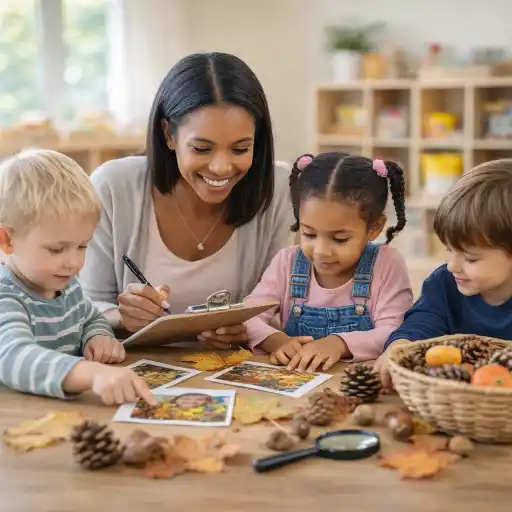
How can teachers document children’s learning objectively?
Useful documentation begins with a focused question: What strategies are children using to compare leaves? How do they describe changes in the weather? What supports help each child join a group investigation? A clear question helps teachers notice relevant evidence while remaining open to unexpected discoveries.
Write what you can see or hear before interpreting what it means. Include the date, context, materials, observable actions, and direct quotes when possible. For example: “During leaf sorting, Sam placed four leaves in a row, moved a smaller leaf to another group, and said, ‘These are the tiny ones.’” This is more informative than “Sam understands size.” Keep interpretation separate from the factual note, and revisit it with additional evidence over time.
Choose documentation methods that fit the activity and your responsibilities. Short anecdotal notes can preserve a meaningful moment; photographs with captions or children’s drawings can show process and change; work samples and portfolios can help make development visible over time. Head Start’s resource on collecting and using work samples describes ways to use children’s classroom work to document learning and inform teaching.
- Use brief, factual notes rather than labels such as “shy,” “good at science,” or “not interested.”
- Record children’s gestures, home-language words, movement, and other forms of communication.
- For photos or recordings, follow program consent and privacy procedures.
- Keep active supervision first; complete notes when it is safe and practical.
How can documentation inform planning and family partnerships?
Documentation becomes especially useful when teachers return to it and make a thoughtful next-step plan. A practical cycle is: observe, record, reflect, plan, and observe again. Look across several moments to identify interests, strategies, successful supports, and questions children continue to explore. Avoid making a broad conclusion from one snapshot.
For example, a teacher may notice that several children compare fallen leaves and return to the same tree each day. The team could add magnifiers, drawing materials, photographs, a simple measurement tool, and books about seasonal change. Teachers might ask, “What has changed since yesterday?” and document the children’s predictions and explanations. The next observation helps educators decide whether to extend the inquiry or adapt materials and adult support.
Share concrete examples with families and invite their perspective. A brief note such as “Ari compared two leaves and told a friend, ‘This one has more points’” gives families a meaningful glimpse of learning and opens a conversation about related interests at home. Family knowledge can add context, particularly when a child uses a home language or has experiences that are not apparent in the classroom.
- Connect observed interests to manageable learning invitations.
- Offer different entry points, such as speaking, pointing, drawing, movement, or partnering with a peer.
- Share strengths-based examples and ask families what they notice.
- Review records with colleagues to consider context and reduce assumptions.
For additional professional learning, Observing & Assessing in Child Care Buy Now $16.00 focuses on observing and documenting children’s growth, while Creating the Natural Outdoor Classroom Buy Now $16.00 supports planning nature-rich outdoor experiences. These English-language courses offer different ways to strengthen observation and classroom practice.
What common documentation pitfalls should teams avoid?
Fall activities can be engaging, but documentation is less helpful when adults focus on completing a checklist or collecting attractive products rather than understanding children’s learning. Keep prompts flexible. If children become absorbed in one pinecone, shadow, or pattern, pause and observe what they are investigating. Their sustained interest may offer better evidence than completing every planned item.
Another pitfall is treating a single observation as a complete picture. Children may communicate or participate differently depending on the setting, materials, language demands, fatigue, or familiarity with adults. Observe across routines and days, and consider work samples, family perspectives, and colleague observations before drawing conclusions. Screening and assessment have distinct purposes; classroom documentation alone does not diagnose a developmental delay.
- Over-structuring: Use a few invitations and leave room for child-led inquiry.
- Subjective notes: Replace assumptions with observable actions, words, and context.
- One-size-fits-all participation: Offer multiple ways to observe, communicate, and create.
- Collecting without reflection: Review evidence and identify a practical next step.
- Privacy oversights: Store records securely and follow permissions and program policies.
Natural materials also require thoughtful safety planning. Check outdoor areas for hazards, supervise actively, and consider choking risks from small objects. State requirements vary - check your state licensing agency, particularly for supervision, outdoor play, documentation, and record handling.
How can teachers begin documenting fall learning today?
Start small and make the routine sustainable. Before a fall activity, choose one question and a manageable focus—perhaps how children compare objects, explain a discovery, or cooperate during a shared task. Decide how you will capture evidence without diverting attention from the children. A few concise notes collected across different contexts are often more useful than a large volume of disconnected paperwork.
After the experience, review the notes with a strengths-based lens. What did the child do or say? What materials or supports seemed to help? What might be a useful next invitation? Write a possible interpretation as a working idea and check it against future observations. This approach keeps documentation responsive rather than turning it into a fixed judgment about a child.
Directors can make the process easier by providing a shared note template, clarifying privacy practices, arranging time for staff reflection, and encouraging educators to exchange observations. A supportive team culture helps teachers learn from one another without expecting perfect records during a busy day.
- Pick one fall experience and one observation question.
- Record a specific action, quote, or work sample with brief context.
- Reflect on a possible next step and revisit the child’s learning later.
Conclusion: How can fall classroom experiences document development?
Fall experiences make development visible because they invite children to explore meaningful materials, revisit questions, and participate in many ways. Teachers can document this learning by observing intentionally, recording objective evidence, and considering children’s actions, language, strategies, and creations across time. They can then use those observations to shape responsive activities and strengthen conversations with families.
The central goal is not to produce more paperwork; it is to understand each child more fully. A leaf hunt, sorting tray, nature drawing, or construction project can become valuable evidence when educators notice the learning process, protect children’s dignity and privacy, and plan a thoughtful next step.
Courses to explore: Tracking Progress, Shaping Futures: Observation & Assessment Skills Buy Now $55.00; Observing & Assessing in Child Care Buy Now $16.00; Creating the Natural Outdoor Classroom Buy Now $16.00; Preschool Assessments & Observations Buy Now $24.00; Privacy Matters: Documentation and Observation in Early Learning Buy Now $55.00.
- Moving About the Classroom: Effective Transitions for Everyday
- CDA Home Visitor Subject Area 3 Part 3 Birth to 5
- Many Colors, One Canvas: MD ECE Conference
- CDA Home Visitor Subject Area 2 Part 3 Birth to 5
- Birth to Five CDA Credential with Portfolio Review
- Art from the Heart for Preschoolers: Open Ended Art Projects that Build Self-Esteem
- Early Childhood Education
- IEPs and IFSPs in Family Child Care
- Moving About the Classroom: Effective Transitions for Everyday
- Technology as a Classroom Tool
- CDA Certification en Español: Recursos y Consejos para Educadores Bilingües
- 10 Ejemplos de Cómo la Cultura Influye en el Desarrollo Infantil
- Proporciones de Cuidado Infantil y Tamaños de Grupo por Edad en Maryland (Guía Rápida para Centros y Hogares)
- Proporciones de Cuidado Infantil y Tamaños de Grupo por Edad en Nueva Jersey (Guía Rápida para Centros y Hogares)
- Proporciones de Cuidado Infantil y Tamaños de Grupo por Edad en Carolina del Norte (Guía Rápida para Centros y Hogares)
- Proporciones de Cuidado Infantil y Tamaños de Grupo por Edad en Virginia (Guía Rápida para Centros y Hogares)
- Actividades de Otoño Fáciles para Preescolares esta Temporada
- Retraso del Habla en la Guardería: Cómo Pueden Ayudar los Proveedores
- Cómo Trabajar en el Cuidado Infantil en California: Requisitos y Pasos
- Celebrando la amistad en el cuidado infantil durante el Día de los Mejores Amigos
- How can pumpkin science create meaningful, hands-on fall learning for preschool classrooms?
- Rainy Fall Day? 12 Indoor Activities Preschoolers Won’t Want to Stop
- Is This Development Typical? When Child Care Providers Should Watch, Document, or Refer
- How Can Teachers Support Children Starting Kindergarten This Fall?
- How Can Preschool Teachers Use Fall Activities to Strengthen Family Engagement?
- How Can You Plan an Engaging Fall Curriculum for Preschoolers?
- What Common Mistakes Do Teachers Make When Observing Children During Fall Activities?
- How Can Teachers Use Fall Classroom Experiences to Document Children’s Development?
- How Can Preschool Teachers Use Fall Experiences to Support Individual Learning Needs?
- How Can Fall Classroom Projects Build Stronger Family Partnerships?
