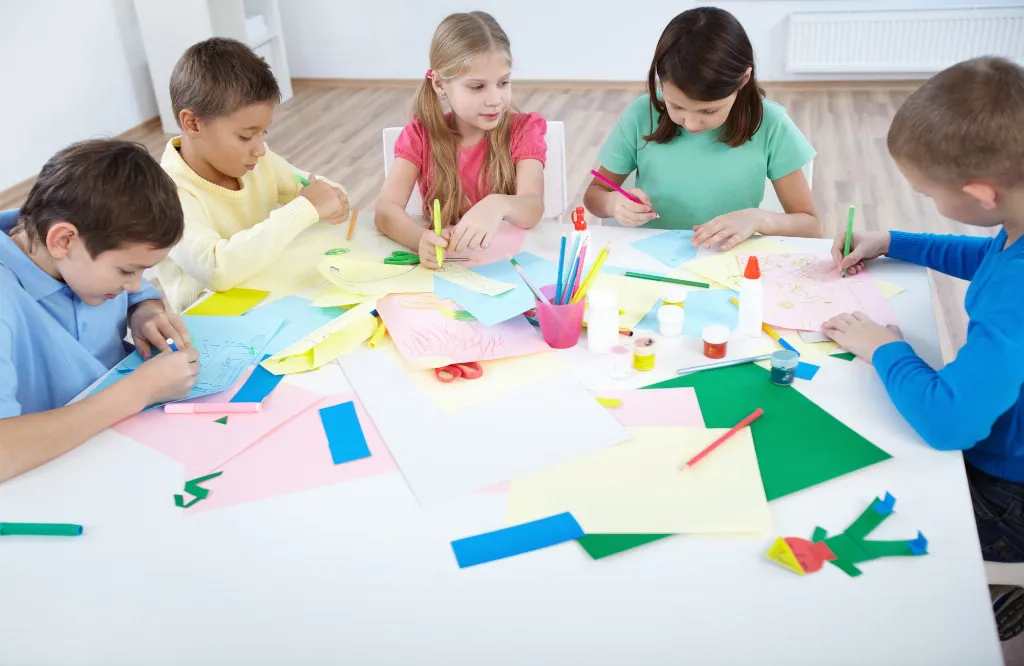
 Open-ended activities give children choice, time, and tools to explore. These invitations help #openended play grow into real learning. When children choose and invent, they build language, thinking, and social skills. If you want quick ideas and simple steps you can use tomorrow, this article is for busy child care providers and directors.
For background on why this matters, see Why Open-Ended Play Is Essential for Healthy Child Development and practical ideas in Open-Ended Activities That Help Preschoolers Learn.
Why it matters: Open invitations let every child try ideas without fear of being wrong. That builds confidence and #creativity. These activities are low-cost, easy to set up, and connect to early STEM, art, and language goals (see Preschool STEM Activities).
What simple open-ended activities can I set up tomorrow?
- 🎨 Open art tray: Paper, washable paint, sponges, loose parts (buttons, fabric scraps). No sample to copy. (See Open-Ended Art Activities.)
- 🔧 Loose-parts bin: Bottle caps, cardboard tubes, stones, wood pieces. Let children sort, build, and create props for play. (Ideas in Open-Ended Activities.)
- 🧪 Water & tools tray: Cups, droppers, funnels, a tub of water for mixing and testing—great for early science and fine motor play. (See STEM for preschoolers.)
- 🚗 Movement art: Toy cars rolled in paint across paper; rock-painting outside; painting with combs or feathers.
- 🏗️ Block challenge: Give a provocation like "build a bridge that holds a toy" and leave materials open.
- 📚 Story props corner: Read a short book then leave related props in dramatic play to extend the story.
Keep materials reachable and rotate items so interest stays high. Want printable prompts and teaching ideas? Check free resources like the Imagination Basket and activity PDFs on ChildCareEd's resources pages.
How do I set up the space so children choose and stay safe?
- 🧭 Arrange shelves low and clear so children can grab materials without asking. Label bins with pictures and words for independence.
- 🪣 Use small baskets or trays—too many choices overwhelm. Rotate one or two invitations every 1–2 weeks.
- 🧰 Provide simple tools: child-safe scissors, big paint brushes, smocks, trays for messy play.
- 🛡️ Do a quick safety check: remove choking hazards for young children, fix sharp edges, and keep small parts in age-appropriate bins.
State rules and licensing can affect what you offer—state requirements vary - check your state licensing agency. For classroom setup tips tied to licensing and best practice, see Classroom resources and PDFs Buy Now $0.00.
Why setup matters: a calm, organized space invites risk-taking and creativity. Children spend less time asking for materials and more time exploring, which gives adults time to observe and support learning.
How can teachers support learning without directing the play?
- 👀 Observe first: Watch how children use materials before stepping in. Note interests and language they use.
- 🗣️ Use descriptive talk: Say what you see—"You used lots of blue paint!"—instead of asking "What is it?" This encourages #preschoolers to explain their ideas (see Open-Ended Art).
- ❓Ask one open question: "Tell me about your idea" or "What will you try next?" These prompts help thinking without taking over.
- ➕ Scaffold gently: Offer one extra material or a new tool to extend play. For example, add a funnel to a water table to spark new experiments (see Preschool STEM Activities).
- 📷 Document simply: Take a photo, write a short caption and a child quote. This shows families the learning behind play.
Teachers benefit from short training and shared language. Courses like The Best Promotion is Play Buy Now $35.00 can build staff confidence in supporting open-ended learning.
What common mistakes should I avoid and how do I involve families?
Common mistakes are easy to fix. Here are pitfalls and how to avoid them, plus quick ways to bring families along.
- ❌ Overfilling shelves — ✅ Rotate and offer 1–2 baskets so children can choose without overwhelm.
- ❌ Over-directing projects — ✅ Give prompts, not templates. Avoid showing a single sample to copy.
- ❌ Skipping safety checks — ✅ Do quick daily inspections of loose parts and tools.
- ❌ Rushing cleanup — ✅ Teach cleanup as part of play; make it a game or a shared routine.
Involving families (quick ideas):
- 📸 Send one photo a week with a short note about what the child explored.
- 📦 Invite simple donations (clean, safe loose parts) with clear rules for drop-offs.
- 🗣️ Offer one-line explanations about the learning: "We let children choose materials to build problem-solving and language."
FAQ (short)
- Q: How long should an open-ended activity last? A: 20–40 minutes is good for many preschool groups; longer if children stay engaged.
- Q: Will parents miss crafts? A: Offer occasional product projects for family gifts and explain the learning in daily open-ended play.
- Q: How often rotate materials? A: Every 2–6 weeks or when interest drops.
- Q: Where to learn more? A: ChildCareEd articles and courses linked above are great places to start.
Summary
Open-ended invitations are simple, powerful, and doable. Try one small change this week: add a loose-parts basket or an open art tray and watch children invent. Document with a photo and a short note to share with families. Keep the space clear, rotate materials, and use descriptive language to support learning. You are making room for big growth from small invitations to #play and choice in your #classroom.
- CDA Home Visitor Subject Area 3 Part 3 Birth to 5
- CDA Home Visitor Subject Area 2 Part 3 Birth to 5
- Birth to Five CDA Credential with Portfolio Review
- Open Ears: Listening in Child Care
- Art from the Heart for Preschoolers: Open Ended Art Projects that Build Self-Esteem
- Emergent Learning & Development
- 45-Hour Infant and Toddler Curriculum
- Creating Engaging and Meaningful Learning Experiences
- Creating Environments that Nurture Growth and Community
- Every Moment Matters: Schedules and Transitions
- ¿Cuáles son las mejores actividades del Día de la Tierra para niños en casa o en el aula?
- Actividades de Motricidad Gruesa que Desarrollan el Equilibrio, la Coordinación y la Fuerza
- Actividades de Fiesta para Niños de Preescolar y Primaria
- Actividades de Otoño Fáciles para Preescolares esta Temporada
- Easy Ways to Add STEM to Your Preschool Classroom
- Memorial Day Activities for Kids: Simple Ways to Honor the Day
- How can I plan peach-themed summer activities for preschoolers in Georgia?
- Open-Ended Activities That Help Preschoolers Learn
- Fun Multicultural Activities for Preschoolers
- How can we prepare preschoolers for kindergarten success?
- How can I use STEM activities in my Preschool and Pre-K classroom?
- How can I teach colors, shapes & numbers through play in Michigan classrooms?
- What are easy STEM activities I can do with preschoolers?
- Calabazas, hojas y manzanas: actividades de otoño para preescolares
- Open-Ended Preschool Activities for Creativity, Language, and Social Skills
- Daycare Activity Ideas for Infants, Toddlers, and Preschoolers
- What skills do preschoolers need to be ready for school?
- How Can Flag Design Help Children Explore Symbols, Patterns, and Individual Expression?
- How Can You Plan Patriotic Crafts Without Limiting Children’s Creativity?
- How Do Cut-and-Paste Activities Build Fine-Motor Control and Planning?
