Preventing the spread of illness in early care and education is an everyday leadership responsibility. Small routines, clear policies, and consistent communication can reduce missed learning days for children while protecting staff and families from avoidable illness. This article provides practical, evidence-based steps that childcare programs can use immediately, including training staff on reliable hygiene practices, creating an effective illness policy, improving cleaning and ventilation routines, and responding appropriately during an outbreak. For additional guidance, explore ChildCareEd’s Prevention and Control of Infectious Diseases  Buy Now $16.00, a two-hour online training focused on maintaining a healthy childcare environment and reducing the spread of illnesses and germs. The article also connects readers with helpful ChildCareEd resources and authoritative guidance from the CDC. Remember that state requirements vary, so always consult your state licensing agency for rules that apply to your program.
Why does preventing illness matter for my program?
Why it matters:
- Fewer illnesses = more consistent attendance, better child development, and lower family stress. See practical program reasons in How can childcare programs prevent the spread of illness?.
- Consistent routines and clear policies build trust with families and reduce confrontations at drop-off. ChildCareEd offers a template for short family handouts and staff policies in What should an illness policy for child care include?.
- Simple prevention steps (hand hygiene, cleaning, ventilation, exclusion rules, vaccination) are cost-effective ways to protect your staff and #children and keep your doors open. See the CDC overview at Protecting Against Infections.
Big-picture takeaways:
- Prioritize a short set of daily routines that every staff member can follow reliably.
- Make policies visible and easy to explain at drop-off.
- Use local public health as a partner when cases cluster.
What daily routines most reduce the spread in child care?
Practical daily routines are the backbone of prevention. Use numbers and checklists so staff can act under pressure.
- 🧼 Hand hygiene: Teach and schedule handwashing for key times (arrival, before/after food, after toileting/diapering, after outdoor or sensory play, after coughing/sneezing). Follow the CDC steps and resources in About Hand Hygiene and the classroom tips in ChildCareEd handwashing guidance Buy Now $1.50. This builds your #handwashing habit.
- 😀 Arrival health check: Use three short screening questions — (1) Can the child participate? (2) Do they need one-on-one care? (3) Could they spread germs today? — and record the result. ChildCareEd shows scripts and a one-page family handout you can copy in How can childcare programs prevent the spread of illness?. For quick symptom checklists and photo examples to help staff recognize early signs of common childhood illnesses during screening, see Ah-Choo!.
- 🧽 Mouth-toy plan: Maintain a labeled "Wash Me" bin and sanitize mouthed toys daily per the CDC process at How To Clean and Disinfect Early Care and Education Settings. This fits into a simple #cleaning schedule staff can follow.
- 💉 Vaccination and staff support: Encourage up-to-date immunizations for staff, children, and families; make sure staff have paid sick leave where possible so they aren’t pressured to work while ill. See immunization resources and program-level guidance at state immunization pages and the CDC ECE overview.
- 🪟 Ventilation and space: When feasible, take activities outdoors, open windows safely, and consider portable HEPA units in isolation spaces; see CDC ventilation tips in Protecting Against Infections. Better #ventilation reduces airborne transmission risk.
How should we clean, sanitize, and disinfect safely and effectively?
Know the difference and use the right step for the right situation. The CDC defines and sequences these steps in How To Clean and Disinfect Early Care and Education Settings, and ChildCareEd offers job aids and printable schedules you can adopt quickly in What’s the difference between cleaning, sanitizing, and disinfecting?.
- Clean first: soap + water removes dirt and many germs. Do this on visibly soiled surfaces and before sanitizing or disinfecting.
- Sanitize when items touch mouths: baby bottles, sippy cups, mouthed toys. Use dishwasher hot cycles or a food-safe sanitizer/bleach soak as CDC describes.
- Disinfect for high-risk areas: diapering stations, bathrooms, and after body-fluid spills. Use EPA-registered products or appropriate bleach solutions and follow contact times closely.
- 🧤 PPE and safety: Train staff to use gloves, eye protection, and masks as appropriate. Store chemicals locked and never mix products (bleach + ammonia is dangerous). The CDC's step-by-step safety tips are here: CDC cleaning guidance.
Common mistakes and how to avoid them:
- ❌ Disinfecting before cleaning — always clean first.
- ❌ Mixing chemicals — fix by labeling and training; keep SDS sheets accessible.
- ❌ Returning mouthed toys to shelves without sanitizing — use the "Wash Me" bin and assign responsibility for daily toy cycles.
When should children and staff stay home, and how do I write an illness policy?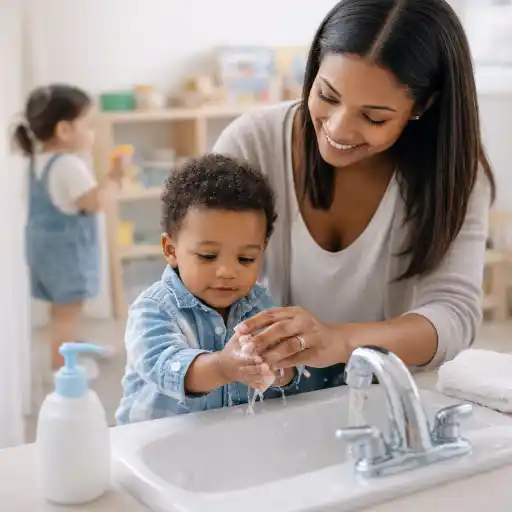
A short, kind illness policy reduces conflict and speeds decisions at drop-off. ChildCareEd's ready-made templates in What should an illness policy for child care include? Show exactly what to include. Remember: state requirements vary - check your state licensing agency.
- Key contents (keep the family handout to 1 page):
- Short summary sentence: Who should stay home?
- Clear exclusion symptoms: fever, vomiting, diarrhea, uncontrolled cough, new rash, eye drainage.
- Return rules: e.g., fever-free 24 hours without medicine; no vomiting or diarrhea for 24 hours; or follow public health directions for reportable diseases.
- Medication and documentation steps, and how families will be notified.
- 📝 Arrival script and documentation: Train staff to use a 3-question screen and to log each exclusion decision (date, symptom, action, parent contacted). Good records protect your program and help public health during an investigation; see ChildCareEd recordkeeping tips and CDC guidance.
- Communication and equity: Use kind language, translate the handout, and avoid punitive requirements (for example, avoid requiring a doctor's note for every minor cold unless state rules mandate it). The ChildCareEd article on illness policy gives sample language and staff scripts.
How do we manage outbreaks and work with public health?
When multiple people have similar symptoms, move fast and use numbered steps. CDC outbreak communication and field investigation guidance explains how to plan messages and roles: Communicating During an Outbreak.
- 📞 Notify local public health early: If you see two or more similar cases in one room, or suspect a reportable disease, contact your health department. ChildCareEd's outbreak checklist and CDC operational guidance are practical starting points (ChildCareEd outbreak steps, CDC ECE guidance).
- 🧯 Immediate control steps:
- Isolate the symptomatic child in a supervised area until pickup.
- Increase cleaning and disinfecting of high-touch surfaces; follow CDC bleach/disinfection directions for vomiting/diarrhea cleanup, especially for viruses like norovirus (Norovirus prevention).
- Use PPE as advised and protect staff who care for the sick child.
- 📣 Communicate clearly to families: explain what happened, what you did, and what symptoms to watch for. Use simple templates (ChildCareEd has parent letter samples) and ask public health to review major notifications when possible.
- 🔁 Review and adapt: After the event, review your routines, staffing coverage, and communication; update your illness policy and training as needed.
Summary and quick leader checklist
Use this short checklist to lead a staff huddle and make immediate improvements.
- 🔹 Post and practice a 20-second handwashing routine and assign who teaches it to each classroom. See CDC materials and ChildCareEd classroom tips.
- 🔹 Adopt a one-page family handout and a 1–2-page staff policy for illness; use ChildCareEd templates and include your local public health contact. State requirements vary - check your state licensing agency.
- 🔹 Implement a daily cleaning schedule: clean first, then sanitize or disinfect as required by the CDC guidance.
- 🔹 Prepare an isolation area, PPE kit, and a short outbreak plan that names who calls public health.
- 🔹 Improve ventilation where practical and encourage vaccination for staff and families.
FAQ (short answers)
- Q: Can hand sanitizer replace handwashing? — A: No. Use soap and water when available; sanitizer (60%+ alcohol) is an adjunct per CDC.
- Q: Do we need a doctor's note for every illness? — A: Not usually. Use clear return rules; require notes only for unclear or reportable illnesses unless state law says otherwise.
- Q: How long should we exclude after vomiting? — A: Generally 24 hours after the last episode; for norovirus, the CDC advises 48 hours or follow public health guidance (Norovirus prevention).
- Q: When should I call public health? — A: For clusters of similar illness, suspected reportable disease, or if staff/families ask for an official determination.
- Q: How often to train staff? — A: At orientation, annually, and brief refreshers (quarterly) or when guidance changes; use short modules from ChildCareEd and CDC resources.
Thanks for the day-to-day work you do to protect children and families. Small, consistent steps — strong #handwashing, clear #policy, reliable #cleaning, attention to #ventilation, and family partnership — add up to safer classrooms and more learning time. For ready-to-use forms and online training, prioritize ChildCareEd resources like Infection Control Practices for Child Care Settings and the CDC early care pages linked above.
- How To Keep A Healthy Class: Six Tips for Germ Control
- 45 Hour Infant and Toddler Methods and Materials
- Emergent Learning & Development
- 45-Hour Infant and Toddler Curriculum
- Creating Environments that Nurture Growth and Community
- Administration of Medicine
- Texas Director Credential
- Prevention and Control of Infectious Diseases
- Preventative Health and Safety
- Everyday Safety: Creating Healthy Environments
- Ah-Choo!
- CDA Certification en Español: Recursos y Consejos para Educadores Bilingües
- Recursos en Español sobre el Sueño Seguro del Bebé
- 10 Ejemplos de Cómo la Cultura Influye en el Desarrollo Infantil
- Proporciones de Cuidado Infantil y Tamaños de Grupo por Edad en Virginia (Guía Rápida para Centros y Hogares)
- How Can Michigan Daycare Centers Prevent the Spread of Illness?
- How can childcare programs prevent the spread of illness?
- Canciones, juegos y preguntas de círculo para niños
- How can child care programs prevent the spread of illness?
- How can Michigan child care providers protect children now that measles is back in 2026?
- How can North Dakota child care providers protect children now that measles is back in 2026?
- How Can New York Child Care Providers Protect Children Now That Measles Is Back in 2026?
- How can child care programs prevent infections and keep kids healthy?
- How should New York child care providers respond to a measles exposure?
- How can North Dakota providers prevent and manage common illnesses?
- How can childcare settings prevent the spread of illness?
- How Can Daycare Programs Prevent the Spread of Common Illnesses?
- How Can Classrooms Prevent the Spread of Illness During Cold and Flu Season?
- How Can Child Care Providers Prevent the Spread of Illness in the Classroom?
