Measles is back in 2026 and it can spread fast in group settings. This short guide helps New York child care providers know what to do to protect the children in your care. Use simple steps you can start today, work with your local health department, and keep families informed. Remember: state requirements vary - check your state licensing agency.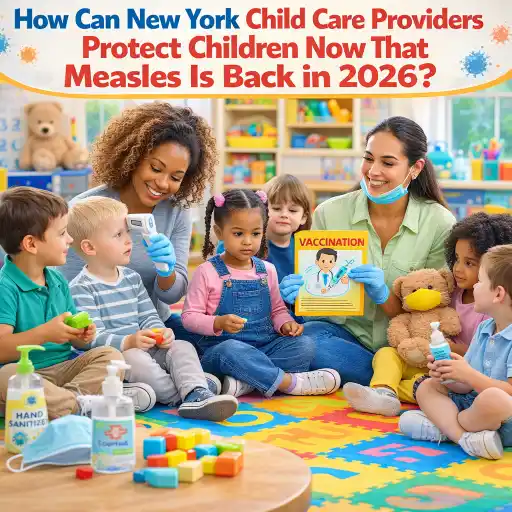
Why it matters:
1. Measles is very contagious and can cause serious illness, especially in young children and babies. See signs and risks at the CDC measles signs and symptoms.
2. High vaccination and quick action stop outbreaks. Child care programs that keep good records and follow simple infection prevention steps protect staff, families, and the community. For practical program steps, see How can childcare programs prevent the spread of illness? and Shots of Success: vaccine guidance.
Key words to remember: protect with #MMR, watch for #measles symptoms in #children, and strengthen your #childcare #vaccination checks.
What are the signs of measles, and when should I act?
Recognize measles early. The usual steps to spot and act are simple:
- Know the common symptoms (1–2 weeks after exposure):
- High fever, cough, runny nose, red watery eyes. (Then small white spots inside the mouth and a red rash that starts on the face and spreads.) See the CDC signs and symptoms page for pictures and timing.
- Act fast if you suspect measles:
- 🔔 Immediately isolate the child from others (place in a supervised space and give a mask if tolerable).
- 📞 Call your local health department and your program lead. The CDC clinical alert explains reporting steps.
- 🧪 Follow public health advice on testing. Lab confirmation is important; collect samples only under public health guidance.
- Timing matters: people are contagious from 4 days before the rash until 4 days after it appears. That means a child may spread measles before anyone notices the rash.
Why quick action works: measles can stay infectious in the air for up to 2 hours after an infected person leaves a room. Early isolation and prompt reporting let public health give post-exposure help to contacts and reduce spread. For details on clinical signs and testing, review the CDC clinical overview.
How should my program check and improve vaccination and records?
Strong immunization checks are your best prevention tool. Follow this simple plan:
- Review current records for every child and staff member:
- ✅ Children: two doses of MMR (first at 12–15 months, second at 4–6 years). If a child will travel internationally or during an outbreak, an early dose may be given at 6–11 months (this extra dose does not replace the routine series). See CDC vaccine recommendations.
- ✅ Staff: document at least one or two MMR doses per ACIP guidance; healthcare and close-contact staff should have two doses or lab evidence of immunity. Guidance for providers is at CDC provider recommendations.
- 🩺 Healthy classroom routines: For programs working to keep vaccine records organized and hygiene routines consistent across infant and toddler rooms, ChildCareEd's How To Keep A Healthy Class for Infants/Toddlers
 Buy Now $32.00 is a 4-hour online course covering illness prevention, cleaning protocols, and daily health checks — directly supporting the MMR record review, drop-off screening, and family communication steps described throughout this article.
 - Update your files and make a susceptibility list that shows who needs follow-up. Many states ask programs to maintain vaccination records—see the ChildCareEd overview on enrollment vaccine rules: Shots of Success.
- Offer or arrange vaccination clinics and reminders:
- 🔁 Encourage families to get kids up to date before enrollment or travel.
- 🧾 Keep a quick process to accept official vaccine records (do not accept only verbal reports).
- Plan for post-exposure prophylaxis (PEP):
- • MMR vaccine can be given within 72 hours of exposure to help prevent or lessen the disease.
- • Immune globulin (IG) can be given within 6 days for high-risk infants, pregnant people, and immunocompromised contacts. Work with public health for PEP decisions—see CDC PEP guidance and NACI updates on IG options in special groups (Canada NACI) if consulted.
Note: state requirements vary - check your state licensing agency. Having clear vaccine checks keeps your program safer and helps stop outbreaks early.
How do we prevent spread inside the center: cleaning, isolation, and ventilation?
Use practical steps that fit a child care setting. Follow this checklist:
- Rapid triage and isolation:
- 🧍 At drop-off, ask about fever, rash, cough, or recent travel. If symptoms look like measles, do not let the child join the group. If a child develops symptoms during the day, move them to a supervised isolation area and have a staff person with PPE care for them until picked up. The CDC recommends immediate isolation and use of airborne precautions when possible (CDC infection control).
- 🦠 Infectious disease prevention and control: To help staff confidently implement triage, isolation, and ventilation strategies during a measles outbreak, ChildCareEd's Prevention and Control of Infectious Diseases Buy Now $16.00 is a 2-hour online course covering how to recognize symptoms, follow isolation guidelines, and reduce airborne disease spread in group care settings — a direct match for the rapid triage, isolation space, and post-exposure reporting steps outlined in this guide.
- Air and ventilation:
- 🪟 Improve air: open windows when safe, use fans to move air out, run HVAC with increased outside air, or use portable HEPA units in the isolation space. The CDC explains airborne risks and ventilation strategies at C. Air.
- Cleaning and disinfecting:
- 🧽 Clean first, then sanitize or disinfect high-touch items (tables, toys, door handles). Use EPA-registered products and follow label contact times. Practical child care steps are available at ChildCareEd, prevention steps,s and CDC environmental guidance (Environmental Services).
- Protect staff and limit exposures:
- 😷 Staff caring for a suspected measles case should use proper masks (respirators) and gloves and have up-to-date MMR. Follow public health advice about exclusion for exposed, non-immune staff (see state and local guidance and the Minnesota HCW guidance Managing Measles Exposures in HCWs).
Simple steps—quick isolation, better air, focused cleaning, and staff protection—reduce spread and keep your program running. Keep copies of your routines and share short family handouts about when to keep children home.
What should we do if a child or staff member has suspected or confirmed measles?
Do these 6 steps immediately:
- 🛑 Isolate the person away from others and provide a mask if tolerated.
- 📞 Notify your local or state health department right away. They will guide testing, contact tracing, and PEP for exposed people. See the CDC HAN alert and toolkit for outbreak steps: CDC HAN and Be Ready for Measles toolkit.
- 🧪 Follow public health on testing and lab sample collection. Do NOT send a suspected measles child to a crowded clinic without calling ahead. Health departments can arrange safe testing.
- 📣 Communicate with families: tell exposed families what happened, what you did, and what to watch for. Use brief, calm language and the CDC templates in the toolkit.
- 🔬 Offer post-exposure help: MMR within 72 hours or immune globulin within 6 days for eligible contacts—work with public health to offer PEP to contacts.
- 📑 Keep neat records: timing of exposure, who was present, vaccine status, and actions taken. This helps public health manage the event.
Common mistakes and how to avoid them:
- ❌ Mistake: Waiting to call public health. Fix: Call as soon as measles is suspected.
- ❌ Mistake: Letting a symptomatic child wait in the general area. Fix: Use a supervised isolation spot away from others.
- ❌ Mistake: Accepting only verbal vaccine histories. Fix: Ask for written records or refer families to their provider for documentation. ChildCareEd explains record best practices in Shots of Success.
FAQ
- Q: Can we require MMR for enrollment?
A: Many states require MMR for childcare enrollment. Check your state rules and your licensing agency—state requirements vary. - Q: What if a parent refuses vaccination?
A: Follow your state laws on exemptions and your program policy. Keep clear communication and document the reason. Consult your licensing agency or local health department for outbreak actions. - Q: When can an exposed child return?
A: Public health will advise case-by-case, but exposed, susceptible children may be excluded up to 21 days after exposure. A confirmed case can return 4 days after rash onset. - Q: Do we need to test vaccinated kids after exposure?
A: Public health may test when needed. Often, vaccinated contacts with documented immunity are considered protected.
Conclusion
Measles is back, but child care providers can act fast to protect kids. Use 1) vaccination checks and easy record systems; 2) clear isolation plans and improved ventilation; 3) strong cleaning routines; and 4) fast reporting and partnership with public health. For practical program tools, visit the ChildCareEd guides on prevention and vaccines (prevent spread, vaccination & enrollment) and the CDC measles toolkit (Be Ready for Measles).
Take small steps today to keep your #children safe, keep your #childcare open, and strengthen #vaccination protection with #MMR against #measles. State requirements vary - check your state licensing agency and your local health department for specific rules and support.
Latest Jobs
- EIP Scholarships Info Session
- Mastering Supervision: Keeping Children Safe in All Settings
- Bienvenido! Welcoming All Families
- Pediatric RSV First Aid & CPR/AED
- CDA Bridge Bundle: Family Child Care
- CDA Bridge Bundle: Family Child Care without Portfolio Review
- CDA Bridge Bundle: Infant/Toddler without Portfolio Review
- CDA Bridge Bundle: Preschool without Portfolio Review
- Texas Director Credential
- CDA Certification en Español: Recursos y Consejos para Educadores Bilingües
- Child Care in New York in 2026: What Families, Providers, and Educators Should Know
- Regulaciones de Licenciamiento de Cuidado Infantil en California para Centros y Hogares de Cuidado Infantil Familiar
- Proporciones de Cuidado Infantil y Tamaños de Grupo por Edad en Maryland (Guía Rápida para Centros y Hogares)
- Proporciones de Cuidado Infantil y Tamaños de Grupo por Edad en Virginia (Guía Rápida para Centros y Hogares)
- What's new for child care providers in Minnesota in 2026?
- What do I need to know to provide child care in New York?
- New Daycare Regulations: What’s Changing in 2026?
- Canciones, juegos y preguntas de círculo para niños
- How can Michigan child care providers protect children now that measles is back in 2026?
- How can North Dakota child care providers protect children now that measles is back in 2026?
- How Can New York Child Care Providers Protect Children Now That Measles Is Back in 2026?
- What Do Texas's New Early Childhood Task Force and 2026 Rules Mean for Providers?
- What do Washington’s 2026 child care licensing changes mean for providers?
- How can New York CCAP providers keep records audit-ready?
- How can I prepare my North Dakota program for the July 13 CCDF rule changes?
- How should Michigan child care providers watch for measles this summer?
- How should New York child care providers respond to a measles exposure?
- What Should Providers Know About the New Measles Guidance for Classrooms?
- What Should Providers Know About Measles and Immunization Records This Fall?
